
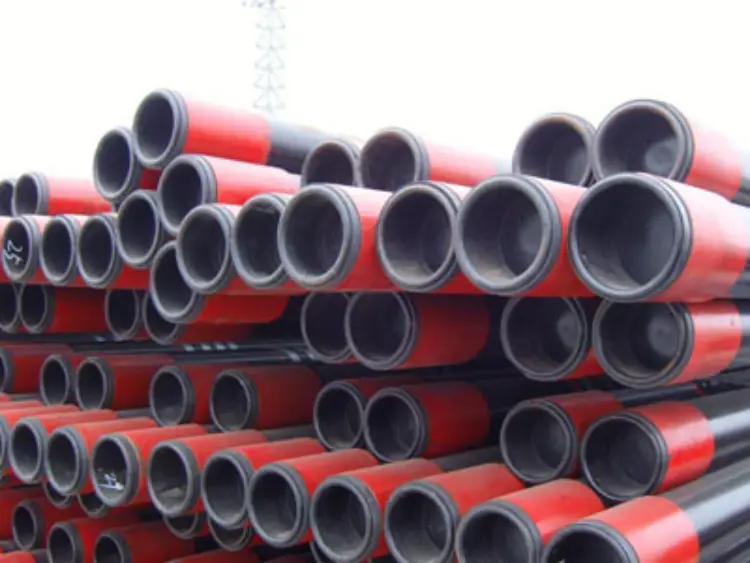
EN10025-2 S275J2 LSAW Pipe
EN10025-2 S275J2 LSAW Pipe - Structural Steel Data, Properties & Equivalent Grades
Complete material specifications for S275J2 hot-rolled structural steel in LSAW pipe form: chemical composition, mechanical and physical properties, international equivalents, and application guide.
Hot rolling, normalising rolling, cold forming, welding, machining
- Phone : +8618037372205
- Email : [email protected]
- WhatsApp: Contact via Whtsapp
- WeChat: +8618037372205
EN10025-2 S275J2 LSAW Pipe Introduction
S275J2 is a non-alloy structural steel grade defined in EN 10025-2. It delivers a minimum yield strength of 275 MPa for thicknesses ≤16 mm and guarantees impact toughness of 27 J at -20°C (J2 quality). The steel is supplied in hot-rolled, normalised-rolled, or as-rolled condition and is widely used for welded structural hollow sections, longitudinally submerged arc welded (LSAW) pipes, and general construction. Its balanced chemistry and fine-grained structure provide good weldability and formability, making it suitable for cold forming and welding. Typical applications include building frames, bridge components, offshore structures, piling pipes, and machinery parts. Delivery condition is usually hot-rolled or normalised rolling with optional impact testing.
EN10025-2 S275J2 LSAW Pipe Chemical composition
Chemical requirements according to EN 10025‑2. The steel is fully killed and may be grain‑refined (e.g. with Al, Nb, V, Ti). Optional copper addition is allowed. Maximum carbon equivalent (CEV) values apply for weldability control. Limits are typical for thicknesses ≤150 mm; for thicknesses >150 mm, C, Mn, and CEV may be adjusted by agreement.
| Element | Maximum value (weight %) | Remarks |
|---|---|---|
| C | 0.18 | For nominal thickness ≤ 150 mm |
| Si | 0.55 | Optional, typical maximum |
| Mn | 1.50 | For nominal thickness ≤ 150 mm |
| P | 0.025 | Ladle analysis |
| S | 0.025 | Ladle analysis |
| N | 0.012 | For products with sufficient Al content; otherwise N ≤ 0.015 % |
| Cu | 0.55 | If copper addition is specified |
| CEV | 0.40 | Max. for thickness ≤ 40 mm; for 40 < t ≤ 150 mm max. 0.45 |
EN10025-2 S275J2 LSAW Pipe Thermal and electrical physical properties
Physical properties are representative for non‑alloy structural steels. Slight variations can occur depending on product form and heat treatment. These values are not mandatory in EN 10025‑2 but are typical for design calculations.
| Property | Typical value | Unit | Test condition / Remarks |
|---|---|---|---|
| Density (ρ) | 7850 | kg/m³ | At room temperature |
| Modulus of elasticity (E) | 210 | GPa | In tension, room temperature |
| Shear modulus (G) | 81 | GPa | Derived, room temperature |
| Poisson's ratio (ν) | 0.3 | – | In elastic range |
| Thermal expansion coefficient (α) | 12.0 | 10⁻⁶/K | Range 20 – 100 °C |
| Thermal expansion coefficient (α) | 12.5 | 10⁻⁶/K | Range 20 – 200 °C |
| Thermal conductivity (λ) | 50 | W/(m·K) | At 20 °C |
| Specific heat capacity (cp) | 460 | J/(kg·K) | At 20 °C |
| Electrical resistivity (ρe) | 0.2 | µΩ·m | At 20 °C |
EN10025-2 S275J2 LSAW Pipe Mechanical properties
Tensile testing in accordance with EN 10025‑2. Yield strength (ReH) and tensile strength (Rm) depend on product thickness. Elongation is measured on proportional gauge length L₀ = 5.65√S₀. Impact energy (KV) is tested at -20 °C on longitudinal Charpy‑V specimens. Bending test is carried out to assess formability. Values below are minimum unless a range is given.
| Property | Specified value | Unit | Test condition |
|---|---|---|---|
| Yield strength ReH | 275 | MPa | Nominal thickness ≤ 16 mm |
| Yield strength ReH | 265 | MPa | Nominal thickness 16 < t ≤ 40 mm |
| Yield strength ReH | 255 | MPa | Nominal thickness 40 < t ≤ 63 mm |
| Yield strength ReH | 245 | MPa | Nominal thickness 63 < t ≤ 80 mm |
| Yield strength ReH | 235 | MPa | Nominal thickness 80 < t ≤ 100 mm |
| Yield strength ReH | 225 | MPa | Nominal thickness 100 < t ≤ 150 mm |
| Tensile strength Rm | 410 – 560 | MPa | Nominal thickness ≤ 100 mm |
| Tensile strength Rm | 400 – 540 | MPa | Nominal thickness 100 < t ≤ 150 mm |
| Elongation A | 23 | % | L₀ = 5.65√S₀, longitudinal, t ≤ 40 mm |
| Elongation A | 22 | % | L₀ = 5.65√S₀, longitudinal, 40 < t ≤ 63 mm |
| Elongation A | 21 | % | L₀ = 5.65√S₀, longitudinal, 63 < t ≤ 100 mm |
| Elongation A | 20 | % | L₀ = 5.65√S₀, longitudinal, 100 < t ≤ 150 mm |
| Impact energy KV (J2) | ≥ 27 | J | Charpy‑V, longitudinal, at -20 °C |
| Bending test (mandrel diameter) | 1.0 × t | – | Thickness ≤ 16 mm; bend to 180° |
| Bending test (mandrel diameter) | 1.5 × t | – | Thickness 16 < t ≤ 100 mm; bend to 180° |
| Bending test (mandrel diameter) | 2.0 × t | – | Thickness 100 < t ≤ 150 mm; bend to 180° |
EN10025-2 S275J2 LSAW Pipe Fully equivalent standards and replaceable grades
| Country/Region | Standard | Grade | Remarks |
|---|---|---|---|
| European EN | EN 10025-2 | S275J2 | Direct equivalent; mandatory impact at -20 °C |
| UK | BS EN 10025-2 | S275J2 | Adopts EN 10025‑2 without changes |
| Germany | DIN EN 10025-2 | S275J2 | Same technical delivery conditions |
| France | NF EN 10025-2 | S275J2 | Identical chemistry and properties |
| Italy | UNI EN 10025-2 | S275J2 | Fully aligned with EN 10025‑2 |
| International | ISO 630-2 | S275J2 | ISO version; properties match EN S275J2 |
EN10025-2 S275J2 LSAW Pipe Application Introduction
S275J2 LSAW pipes combine moderate strength with guaranteed low‑temperature toughness. They are primarily used in structural applications that require weldability and reliability at sub‑zero service temperatures. The longitudinal submerged arc welding process produces large‑diameter pipes with excellent uniformity. Typical uses are listed below.
Product Applications: Longitudinally welded large-diameter structural pipes (LSAW), Hollow structural sections (circular, square, rectangular), Piling pipes and sheet piles, Tower sections for wind turbines and telecommunication, Architectural exposed steelwork, Bollards, sign posts, and lighting columns, Conveyor belt rollers and structural tubing
Processed into products: Columns and beams in multi-storey buildings, Bridge girders and trusses, Offshore platform structural members (jackets, decks), Pipe piles and foundation casings, Rollers and shafts in conveyor systems, Frame elements for heavy machinery, Welded pipe bends and elbows (structural, non-pressure)
Application industries: Construction and civil engineering, Bridge and infrastructure building, Offshore and marine structures, Mechanical and heavy equipment manufacturing, Energy sector (structural supports, not pressure vessels), Piling and foundation engineering, Conveyor systems and material handling
EN10025-2 S275J2 LSAW Pipe Near-equivalent / similar substitution materials
| Country/Region | Standard | Grade | Remarks |
|---|---|---|---|
| USA | ASTM A36/A36M | A36 | Min. yield 250 MPa; 0 °C impact not equivalent to -20 °C (J2) |
| USA | ASTM A572/A572M | Grade 42 | Min. yield 290 MPa; higher strength; impact properties by agreement |
| Japan | JIS G3101 | SS400 | Min. yield 245 MPa; no mandatory impact specification |
| Japan | JIS G3106 | SM400B / SM490B | SM400B has min. yield 245 MPa and impact 0 °C; not a direct J2 match |
| China | GB/T 1591 | Q355D | Higher yield (355 MPa) and -20 °C impact; a strength upgrade equivalent |
| Russia | GOST 27772 | C275 (St3sp5) | Min. yield 275 MPa with -20 °C impact; similar concept but chemistry may differ |
| International | ISO 630-2 | S235J2, S355J2 | Neighbouring strength grades with same -20 °C toughness class |
Notes:
Weldability: Due to controlled carbon content (C ≤ 0.18) and suitable CEV, S275J2 offers good arc welding performance with standard procedures. Preheating is normally not required for thicknesses up to 30 mm. For thicker sections and low heat input welding, preheating may be necessary to avoid cold cracking.
Cold forming: The steel can be cold formed; a stress relief heat treatment is recommended for severe deformations or thick sections to restore toughness.
Testing and certification: Inspection documents may be 2.2, 3.1, or 3.2 per EN 10204. Impact testing at -20 °C must be documented for J2 quality. LSAW pipes are usually supplied with a 3.1 certificate.
Surface condition: Products are typically supplied as‑rolled, blast‑cleaned, or with a shop primer.
- Share



