
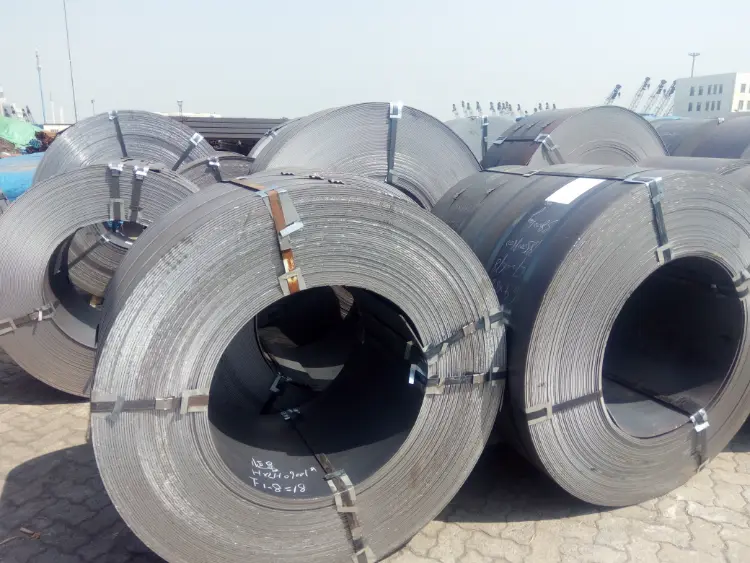
API 5CT J55 Pipeline Steel Coil
API 5CT J55 Pipeline Steel Coil - Composition, Properties & Equivalents
Complete material data sheet for API 5CT J55 steel coil used in oil country tubular goods: chemical composition, mechanical properties, thermal and electrical properties, equivalent grades and applications.
Hot rolling, normalising, cold forming, ERW/HFW welding, threading, end finishing
- Phone : +8618037372205
- Email : [email protected]
- WhatsApp: Contact via Whtsapp
- WeChat: +8618037372205
API 5CT J55 Pipeline Steel Coil Introduction
API 5CT J55 is a carbon-manganese steel grade primarily used for oil country tubular goods (OCTG), including casing and tubing. It offers a minimum yield strength of 379 MPa (55 ksi) and tensile strength ≥517 MPa (75 ksi), making it suitable for moderate-depth oil and gas wells. The product designation "Pipeline Steel Coil" indicates the material is often supplied as hot‑rolled coil or strip for the manufacture of electric resistance welded (ERW) or high‑frequency welded (HFW) pipes. J55 can be delivered in as‑rolled or normalised condition and provides good weldability, formability and consistent mechanical properties at a competitive cost.
API 5CT J55 Pipeline Steel Coil Chemical Composition – API 5CT J55
Chemical requirements as specified in API 5CT-2011 Table C.1 for J55, percent by mass. For welded products the carbon equivalent (CE) is limited to 0.43% max. Elements not listed have no specified maximum but may be reported by the manufacturer.
| Element | Maximum or Range (wt %) | Remarks |
|---|---|---|
| C | 0.34 max | Product analysis: 0.37 max |
| Mn | 1.20 max | |
| P | 0.030 max | |
| S | 0.030 max | |
| Cu | 0.35 max | Applicable for weldable grades |
| Ni | 0.35 max | |
| Cr | 0.35 max | |
| Mo | 0.08 max | |
| V + Nb | 0.02 max | |
| Carbon Equivalent (CE) | 0.43 max | For welded products per API 5CT Annex A |
API 5CT J55 Pipeline Steel Coil Thermal and Electrical Physical Properties
Physical properties given below are typical for carbon steel of this grade and are not mandatory per API 5CT. Actual values can vary slightly depending on manufacturing route and condition.
| Property | Typical Value | Unit | Test Condition |
|---|---|---|---|
| Density (ρ) | 7.85 | g/cm³ | Room temperature |
| Elastic Modulus (E) | 200 – 210 | GPa | Room temperature |
| Shear Modulus (G) | 80 | GPa | From typical Poisson's ratio |
| Poisson's Ratio (ν) | 0.3 | – | |
| Thermal Expansion Coefficient (α) | 11.5 × 10⁻⁶ | K⁻¹ | 20–100°C |
| Thermal Conductivity (λ) | 50 | W/(m·K) | 25°C |
| Specific Heat Capacity (cₚ) | 480 | J/(kg·K) | 25°C |
| Electrical Resistivity (ρₑ) | ~ 0.15 – 0.20 | µΩ·m | 20°C |
API 5CT J55 Pipeline Steel Coil Mechanical Properties – API 5CT J55
Mechanical properties for J55 casing and tubing as stipulated in API 5CT-2011. Yield and tensile strengths are measured on the pipe body. Elongation is calculated by the formula given in the standard and applies to full‑section specimens. Bending test is required for all pipe sizes; the bend angle depends on the outside diameter.
| Property | Required Value | Unit | Test Condition |
|---|---|---|---|
| Yield Strength (Rt0.5) | 379 – 552 | MPa | 0.5% extension under load |
| Yield Strength | 55 – 80 | ksi | 0.5% extension under load |
| Tensile Strength (Rm) | ≥ 517 | MPa | |
| Tensile Strength | ≥ 75 | ksi | |
| Elongation (A) | e = 1940·A0.2 / U0.9 | % | A = cross‑sectional area (mm²); U = specified minimum tensile strength (MPa). Minimum value is calculated; for typical pipe sizes roughly 20–25%. |
| Bending Test | Bend through 90° (OD > 60.3 mm) or 180° (OD ≤ 60.3 mm), mandrel diameter = wall thickness | – | No cracks or fractures allowed |
| Hardness | ≤ 22 | HRC | If hardness testing is performed |
API 5CT J55 Pipeline Steel Coil Internationally Equivalent Standards – J55
| Country / Region | Standard | Grade | Remarks |
|---|---|---|---|
| International | ISO 11960 | J55 | Identical technical specifications |
| China | SY/T 6194 | J55 | Chinese national standard for OCTG |
| Russia / CIS | GOST R 53366 (ISO 11960) | J55 | Adopted ISO standard directly |
API 5CT J55 Pipeline Steel Coil Application Introduction
J55 steel coil is primarily used to manufacture welded casing and tubing pipes that withstand moderate pressures in oil and gas wells. As a coil product, it is slit, formed and welded into pipes, then often threaded. It also finds use in structural and fluid transportation projects where the 55 ksi yield strength is adequate.
Product Applications: Casing pipes (surface and intermediate), Tubing strings, Line pipes for gathering systems, Structural hollow sections (when certified to dual standards)
Processed into products: Oil well casing joints and collars, Downhole tubing sections, Couplings and pup joints, Fittings for low‑pressure oilfield piping, Piles and tubular structural components
Application industries: Oil & Gas exploration and production, Water well drilling, Pipeline transportation (limited to low‑pressure applications), Structural and piling construction
API 5CT J55 Pipeline Steel Coil Similar / Closely Matching Steel Grades
| Country / Region | Standard | Grade | Remarks |
|---|---|---|---|
| International | API 5CT | K55 | Same strength level (55 ksi min YS), similar chemistry, often used interchangeably for casing. |
| Europe | EN 10208-1 | L245GA | Minimum yield 245 MPa, lower than J55; for line pipe applications. |
| USA | ASTM A139 / A139M | Grade B | Minimum yield 241 MPa (35 ksi); lower strength but similar weldability. |
| Canada | CSA Z662 | Grade 290 (290Y) | Minimum yield 290 MPa, close to the lower end of J55 range; for pipeline use. |
Notes:
- When ordering J55 pipeline steel coil, the manufacturer usually certifies the product to both API 5CT and any supplementary specification, such as API 5L if the pipe is intended for line pipe service.
- For sour service environments, J55 is not suitable unless specifically tested for HIC/SSC resistance per NACE MR0175/ISO 15156.
- The carbon equivalent limit (CE ≤ 0.43) ensures good field weldability even when the material is not subsequently heat treated.
- In practice, J55 coils may be produced from low‑carbon‑manganese steel with micro‑alloy additions (e.g., Nb, V) to meet strength requirements without excessive carbon.
- Share



