
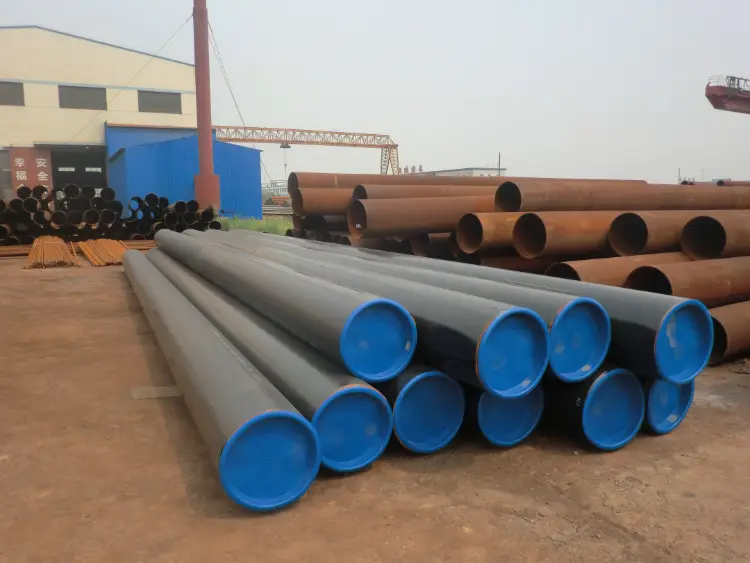
EN10025-2 S275J0 Steel for LSAW Pipe
EN10025-2 S275J0 Steel for LSAW Pipe: Chemical & Mechanical Properties, Equivalents
Comprehensive material data for EN10025-2 S275J0 hot-rolled non-alloy structural steel, widely used in LSAW pipe manufacturing. Includes chemical composition, mechanical properties, physical properties, international equivalents, and application guidance.
Hot rolling, normalizing, cold forming, welding (including LSAW process), machining, cutting, bending
- Phone : +8618037372205
- Email : [email protected]
- WhatsApp: Contact via Whtsapp
- WeChat: +8618037372205
EN10025-2 S275J0 Steel for LSAW Pipe Introduction
S275J0 is a hot-rolled, non-alloy structural steel grade specified in EN 10025-2. It is designed for welded, bolted, and riveted structures, offering a minimum yield strength of 275 MPa for thicknesses up to 16 mm. The "J0" designation guarantees a minimum impact energy of 27 J at 0 °C, ensuring reliable toughness for moderate low-temperature service. This grade is commonly supplied in the normalized or as-rolled condition and is extensively used for manufacturing longitudinal submerged arc welded (LSAW) pipes, structural hollow sections, and general construction components. Its balanced chemistry provides good weldability, formability, and consistency, making it a versatile choice for pressure-bearing and structural applications in civil engineering, offshore, and energy transportation sectors.
EN10025-2 S275J0 Steel for LSAW Pipe Chemical Composition
The chemical composition of S275J0 is governed by EN 10025-2. The values below represent the maximum limits for the heat analysis, unless otherwise noted. Elements not listed are permitted only in trace amounts for residual elements. The steel is fully killed and usually contains aluminum as a grain refiner. The low carbon and manganese content ensures excellent weldability, while the controlled phosphorus and sulfur levels maintain steel cleanliness and toughness.
- For product thicknesses > 100 mm, carbon equivalent (CEV) may be reported for weldability assessment.
- Optional stricter limits for Cu, Cr, Ni, etc., may apply in certain delivery conditions.
| Chemical Element | Standard Value (max, %) | Remarks |
|---|---|---|
| Carbon (C) | 0.20 (t ≤ 16 mm); 0.20 (16 < t ≤ 40 mm); 0.22 (t > 40 mm) | Based on product thickness t in mm |
| Silicon (Si) | ≤ 0.60 | Si content depends on deoxidation practice; typically 0.15–0.40 for fully killed steel |
| Manganese (Mn) | 1.50 (t ≤ 40 mm); 1.60 (t > 40 mm) | For better weldability and strength |
| Phosphorus (P) | ≤ 0.030 | Maximum for heat analysis; option up to 0.025 for improved toughness |
| Sulfur (S) | ≤ 0.030 | Maximum; lower levels available on request |
| Nitrogen (N) | ≤ 0.012 | If Al is present, N is bound as AlN |
| Copper (Cu) | ≤ 0.55 | Residual element from scrap; if higher, it may be stated |
| Aluminum (Al) | ≥ 0.020 (total Al) or adequate N-binding | Required for fully killed fine-grain practice |
| Other residual elements (Cr, Ni, Mo, etc.) | Cr+Mo+Ni ≤ 0.75, etc. | As per standard, unless otherwise agreed |
EN10025-2 S275J0 Steel for LSAW Pipe Thermal and Electrical Physical Properties
The following physical properties are typical for S275J0 carbon-manganese steel at room temperature unless otherwise noted. These values are derived from general structural steel data and are suitable for design calculations. Actual properties may vary slightly with exact composition and heat treatment.
- Thermal expansion coefficient varies with temperature; a range is given for 20–200 °C.
- Electrical resistivity is for reference in non-critical electrical applications.
| Property | Standard/Typical Value | Unit | Test Condition / Temperature |
|---|---|---|---|
| Density (ρ) | 7.85 | g/cm³ | at 20 °C |
| Elastic Modulus (E) | 210 | GPa | at 20 °C, tensile |
| Shear Modulus (G) | 80 | GPa | at 20 °C, calculated from E and ν |
| Poisson's Ratio (ν) | 0.3 | – | in elastic range |
| Thermal Expansion Coefficient (α) | 11.7 | 10⁻⁶/K | 20–100 °C |
| Thermal Expansion Coefficient (α) | 12.2 | 10⁻⁶/K | 20–200 °C |
| Thermal Expansion Coefficient (α) | 13.2 | 10⁻⁶/K | 20–400 °C |
| Thermal Conductivity (λ) | 52 | W/(m·K) | at 20 °C |
| Thermal Conductivity (λ) | 48 | W/(m·K) | at 200 °C |
| Specific Heat Capacity | 460 | J/(kg·K) | at 20–100 °C |
| Electrical Resistivity (ρ_e) | 0.17 | μΩ·m | at 20 °C |
EN10025-2 S275J0 Steel for LSAW Pipe Mechanical Properties
Mechanical properties are standardized according to EN 10025-2 for S275J0. The yield strength, tensile strength, and elongation requirements vary with product thickness. Impact energy is verified on longitudinal specimens at 0 °C. Values below are for the hot-rolled or normalized condition.
- Bend test is applicable to products up to 12 mm thickness for sheet/plate or according to specified ratios.
- Transverse properties may have slightly lower elongation values.
| Property | Standard Requirement | Unit | Test Condition |
|---|---|---|---|
| Yield Strength (ReH) | 275 (t ≤ 16 mm) | MPa | Upper yield strength, transverse or longitudinal |
| Yield Strength (ReH) | 265 (16 < t ≤ 40 mm) | MPa | Upper yield strength |
| Yield Strength (ReH) | 255 (40 < t ≤ 63 mm) | MPa | Upper yield strength |
| Yield Strength (ReH) | 245 (63 < t ≤ 80 mm) | MPa | Upper yield strength |
| Yield Strength (ReH) | 235 (80 < t ≤ 100 mm) | MPa | Upper yield strength |
| Yield Strength (ReH) | 225 (100 < t ≤ 150 mm) | MPa | Upper yield strength |
| Yield Strength (ReH) | 215 (150 < t ≤ 200 mm) | MPa | Upper yield strength |
| Yield Strength (ReH) | 195 (200 < t ≤ 250 mm) | MPa | Upper yield strength |
| Tensile Strength (Rm) | 410–560 (t ≤ 100 mm) | MPa | Transverse or longitudinal |
| Tensile Strength (Rm) | 400–540 (100 < t ≤ 150 mm) | MPa | Transverse or longitudinal |
| Tensile Strength (Rm) | 380–540 (150 < t ≤ 250 mm) | MPa | Transverse or longitudinal |
| Elongation after fracture (A, L0 = 5.65√S0) | ≥ 19 (t ≤ 1 mm) | % | Longitudinal, for thickness range indicative; for t ≤ 1 mm gauge length 80 mm |
| Elongation (A) | ≥ 15 (t > 1 ≤ 40 mm) | % | Longitudinal (standard test piece) |
| Elongation (A) | ≥ 15 (40 < t ≤ 63 mm) | % | Longitudinal |
| Elongation (A) | ≥ 15 (63 < t ≤ 100 mm) | % | Longitudinal |
| Elongation (A) | ≥ 14 (100 < t ≤ 150 mm) | % | Longitudinal |
| Elongation (A) | ≥ 14 (150 < t ≤ 200 mm) | % | Longitudinal |
| Elongation (A) | ≥ 13 (200 < t ≤ 250 mm) | % | Longitudinal |
| Impact Energy (KV) | ≥ 27 | J | Charpy V-notch, 0 °C, longitudinal |
| Bend Test (t ≤ 12 mm) | D = 1t (180°) | – | Bend diameter D, sample thickness t; no cracks |
EN10025-2 S275J0 Steel for LSAW Pipe Completely Equivalent Material Standards and Replaceable Grades
| Country/Region | Standard | Grade | Remarks |
|---|---|---|---|
| International (ISO) | ISO 630-2 | S275J0 | Chemically and mechanically identical; widely used for global projects. |
| European Union | EN 10025-2 | S275J0 | The original standard; this entry confirms self-identity. |
| United Kingdom | BS EN 10025-2 | S275J0 | Adopted EN standard, fully equivalent. |
| Germany | DIN EN 10025-2 | S275J0 | Direct adoption, former DIN 17100 St 44-3 U is withdrawn and not a direct equivalent. |
EN10025-2 S275J0 Steel for LSAW Pipe Application Introduction
S275J0 LSAW pipe combines balanced strength and excellent weldability with assured toughness at 0 °C, making it suitable for a wide range of structural and pressure applications. The longitudinal submerged arc welding process ensures high-quality, large-diameter, thick-wall pipes. Typical application sectors and products are listed below, along with specific components that can be fabricated from this material.
Product Applications: Long-distance oil and gas line pipe, Water main and distribution pipes, Structural pipes and hollow sections for columns and trusses, Piling pipes (foundation piles, jacket legs for offshore platforms), Process piping in industrial plants (low pressure, structural), Dredging pipes and slurry transport lines
Processed into products: Pipe elbows, tees, reducers, and flanges for pipeline systems, Wind turbine tower tubular sections, Bridge structural members and chords, Jacket leg cans and brace pipes for offshore jackets, Crane booms and heavy equipment arms, Pile connectors, shoes, and reinforcement rings, Tube-to-tube joints, gusset plates, and welded brackets
Application industries: Oil and gas transportation (onshore and offshore pipelines), Water supply and wastewater treatment systems, Structural engineering (building frames, bridges, stadiums), Piling and foundation engineering (marine and land piles), Renewable energy (wind turbine towers, support structures), Heavy machinery and equipment manufacturing
EN10025-2 S275J0 Steel for LSAW Pipe Similar or Closely Related Alternative Grades
| Country/Region | Standard | Grade | Remarks |
|---|---|---|---|
| European Union | EN 10025-2 | S275JR | Room temperature impact (27 J at +20 °C); otherwise same strength, suitable where 0 °C toughness not required. |
| European Union | EN 10025-2 | S275J2 | Higher toughness: 27 J at -20 °C; can replace S275J0 for lower temperature service. |
| European Union | EN 10025-2 | S275M/ML | Thermomechanical rolled versions with fine grain, potentially better weldability for thicker sections. |
| Japan | JIS G 3106 | SM400B | Weldable structural steel with yield 235–245 MPa (400 class). Requires strength adjustment but similar application. |
| USA | ASTM A572/A572M | Grade 42 | Yield 290 MPa (42 ksi), no direct 0 °C impact guarantee; may require supplementary testing. |
| China | GB/T 1591 | Q235D | Impact at -20 °C, yield 235 MPa. Not strength equivalent but widely used for structural pipes; must check mechanical compatibility. |
Notes:
LSAW pipe specific notes: S275J0 base material is typically formed from plate or coil. The forming and welding process (LSAW) may introduce cold working; a stress-relieving heat treatment may be applied for critical sour service or when thickness reduction exceeds certain limits. Weldability is excellent with common processes (SAW, GMAW, SMAW), but preheating may be recommended for thick sections (>30 mm) to avoid hydrogen cracking. For sour service applications, additional HIC/SSC testing per NACE MR0175 may be required, although S275J0 is not specifically resistance-qualified unless supplementary chemistry control is applied. Always verify the latest version of EN 10025-2 and project-specific requirements.
- Share



