
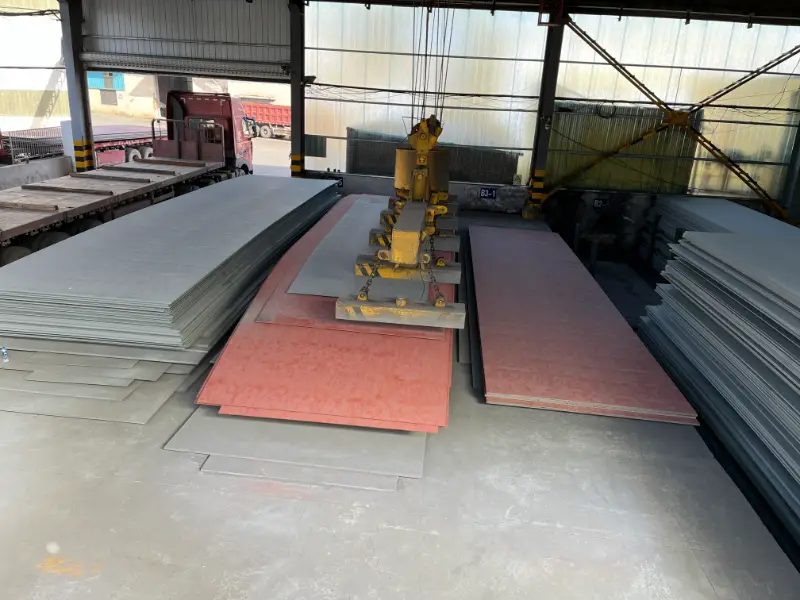
EN 10219 S235JRH Steel Hollow Section
EN 10219 S235JRH Steel Hollow Section: Properties, Equivalents and Applications for Structural Tubing
Comprehensive technical data for S235JRH cold-formed welded structural hollow sections according to EN 10219. Includes chemical composition, mechanical and physical properties, equivalent grades, and application guidance.
Cold forming, welding, cutting, punching, bending, galvanizing, painting
- Phone : +8618037372205
- Email : [email protected]
- WhatsApp: Contact via Whtsapp
- WeChat: +8618037372205
EN 10219 S235JRH Steel Hollow Section Introduction
S235JRH is a non-alloy structural steel grade defined in EN 10219 for cold-formed welded structural hollow sections of circular, square or rectangular forms (SHS/RHS). It is intended for general structural and engineering applications where good weldability and adequate toughness at room temperature (+20°C) are required. The designation 'JRH' indicates that the steel fulfills impact requirements (Charpy V-notch, 27 J at 20°C) for hollow sections. Typical delivery condition is as-welded and cold-formed (+CR) without subsequent heat treatment. It offers a minimum yield strength of 235 MPa for thicknesses up to 16 mm, with elongation above 25%, making it suitable for static and dynamically loaded structures.
EN 10219 S235JRH Steel Hollow Section Chemical Composition
Chemical requirements according to EN 10219-2:2019 for grade S235JRH. The maximum values apply to the heat analysis. For product analysis, specified deviations according to the standard are permitted. The steel is fully killed and contains fine grain elements (Al, Nb, V, Ti) if required. Nitrogen content is limited to ensure adequate ductility and ageing resistance.
- Cr, Cu, Mo, Ni: residual elements may be present but are not deliberately added.
- CEV (Carbon Equivalent Value) is typically ≤0.35% for good weldability.
| Element | Standard Value (max) | Remarks |
|---|---|---|
| C | ≤ 0.17 % | If CEV ≤0.39% then C up to 0.19% is allowed |
| Si | ≤ 0.40 % | Silicon content is usually deliberate but limited |
| Mn | ≤ 1.40 % | Higher Mn may be agreed for thicker sections |
| P | ≤ 0.040 % | For product analysis ≤0.045% |
| S | ≤ 0.040 % | For product analysis ≤0.045% |
| N | ≤ 0.012 % | Nitrogen may be higher if sufficient N-binding elements are present |
| Altot | ≥ 0.020 % | Minimum when aluminium is used as grain refiner; other elements (Nb, V, Ti) may also be used |
| CEV | ≤ 0.39 % | Carbon equivalent based on ladle analysis; if C≤0.19% then CEV ≤0.41% |
EN 10219 S235JRH Steel Hollow Section Thermal and Electrical Physical Properties
Physical properties for S235JRH steel are not specified in EN 10219 but are representative for a non-alloy structural steel with low carbon content. These values can be used for design calculations.
- Thermal properties are temperature-dependent; values provided are at room temperature unless otherwise indicated.
- Electrical resistivity increases with temperature.
| Property | Standard Value | Unit | Test Condition |
|---|---|---|---|
| Density (ρ) | 7.85 | g/cm³ | At 20 °C |
| Modulus of elasticity (E) | 210 | GPa | At 20 °C |
| Shear modulus (G) | 81 | GPa | Calculated from E and Poisson's ratio |
| Poisson's ratio (ν) | 0.3 | — | At 20 °C |
| Thermal expansion coefficient (α) | 12 × 10⁻⁶ | K⁻¹ | 20 °C to 100 °C |
| Thermal expansion coefficient (α) | 12.5 × 10⁻⁶ | K⁻¹ | 20 °C to 200 °C |
| Thermal expansion coefficient (α) | 13.5 × 10⁻⁶ | K⁻¹ | 20 °C to 400 °C |
| Thermal conductivity (λ) | 52 | W/(m·K) | At 20 °C |
| Thermal conductivity (λ) | 48 | W/(m·K) | At 100 °C |
| Specific heat capacity (cp) | 460 | J/(kg·K) | At 20 °C |
| Electrical resistivity (ρe) | 0.15 | Ω·mm²/m | At 20 °C |
EN 10219 S235JRH Steel Hollow Section Mechanical Properties
Mechanical properties according to EN 10219-2:2019 for cold-formed welded hollow sections. The values are valid for longitudinal test pieces unless otherwise stated. Thickness range up to 40 mm (for larger thicknesses properties must be agreed). The impact test temperature for J2 subgrade is -20°C, JR is 20°C.
- Transverse properties: allowed reduction in yield strength of 10 MPa, elongation reduced by 2%.
- Bend test: no cracks after bending through 180° around a mandrel with diameter 3×t (t ≤ 8 mm) or D = 4×t (8 < t ≤ 40 mm).
| Property | Standard Required Value | Unit | Test Condition |
|---|---|---|---|
| Yield strength (ReH) | ≥ 235 | MPa | Nominal wall thickness ≤ 16 mm |
| Yield strength (ReH) | ≥ 225 | MPa | 16 mm < t ≤ 40 mm |
| Tensile strength (Rm) | 360 – 510 | MPa | Nominal wall thickness ≤ 40 mm |
| Elongation after fracture (A) | ≥ 25 | % | Longitudinal, L0=5.65√S0, t ≤ 40 mm |
| Elongation after fracture (A) | ≥ 23 | % | Transverse, t ≤ 40 mm |
| Impact energy (KV, Charpy-V) | ≥ 27 | J | at +20 °C, longitudinal, standard specimen |
| Impact energy (KV, Charpy-V) | ≥ 27 | J | at 0 °C (J0 subgrade), longitudinal |
| Impact energy (KV, Charpy-V) | ≥ 27 | J | at -20 °C (J2 subgrade), longitudinal |
| Bend test (mandrel diameter) | D = 3 × t (t ≤ 8 mm) | — | 180° bend, no cracks |
| Bend test (mandrel diameter) | D = 4 × t (8 < t ≤ 40 mm) | — | 180° bend, no cracks |
EN 10219 S235JRH Steel Hollow Section Fully Equivalent Material Standards and Substitutable Grades
| Country/Region | Standard | Designation | Remarks |
|---|---|---|---|
| Europe | EN 10219-2:2019 | S235JRH | Identical – cold-formed welded hollow sections |
| Europe | EN 10210-2:2019 | S235JRH | Hot-finished hollow sections, similar chemistry and mechanicals; may have slightly higher yield due to different process |
| International | ISO 10799-2:2015 | S235JRH | Technically identical under ISO standard for cold-formed hollow sections |
| United Kingdom | BS 7668:2004 | S235JRH | British adoptation of the European standard; fully equivalent |
| Germany | DIN EN 10219-2 | S235JRH | German implementation, identical |
| France | NF EN 10219-2 | S235JRH | French implementation, identical |
EN 10219 S235JRH Steel Hollow Section Application Introduction
S235JRH hollow sections are extensively used in welded structural frameworks and mechanical engineering. Their moderate strength, excellent weldability and good cold formability make them suitable for a wide range of applications. Typical uses include:
- Building and civil engineering: columns, beams, trusses, purlins, space frames, and foundation structures.
- Infrastructure: bridges, pedestrian walkways, noise barriers, and sign supports.
- Mechanical engineering: chassis, frames for machinery, conveyors, and agricultural equipment.
- Offshore and marine: lightweight secondary structures, handrails, and platforms (subject to corrosion protection).
- Renewable energy: solar panel support structures, wind turbine towers (internal platforms).
SHS/RHS profiles are also employed in architectural designs, furniture, and storage racks.
Product Applications: Structural frames for industrial and commercial buildings, Roof trusses and space frames, High-bay warehouse racking systems, Scaffolding and temporary structures, Solar mounting structures (ground-mount and rooftop), Agricultural equipment (booms, trailers), Light poles and sign gantries, Crane booms and material handling systems
Processed into products: Columns and beams in steel frame buildings, Truss chords and web members, Bridge parapets and pedestrian railings, Machine frames and base plates, Conveyor frames and idler supports, Solar tracker torque tubes and purlins, Telecommunication tower legs and bracing, Prefabricated modular housing components
Application industries: Construction and building engineering, Civil infrastructure (bridges, tunnels), Mechanical and plant engineering, Agricultural and forestry machinery, Transport and logistics (shelving, container frames), Renewable energy (solar, wind), Offshore and shipbuilding (non-critical areas)
EN 10219 S235JRH Steel Hollow Section Similar or Alternative Material Recommendations
| Country/Region | Standard | Designation | Remarks |
|---|---|---|---|
| USA | ASTM A500/A500M | Grade B (round) / Grade C (shaped) | Similar yield (290–315 MPa for Grade B shaped, 270–310 MPa for Grade B round) and tensile 400 MPa min. Higher yield strength, slightly higher carbon equivalent. Check impact requirements. |
| Japan | JIS G 3466 | STKR400 | Yield ≥245 MPa, tensile 400-510 MPa. Comparable for general structural use. May require verification of toughness. |
| China | GB/T 6728 | Q235B | Closest Chinese hollow section grade; yield 235 MPa, but chemistry and delivery condition differ. Requires verification for cold-forming. |
| India | IS 4923 / IS 1161 | YSt 240 (IS 1161) / YSt 210 (IS 4923) | Indian structural hollow sections with similar yield (~240 MPa) but different quality levels. Check impact and welding suitability. |
| Russia | GOST 30245-2012 | C235 | Yield 235 MPa; comparable for general structures; verify tolerances and testing requirements. |
| Brazil | ABNT NBR 8261 | CG-24 (MR-250 equivalent) | Cold-formed welded RHS with yield ≥245 MPa, may substitute after confirming chemical and impact properties. |
Notes:
Additional remarks:
- For thicknesses above 40 mm, chemical composition and mechanical properties shall be agreed at the time of enquiry and order.
- Optional finish: pickled and oiled, or hot-dip galvanized (according to EN ISO 1461).
- Weldability: good; CEV ≤0.39 ensures no preheating is generally required for thicknesses up to 30 mm (follow EN 1011-2).
- Dimensional tolerances: according to EN 10219-2, tables for wall thickness, corner profiles, straightness, and mass.
- When ordering S235JRH pipes for projects requiring CE marking, the product must comply with EN 1090-1 and be supplied with a Factory Production Control certificate 2.2 or 3.1 according to EN 10204.
- Share



