
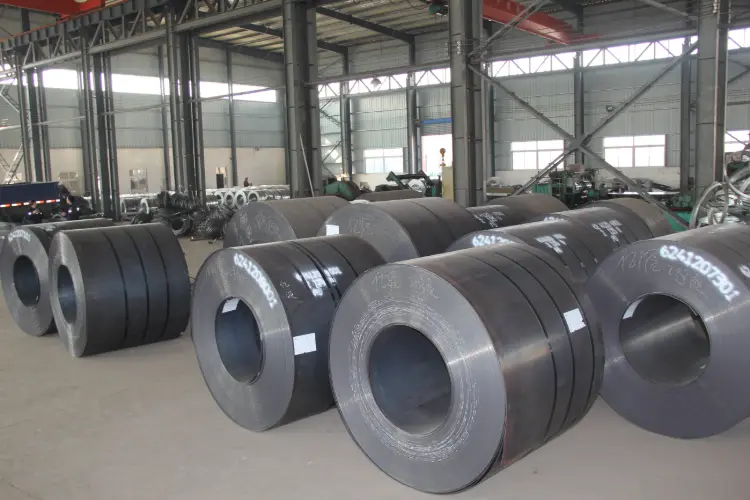
CCS DQ51 Shipbuilding Steel Coil
CCS DQ51 Shipbuilding Steel Coil: Quenched & Tempered Extra-High Strength Marine Structural Steel
Comprehensive material data for CCS DQ51 shipbuilding steel coil, including chemical composition, mechanical properties, physical properties, international equivalents, and application guidance.
Hot rolling, Quenching and Tempering, Welding, Cutting, Forming
- Phone : +8618037372205
- Email : [email protected]
- WhatsApp: Contact via Whtsapp
- WeChat: +8618037372205
CCS DQ51 Shipbuilding Steel Coil Introduction
CCS DQ51 is an extra-high strength quenched and tempered shipbuilding structural steel plate/coil with a minimum specified yield strength of 500 MPa. It offers an excellent combination of strength, toughness, and weldability, primarily used in critical structural components of ships and offshore structures subjected to high loads and harsh marine environments. The letter 'D' indicates impact toughness guaranteed at -20 °C, 'Q' denotes quenched and tempered delivery condition, and '51' corresponds to the minimum yield strength class of 51 kgf/mm² (500 MPa). This grade meets the requirements of the China Classification Society (CCS) Rules for Materials and Welding. Typical supply forms include hot-rolled coil, plate, and strip.
CCS DQ51 Shipbuilding Steel Coil Chemical Composition
The chemical composition of CCS DQ51 steel is controlled to achieve high strength and good weldability after quenching and tempering. Microalloying elements such as Nb, V, and Ti are added to refine grain size and improve toughness. Carbon equivalent (CEV) is typically limited to ensure weldability. The following values represent the ladle analysis according to CCS rules.
| Element | Standard Value | Remarks |
|---|---|---|
| Carbon (C) | ≤0.20 | |
| Silicon (Si) | ≤0.55 | |
| Manganese (Mn) | 0.90 – 1.60 | |
| Phosphorus (P) | ≤0.025 | |
| Sulfur (S) | ≤0.025 | |
| Chromium (Cr) | ≤0.80 | |
| Nickel (Ni) | ≤2.00 | |
| Molybdenum (Mo) | ≤0.50 | |
| Copper (Cu) | ≤0.50 | |
| Aluminum (Al) acid soluble | 0.015 – 0.050 | Total Al, min 0.020 |
| Niobium (Nb) | ≤0.05 | |
| Vanadium (V) | ≤0.10 | |
| Titanium (Ti) | ≤0.02 | |
| Nitrogen (N) | ≤0.012 | |
| Boron (B) | ≤0.0005 | If added |
| Calcium (Ca) | 0.0015 – 0.005 | Optional for inclusion shape control |
| Carbon Equivalent (CEV) | ≤0.57 | CEV = C + Mn/6 + (Cr+Mo+V)/5 + (Ni+Cu)/15 |
CCS DQ51 Shipbuilding Steel Coil Thermal and Electrical Physical Properties
The following physical properties are typical for quenched and tempered low-alloy shipbuilding steel of this strength class. Actual values can vary slightly with composition and heat treatment. Thermal conductivity and specific heat are given at room temperature unless noted otherwise.
| Property | Typical Value | Unit | Test Condition |
|---|---|---|---|
| Density (ρ) | 7850 | kg/m³ | At 20 °C |
| Elastic modulus (E) | 205 | GPa | At 20 °C |
| Shear modulus (G) | 79.3 | GPa | Calculated, G = E / [2(1+ν)] |
| Poisson's ratio (ν) | 0.3 | ||
| Thermal expansion coefficient (α) | 12.0 × 10⁻⁶ | K⁻¹ | 20 – 100 °C |
| Thermal expansion coefficient (α) | 13.0 × 10⁻⁶ | K⁻¹ | 20 – 200 °C |
| Thermal conductivity (λ) | 45 | W/(m·K) | At 20 °C |
| Thermal conductivity (λ) | 38 | W/(m·K) | At 200 °C |
| Specific heat capacity (c) | 460 | J/(kg·K) | At 20 °C |
| Electrical resistivity (ρ_e) | 0.20 | μΩ·m | At 20 °C |
CCS DQ51 Shipbuilding Steel Coil Mechanical Properties
Mechanical properties of CCS DQ51 steel are determined by tensile and impact testing on specimens from the finished product. Yield and tensile strength values may vary with plate thickness. Charpy V-notch impact energy is guaranteed at -20 °C. Bend tests are performed to verify formability. All values are minimum unless a range is given.
| Property | Required Value | Unit | Test Condition |
|---|---|---|---|
| Yield strength (ReH) | ≥500 | MPa | Thickness ≤ 50 mm, transverse |
| Yield strength (ReH) | ≥480 | MPa | Thickness > 50 – 80 mm, transverse |
| Yield strength (ReH) | ≥460 | MPa | Thickness > 80 – 100 mm, transverse |
| Tensile strength (Rm) | 610 – 770 | MPa | Thickness ≤ 100 mm, transverse |
| Elongation after fracture (A5) | ≥16 | % | L₀ = 5.65√S₀, longitudinal specimen |
| Charpy impact energy (KV₂) | ≥27 (longitudinal), ≥20 (transverse) | J | At -20 °C |
| Bend test (180°) | d = 3a | Thickness ≤ 30 mm, a = specimen thickness | |
| Bend test (180°) | d = 4a | Thickness > 30 – 60 mm |
CCS DQ51 Shipbuilding Steel Coil Equivalent Material Standards & Replaceable Grades
| Country/Region | Standard | Grade | Remarks |
|---|---|---|---|
| China | CCS Rules | DQ51 | China Classification Society |
| Norway/Germany | DNV GL Rules | DQ51 (NV DQ51) | DNV notation, identical minimum requirements |
| USA | ABS Rules | DQ51 | American Bureau of Shipping |
| UK | LR Rules | DQ51 | Lloyd's Register |
| France | BV Rules | DQ51 | Bureau Veritas |
| South Korea | KR Rules | DQ51 | Korean Register |
| Japan | NK Rules | DQ51 | ClassNK (Nippon Kaiji Kyokai) |
| Italy | RINA Rules | DQ51 | Registro Italiano Navale |
| China | GB 712 | DH500 | National standard, D indicates -20 °C toughness, H for high strength; 500 MPa yield class |
CCS DQ51 Shipbuilding Steel Coil Application Introduction
CCS DQ51 steel is primarily used in harsh marine environments where high strength and good low-temperature toughness are essential. Typical applications include:
Product Applications: Hull plates for container ships, bulk carriers, tankers, and warships, Deck plates and stringers, Offshore platform topsides and jacket members, Crane booms and heavy lifting equipment, Ice-strengthened structures
Processed into products: Longitudinal and transverse stiffeners, Girders and frames, Bulkhead plates, Bracket plates, Rudders and stern frames, Offshore structural nodes
Application industries: Shipbuilding, Offshore oil & gas, Marine construction, Port and harbor infrastructure
CCS DQ51 Shipbuilding Steel Coil Similar / Alternative Materials
| Country/Region | Standard | Grade | Remarks |
|---|---|---|---|
| China | GB 712 | DH500 | Similar strength level, quenched & tempered, -20 °C impact; CCSE equivalent to DQ51 |
| Europe | EN 10225 | S500G2+M | Offshore structural steel with minimum 500 MPa yield, impact at -20 °C; similar application |
| USA | ASTM A514 / A517 | Grade B | Quenched and tempered alloy steel plate with min 690 MPa tensile; higher strength, but often substitutable where CCS DQ51 is specified after engineering review |
Notes:
All material supplied under this grade shall be certified by a CCS surveyor. Marking includes the grade (DQ51), heat number, and CCS stamp. Ultrasonic testing may be required depending on the application and thickness. Welding should follow approved procedures with low-hydrogen consumables to avoid cold cracking. Post-weld heat treatment is generally not required for thicknesses up to 50 mm if proper preheat is applied.
- Share



