
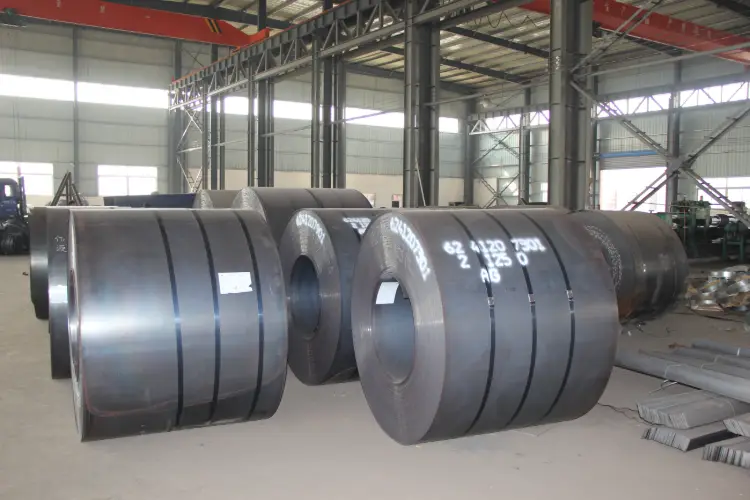
CCS AQ51 Shipbuilding Steel Coil
CCS AQ51 Shipbuilding Steel Coil - High-Strength Quenched & Tempered Marine Grade
Complete material data for CCS AQ51 shipbuilding steel coil, including chemical composition, mechanical and thermal properties, international equivalents, and application guide.
Hot rolling, quenching, tempering; can be processed by cutting, welding, bending, machining
- Phone : +8618037372205
- Email : [email protected]
- WhatsApp: Contact via Whtsapp
- WeChat: +8618037372205
CCS AQ51 Shipbuilding Steel Coil Introduction
CCS AQ51 is a high-strength quenched and tempered steel grade specified by China Classification Society (CCS) for offshore and marine structural applications. It belongs to the Q51 yield strength category (minimum yield strength 510 MPa under 50 mm thickness) and offers excellent toughness at low temperatures (grade A, impact test at 0°C).
This steel is characterized by:
- Superior strength-to-weight ratio, enabling lighter structural designs.
- Good weldability with controlled carbon equivalent (Ceq ≤ 0.52% for t ≤ 50 mm) and low crack sensitivity.
- Fine-grain microstructure achieved through controlled rolling and quenching & tempering.
- Compliance with CCS Rules for Materials and Welding, suitable for primary hull structures, offshore platforms, and high-stress components.
Typical delivery condition is quenched and tempered, supplied as plates and coils with thicknesses up to 150 mm according to CCS class approval.
CCS AQ51 Shipbuilding Steel Coil Chemical Composition
The chemical composition of CCS AQ51 steel is strictly controlled to achieve high strength and good weldability. The values below represent ladle analysis limits as per CCS Rules. Total aluminum content is required for fine grain practice. Carbon equivalent (Ceq) and optional Pcm are calculated to ensure weldability. Microalloying elements (Nb, V, Ti) are added to refine grain size and enhance precipitation strengthening.
| Element | Standard Value (max, unless range noted) | Remarks |
|---|---|---|
| C | ≤ 0.18 | |
| Si | ≤ 0.55 | |
| Mn | ≤ 1.60 | |
| P | ≤ 0.025 | |
| S | ≤ 0.025 | |
| Al (total) | ≥ 0.015 | Acid soluble or total aluminum |
| Nb | ≤ 0.05 | |
| V | ≤ 0.10 | |
| Ti | ≤ 0.05 | |
| Cu | ≤ 0.50 | |
| Cr | ≤ 1.00 | |
| Ni | ≤ 2.00 | |
| Mo | ≤ 0.80 | |
| Ceq | ≤ 0.52 (t ≤ 50 mm); ≤ 0.54 (50 < t ≤ 100 mm); ≤ 0.56 (100 < t ≤ 150 mm) | Ceq = C + Mn/6 + (Cr+Mo+V)/5 + (Ni+Cu)/15 |
| Pcm (optional) | ≤ 0.28 (t ≤ 50 mm); ≤ 0.30 (50 < t ≤ 100 mm) | Pcm = C + Si/30 + (Mn+Cu+Cr)/20 + Ni/60 + Mo/15 + V/10 + 5B |
CCS AQ51 Shipbuilding Steel Coil Thermal and Electrical Physical Properties
The physical properties listed below are typical for low-alloy quenched and tempered steels and are not mandatory acceptance criteria. They are provided for design and calculation purposes. Values are based on literature for similar steel grades (yield strength ≈ 510–550 MPa) and may vary slightly with specific heat treatment and composition.
| Property | Typical Value | Unit | Test Condition / Remarks |
|---|---|---|---|
| Density (ρ) | 7.85 | g/cm³ | Room temperature |
| Elastic Modulus (E) | 210 | GPa | Room temperature, tensile modulus |
| Shear Modulus (G) | 80 | GPa | Calculated from E and ν |
| Poisson's Ratio (ν) | 0.3 | - | Room temperature |
| Thermal Expansion Coefficient (α) | 12.0 × 10⁻⁶ / K (20–100°C); 12.8 × 10⁻⁶ / K (20–300°C) | /K | Mean coefficient of linear expansion |
| Thermal Conductivity (λ) | 48 | W/(m·K) | At 20°C |
| Specific Heat Capacity (cp) | 460 | J/(kg·K) | At 20°C |
| Electrical Resistivity (ρe) | 0.22 – 0.28 | μΩ·m | At 20°C |
CCS AQ51 Shipbuilding Steel Coil Mechanical Properties
Mechanical properties are determined after quenching and tempering. Values depend on product thickness. Tensile test specimens are taken transverse to the rolling direction. Impact tests are performed on longitudinal Charpy-V specimens at 0°C (grade A). Bending test uses a 180° angle with defined mandrel diameter depending on thickness.
All data conform to CCS Rules for AQ51 grade. Multiple rows are given for different thickness ranges where requirements differ.
| Property | Standard Required Value | Unit | Test Condition |
|---|---|---|---|
| Yield Strength (ReH) | ≥ 510 | MPa | t ≤ 50 mm, transverse |
| Yield Strength (ReH) | ≥ 490 | MPa | 50 < t ≤ 100 mm, transverse |
| Yield Strength (ReH) | ≥ 470 | MPa | 100 < t ≤ 150 mm, transverse |
| Tensile Strength (Rm) | 610 – 770 | MPa | t ≤ 50 mm, transverse |
| Tensile Strength (Rm) | 590 – 770 | MPa | 50 < t ≤ 100 mm, transverse |
| Tensile Strength (Rm) | 570 – 720 | MPa | 100 < t ≤ 150 mm, transverse |
| Elongation (A5) | ≥ 16 | % | t ≤ 50 mm, gauge length 5.65√So |
| Elongation (A5) | ≥ 16 | % | 50 < t ≤ 100 mm |
| Elongation (A5) | ≥ 15 | % | 100 < t ≤ 150 mm |
| Impact Energy (KV2) | ≥ 27 (longitudinal); ≥ 20 (transverse) | J | Charpy-V notch, 0°C |
| Bending Test | d=3a, 180° | - | t ≤ 25 mm; for t > 25 mm, bend diameter by agreement |
CCS AQ51 Shipbuilding Steel Coil Fully Equivalent Material Standards and Substitutable Grades
| Country / Region | Standard | Grade | Remarks |
|---|---|---|---|
| International | CCS (China Classification Society) | AQ51 | Base grade, quenched and tempered, A class |
| USA / International | ABS (American Bureau of Shipping) | EQ51 | Same yield strength category, E class (impact 0°C for AQ51 may differ, check impact test temperature: ABS EQ51 is E class with -20°C; for 0°C, ABS AQ51 exists) |
| Norway | DNV (Det Norske Veritas) | NVEQ51 | Fully equivalent, NV EQ51 is E class; DNV also has AQ51 with 0°C impact |
| UK / International | LR (Lloyd's Register) | EQ51 | LR EQ51 corresponds to grade E; LR AQ51 corresponds to grade A |
| France | BV (Bureau Veritas) | AQ51 | Directly equivalent |
| Japan | NK (Nippon Kaiji Kyokai) | KE51 | KE51 is grade E; KA51 grade A is equivalent |
| Korea | KR (Korean Register) | EQ51 | EQ51 grade E, AQ51 grade A is equivalent |
| Italy | RINA (Registro Italiano Navale) | AQ51 | Directly equivalent |
CCS AQ51 Shipbuilding Steel Coil Application Introduction
CCS AQ51 steel is predominantly used in harsh marine environments where high strength, excellent toughness, and good weldability are critical. It is approved by major classification societies for shipbuilding and offshore structures. The quenched and tempered condition provides a fine bainitic/martensitic microstructure that balances strength and ductility.
Typical applications include:
Product Applications: Complete hull structures including decks, bottom shell, side shell, and longitudinal bulkheads, Offshore module support frames and helidecks, Legs and spud cans for self-elevating platforms, Heavy-lift crane booms and A-frames on construction vessels, Subsea manifolds and structural components
Processed into products: Shell plates for waterline and high-stress zones, Stiffeners, girders, frames, and brackets, Transverse bulkheads and webs in cargo holds, Fatigue-critical details like hatch corners and welded joints, Machined parts such as pins, fasteners, and connector plates (after Q&T)
Application industries: Shipbuilding (large container ships, bulk carriers, tankers, naval vessels), Offshore oil and gas (jack-up rig legs, platform decks, flare booms), Marine heavy lifting equipment (crane pedestals, winch frames), Pressure vessels and storage tanks for low-temperature service, Arctic and ice-going vessel structures (with appropriate low-temperature toughness grade upgrade), Structural steelwork for bridges and heavy construction
CCS AQ51 Shipbuilding Steel Coil Similar / Alternative Material Recommendations
| Country / Region | Standard | Grade | Remarks |
|---|---|---|---|
| International | CCS | AQ47 | Lower yield strength (460 MPa), similar toughness and weldability, somewhat easier to form |
| International | CCS | DQ51 | Same strength but grade D with impact test at -20°C, better low-temperature toughness |
| International | CCS | EQ51 | Grade E, -40°C impact, superior toughness; often direct substitute for AQ51 when lower temperature service required |
| International | CCS | AH36 / DH36 / EH36 | Lower yield strength (355 MPa), traditional high-strength hull steel, used where strength requirements are less demanding |
| International | EN 10025-6 | S690QL/QL1, S500QL | European quenched and tempered structural steel with similar strength levels, but must be checked for marine and class approval requirements |
Notes:
- Material must be certified by a recognized classification society (CCS) with full traceability to heat and production batch.
- For thicknesses above 25 mm, supplementary ultrasonic testing is recommended to ensure internal soundness.
- Preheating before welding may be required depending on plate thickness, carbon equivalent, and ambient conditions. Typical preheat temperature range is 100–150°C for thickness ≤ 50 mm; higher for thicker sections.
- Post-weld heat treatment (PWHT) is generally not required for this grade but may be applied for stress relief with careful control to avoid temper embrittlement.
- Weld metal should match the base metal's strength and toughness; use of appropriate consumables (e.g., E110T1-K4 or low-hydrogen electrodes) is essential.
- The steel can be supplied with additional requirements such as NACE MR0175 for sour service, but separate qualification is needed.
- Share



