
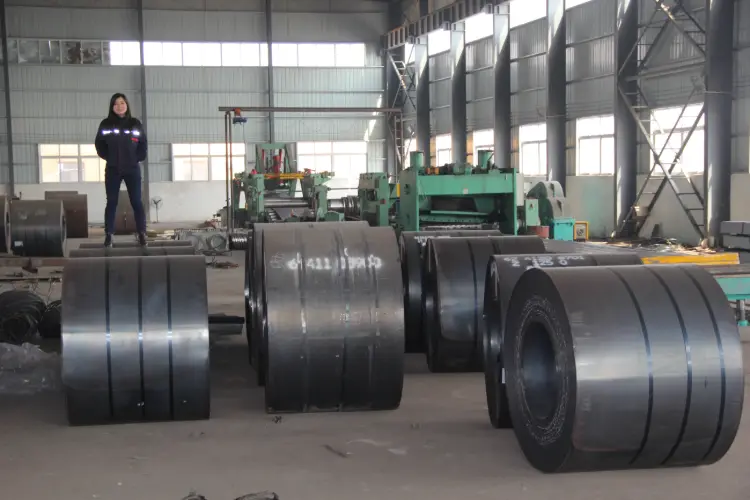
CCS EQ51 Shipbuilding Steel Coil
CCS EQ51 Shipbuilding Steel Coil - High-Strength Quenched & Tempered Plate for Extreme Marine Environments
Explore the comprehensive material data for CCS EQ51 shipbuilding steel coil, including chemical composition, mechanical properties, and international equivalents. Designed for heavy-duty ship structures requiring high strength and excellent low-temperature toughness.
Hot rolling controlled cooling + quenching and tempering; suitable for cold forming, flame cutting, welding, and machining
- Phone : +8618037372205
- Email : [email protected]
- WhatsApp: Contact via Whtsapp
- WeChat: +8618037372205
CCS EQ51 Shipbuilding Steel Coil Introduction
CCS EQ51 is a high-strength shipbuilding steel grade certified by the China Classification Society. It is a quenched and tempered (Q&T) low-alloy steel with a minimum yield strength of 460 MPa, intended for critical structural components in ships and offshore platforms operating in harsh environments. Key characteristics include excellent weldability, good notch toughness at low temperatures down to -40°C, and uniform mechanical properties through thickness.
- High yield-to-tensile ratio for weight reduction
- Superior resistance to brittle fracture in Arctic conditions
- Precise chemistry control ensures consistent hardenability and toughness
CCS EQ51 Shipbuilding Steel Coil Chemical Composition
The ladle analysis conforms to CCS Rules for High-Strength Hull Structural Steel EQ51. All values are maxima unless a range is given.
- Fine grain practice with total aluminum content usually ≥ 0.020% and/or micro-alloying elements (Nb, V, Ti) added for grain refinement and precipitation hardening.
- Carbon equivalent Ceq = C + Mn/6 + (Cr+Mo+V)/5 + (Ni+Cu)/15 is typically ≤ 0.45% for good weldability.
| Element | Standard Value (max, %) | Remarks |
|---|---|---|
| C | ≤ 0.20 | Reduced for weldability and toughness |
| Si | ≤ 0.55 | Deoxidation element |
| Mn | ≤ 1.60 | Contributes to strength and hardenability |
| P | ≤ 0.025 | Low phosphorus for improved toughness |
| S | ≤ 0.025 | Low sulfur for improved toughness |
| Cr | ≤ 0.20 | Residual from scrap; may be intentionally added up to 0.25% |
| Ni | ≤ 0.40 | Optional for low-temperature toughness |
| Mo | ≤ 0.08 | Trace; higher values require special agreement |
| Cu | ≤ 0.35 | For atmospheric corrosion resistance; may be limited for welding |
| Al (total) | ≥ 0.015 | Grain refinement; typical 0.020-0.050% |
| Nb | ≤ 0.05 | Micro-alloy for precipitation strengthening |
| V | ≤ 0.10 | Micro-alloy for precipitation strengthening |
| Ti | ≤ 0.02 | Grain refinement; nitrogen binding |
| N | ≤ 0.009 | Max for aged toughness |
CCS EQ51 Shipbuilding Steel Coil Physical Properties
Physical properties are indicative for low-alloy QT steels with similar composition. Values may vary slightly with temperature and manufacturing process. These data are suitable for engineering calculations and finite element modelling.
- Density is typical for steel.
- Thermal conductivity and expansion coefficients are comparable to that of carbon-manganese steels.
| Property | Typical Value | Unit | Test Condition / Temperature |
|---|---|---|---|
| Density (ρ) | 7850 | kg/m³ | 20°C |
| Modulus of Elasticity (E) | 205 | GPa | 20°C |
| Shear Modulus (G) | 80 | GPa | 20°C (estimated from E and ν) |
| Poisson's Ratio (ν) | 0.3 | — | 20°C |
| Thermal Expansion Coefficient (α) | 11.5 | 10⁻⁶/K | 20 – 100°C |
| Thermal Expansion Coefficient (α) | 12.5 | 10⁻⁶/K | 20 – 400°C |
| Thermal Conductivity (λ) | 42 | W/(m·K) | 20°C |
| Thermal Conductivity (λ) | 38 | W/(m·K) | 400°C |
| Specific Heat Capacity (c) | 480 | J/(kg·K) | 20°C |
| Electrical Resistivity (ρ_e) | 0.22 | 10⁻⁶ Ω·m | 20°C |
CCS EQ51 Shipbuilding Steel Coil Mechanical Properties
Mechanical tests are carried out in accordance with CCS requirements for thickness ≤ 50 mm. Properties are valid for both longitudinal and transverse directions (transverse values may be 10% lower). Impact testing is conducted at -40°C using standard Charpy V-notch specimens.
- Tensile testing is performed on flat specimens; yield strength is 0.2% proof stress (ReH).
- Bend test (180°) – no cracks permitted on full thickness specimen.
| Property | Typical Requirement | Unit | Test Condition |
|---|---|---|---|
| Yield Strength (ReH) | ≥ 460 | MPa | Thickness ≤ 50 mm, ambient temperature |
| Tensile Strength (Rm) | 570 – 720 | MPa | Thickness ≤ 50 mm |
| Elongation (A) | ≥ 17 | % | Gauge length 5.65√S₀ (L₀=200mm optional), transverse |
| Bend test (180°) | d = 3a (thickness ≤ 25 mm) | — | Mandrel diameter d, specimen thickness a |
| Bend test (180°) | d = 4a (thickness > 25 mm) | — | Mandrel diameter d, specimen thickness a |
| Charpy Impact (KV₂) | ≥ 41 (longitudinal) | J | -40°C, 10×10 mm specimen |
| Charpy Impact (KV₂) | ≥ 28 (transverse) | J | -40°C, 10×10 mm specimen |
CCS EQ51 Shipbuilding Steel Coil Identical Material Standards and Substitutable Grades
| Country / Region | Standard | Grade | Remarks |
|---|---|---|---|
| International (IACS) | UR W11 | High Strength Steel YS≥460 | Equivalent strength, notch toughness and welding performance |
| Norway / Germany (DNV) | DNV Rules | E460 | Same yield and tensile range; Charpy at -40°C |
| France (BV) | BV Rules | E460 | Identical chemical and mechanical requirements |
| USA (ABS) | ABS Rules | EQ51 | Direct adoption of IACS; full interchangeability |
| UK (LR) | LR Rules | EH46 | Historic designation; now EH460; equivalent properties |
| Japan (NK) | NK Rules | KE460 | Equivalent to EQ51 under new notation |
| Italy (RINA) | RINA Rules | E460 | Fully equivalent |
| South Korea (KR) | KR Rules | RE460 | Equivalent to CCS EQ51 |
CCS EQ51 Shipbuilding Steel Coil Application Introduction
CCS EQ51 steel is purpose-designed for the highest demands of modern shipbuilding and offshore engineering. Its through-thickness toughness and uniform hardness after Q&T allow reliable fabrication of thick-walled, cyclic-loaded structures.
- Pre-qualified for welding with low hydrogen consumables (E7018, flux-cored wires) as per CCS approved procedures.
- Excellent fatigue resistance in splash zone and ice belt regions.
Product Applications: Ship hull plates and stiffeners, Deck plates and hatch coamings, Leg structures for jack-up platforms, Ice belt strakes, High-capacity crane pedestals and booms
Processed into products: Keel plates, bilge strakes, sheer strakes, Web frames and stringers, Heavy lifting pad-eyes and lugs, Fatigue-critical brackets and insert plates, Machined pinions and rack plates for jacking systems
Application industries: Shipbuilding (container ships, bulk carriers, LNG carriers), Offshore oil & gas (jack-up rigs, semi-submersibles, FPSO hulls), Offshore wind energy (foundation transition pieces, heavy-lift vessel cranes), Heavy-lift and marine crane manufacturing, Polar vessels and icebreakers (Arctic hull structures)
CCS EQ51 Shipbuilding Steel Coil Similar / Alternative Grades for Reference
| Country / Region | Standard | Grade | Remarks |
|---|---|---|---|
| China (CCS) | CCS Rules | EH36 | Lower strength grade (YS ≥355 MPa); may be used where toughness at -40°C is required but strength demand is lower |
| Norway (DNV) | DNV Rules | E500 | Higher strength grade (YS ≥500 MPa) – suitable when even higher yield is needed; similar weldability |
| USA (API) | API 2W | 50 (YS ≥345 MPa) | Toughness class B, for offshore structures; mechanical properties not identical but plate processing similar |
| Japan (JIS) | JIS G 3106 | SM570TMC | Structural steel with YS ≥460 MPa; different chemical approach, requires careful procedure qualification for welding |
| Europe (EN) | EN 10025-6 | S460QL | Quenched and tempered structural steel; YS 460 MPa; Charpy at -40°C; nearest industrial equivalent for general engineering |
Notes:
Certification: All coils/plates are delivered with CCS certificate 3.1 or 3.2 per EN 10204, stating heat number, chemical analysis, mechanical tests and NDT results if agreed. Weldability: Pre-heat and interpass temperature control may be necessary for thicker sections; typical carbon equivalent (Ceq) ≤ 0.45 ensures low cold cracking susceptibility. Suitability for hot-dip galvanizing: Due to silicon content limits, EQ51 can be galvanized if special precautions (pre-flux) are taken; consult the manufacturer. Further processing: The material is amenable to cold forming with radii ≥ 2t; for hot forming, re-heat treatment may be required to restore properties. Tolerances: Produced to tight thickness and flatness tolerances as per CCS requirements or EN 10029 class A/B. Precautions during storage: Store in dry conditions to prevent pitting; surface is usually shot blasted and shop primed.
- Share



