
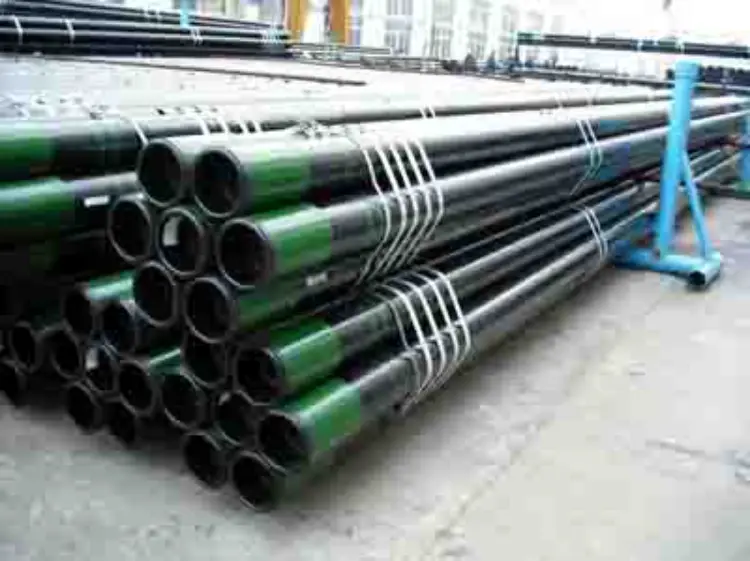
EN 10216-2 P265GH Seamless Steel Material Tubes for Pressure Purposes
EN 10216-2 P265GH Seamless Steel Tubes for Pressure Purposes: Chemical Composition, Mechanical & Thermal Properties
Comprehensive technical data for P265GH seamless steel tubes per EN 10216-2, including chemical composition, mechanical properties, thermal and electrical characteristics, international equivalents, and application guidance for pressure equipment.
Hot Finished, Cold Finished with subsequent normalizing, Welding (for fabrication, not tube manufacture)
- Phone : +8618037372205
- Email : [email protected]
- WhatsApp: Contact via Whtsapp
- WeChat: +8618037372205
EN 10216-2 P265GH Seamless Steel Tubes for Pressure Purposes Introduction
P265GH is a non-alloy quality steel grade specified in EN 10216-2 for seamless steel tubes used in pressure applications. It is characterized by good weldability, ductility, and reliable mechanical strength at both ambient and elevated temperatures, making it suitable for the construction of boilers, pressure vessels, and piping systems. The designation 'P' stands for pressure, '265' indicates the minimum yield strength in MPa, 'G' denotes general properties, and 'H' confirms the standard for pressure purposes. The material is typically delivered in a normalized condition to ensure consistent microstructure and mechanical stability. It is widely used across the energy, petrochemical, and power generation industries, offering a balanced performance for a range of service conditions up to approximately 400°C.
EN 10216-2 P265GH Seamless Steel Tubes for Pressure Purposes Chemical Composition
The chemical composition of P265GH is strictly controlled to ensure weldability and mechanical properties. The limits are according to cast analysis as specified in EN 10216-2.
- Carbon (C) is limited to maintain weldability.
- Silicon (Si) acts as a deoxidizer.
- Manganese (Mn) contributes to strength and toughness.
- Phosphorus (P) and Sulfur (S) are strictly limited as impurities.
- Chromium (Cr), Nickel (Ni), Molybdenum (Mo), and Copper (Cu) are residual elements with limited maximum values.
| Element | Standard Value (wt.%) | Remarks |
|---|---|---|
| Carbon (C) | ≤ 0.20 | For product thickness ≤ 16 mm; ≤ 0.22 for thickness > 16 mm |
| Silicon (Si) | ≤ 0.40 | |
| Manganese (Mn) | 0.80 ~ 1.40 | |
| Phosphorus (P) | ≤ 0.025 | |
| Sulfur (S) | ≤ 0.020 | |
| Chromium (Cr) | ≤ 0.30 | Residual |
| Nickel (Ni) | ≤ 0.30 | Residual |
| Molybdenum (Mo) | ≤ 0.08 | Residual |
| Copper (Cu) | ≤ 0.30 | Residual |
| Vanadium (V) | ≤ 0.02 | Residual |
| Niobium (Nb) | ≤ 0.01 | Residual |
| Titanium (Ti) | ≤ 0.04 | Residual |
| Aluminium (Al total) | ≥ 0.020 | For fine grain practice; Al/N ≥ 2 when applicable |
| Nitrogen (N) | ≤ 0.012 | Typically limited for Al-killed steels |
EN 10216-2 P265GH Seamless Steel Tubes for Pressure Purposes Thermal and Electrical Physical Properties
These values are typical for non-alloy steel grades of this type and are provided for design guidance. They are not mandatory requirements in the product standard.
- Density is standard for carbon steels and used for weight calculations.
- Elastic moduli are critical for structural design and stress analysis.
- Thermal conductivity and expansion are essential for thermal stress calculations in pressure equipment.
| Property | Typical Value | Unit | Test Condition / Remarks |
|---|---|---|---|
| Density (ρ) | 7.85 | g/cm³ | At 20°C |
| Elastic Modulus (E) | 210 | GPa | At 20°C, typical for carbon steels |
| Shear Modulus (G) | 81 | GPa | At 20°C, calculated |
| Poisson's Ratio (ν) | 0.30 | — | At 20°C, typical |
| Thermal Expansion Coefficient (α) | 11.7 | 10⁻⁶/K | Mean value between 20°C and 100°C |
| Thermal Expansion Coefficient (α) | 12.5 | 10⁻⁶/K | Mean value between 20°C and 200°C |
| Thermal Expansion Coefficient (α) | 13.5 | 10⁻⁶/K | Mean value between 20°C and 400°C |
| Thermal Conductivity (λ) | 51 | W/(m·K) | At 20°C |
| Specific Heat Capacity (cp) | 460 | J/(kg·K) | At 20°C to 100°C |
| Electrical Resistivity (ρe) | 0.18 | Ω·mm²/m | At 20°C |
EN 10216-2 P265GH Seamless Steel Tubes for Pressure Purposes Mechanical Properties at Room Temperature
The mechanical properties are determined on test specimens taken from the tubes. The values are dependent on wall thickness.
- Yield Strength (ReH) and Tensile Strength (Rm) are guaranteed for room temperature.
- Elongation (A) is measured longitudinally or transversely as per the standard.
- Minimum impact energy (KV) is verified at 0°C for sufficient toughness.
| Property | Standard Requirement | Unit | Test Condition / Thickness (t) Range |
|---|---|---|---|
| Yield Strength (ReH), min. | 265 | MPa | t ≤ 16 mm |
| Yield Strength (ReH), min. | 255 | MPa | 16 < t ≤ 40 mm |
| Yield Strength (ReH), min. | 245 | MPa | 40 < t ≤ 60 mm |
| Yield Strength (ReH), min. | 215 | MPa | 60 < t ≤ 100 mm |
| Tensile Strength (Rm) | 410 ~ 570 | MPa | t ≤ 60 mm |
| Tensile Strength (Rm) | 410 ~ 550 | MPa | 60 < t ≤ 100 mm |
| Elongation (A), min. | 21 (Longitudinal) / 19 (Transverse) | % | t ≤ 60 mm |
| Impact Energy (KV2), min. | 27 (Longitudinal) / 22 (Transverse) | J | Test temperature: 0°C |
| Bend Test (Mandrel Diameter) | No cracks | — | 180° bend, mandrel diameter = 3 x thickness (for up to 25 mm thickness) |
EN 10216-2 P265GH Seamless Steel Tubes for Pressure Purposes Completely Equivalent Material Standards and Replaceable Grade Designations
| Country/Region | Standard | Grade | Remarks |
|---|---|---|---|
| European Union | EN 10216-2 | P265GH | Original specification |
| International (ISO) | ISO 9329-2 | PH26 | Technically equivalent seamless tube grade for pressure purposes |
| Germany | DIN 17175 | St 45.8 | Withdrawn standard, but historically equivalent and often considered interchangeable with P265GH |
| United Kingdom | BS 3059-2 | 440 | Comparable grade in withdrawn standard, offered equivalent mechanical properties |
| France | NF A49-213 | TU 42-c | Historically equivalent seamless tube grade for pressure service |
EN 10216-2 P265GH Seamless Steel Tubes for Pressure Purposes Application Introduction
P265GH seamless steel tubes are engineered for demanding pressure environments. Their reliable mechanical properties, good weldability, and proven performance under thermal cycling make them a primary choice in the energy and process industries. They are typically used in the construction of steam boilers, pressure vessels, and piping systems where safety and durability are critical.
- Ideal for service temperatures up to approximately 400°C.
- Commonly used across thermal power stations, petrochemical refineries, and chemical plants.
- Suitable for both on-site welding and shop fabrication of complex pressure components.
Product Applications: Steam boilers and superheaters, High-pressure steam pipelines, Heat exchangers and preheaters, Pressure vessel shells and drums, Reformer tubes and header boxes, Industrial piping systems for high-temperature fluids
Processed into products: Boiler water wall panels, Superheater and reheater tube bundles, Steam manifold headers, Process piping bends and elbows, Flanged pipe sections and connectors, Tube sheets for heat exchangers, Reactor coil tubes
Application industries: Power Generation (Fossil fuel, Nuclear, Concentrated Solar Power), Oil & Gas (Refineries, Petrochemical plants, Gas processing), Chemical Industry (Reactors, Process piping), Heating and Boiler Manufacturing, Pharmaceutical and Food Processing (Steam supply systems)
EN 10216-2 P265GH Seamless Steel Tubes for Pressure Purposes Recommendation for Similar/Comparable Alternative Materials
| Country/Region | Standard | Grade | Remarks |
|---|---|---|---|
| USA | ASTM A106 | Grade B | Widely used seamless carbon steel pipe for high-temperature service. Slightly different Mn range and no guaranteed Al content. Requires careful comparison for pressure design. |
| USA | ASTM A53 | Grade B | Seamless and welded pipe for pressure/structural use. Similar strength but less stringent on some residual elements. Not always a direct substitute for high-temperature strength design. |
| China | GB/T 5310 | 20G | Seamless steel tubes for high-pressure boilers. Equivalent strength and carbon content, but specific Mn and Si ranges differ. Widely used in Asian markets for similar applications. |
| Japan | JIS G3456 | STPT410 | Carbon steel tubes for high-temperature service. Designed for similar working temperature and pressure ranges, with comparable tensile and yield strengths. |
| India | IS 1239-2 | YSt 240 / Medium | Generally lower strength pipe, not a direct substitute. Only mentionable for non-critical, low-pressure, ambient-temperature services after thorough engineering review. |
Notes:
Important Considerations for Use:
- Welding: P265GH has excellent weldability with all conventional welding processes. Preheating is generally not required for thin-walled tubes but may be recommended for thicker sections (>30mm) to avoid hydrogen cracking. Post-weld heat treatment (PWHT) should be applied according to the relevant pressure vessel code (e.g., EN 13445).
- Inspection and Testing: Tubes are subject to specific inspection and testing as defined by EN 10216-2, including tensile testing at room temperature, impact testing, bend testing, a leak tightness test (hydrostatic or non-destructive), and dimensional inspection. Non-destructive testing (NDT) for longitudinal and transverse defects is mandatory.
- Elevated Temperature Properties: The 0.2% proof strength values at elevated temperatures are not specified in the room temperature mechanical table. For design purposes, refer to the values prescribed in the relevant design code (e.g., EN 13445-2), which provides de-rated strength values up to 400°C to ensure safe creep performance.
- Share



