
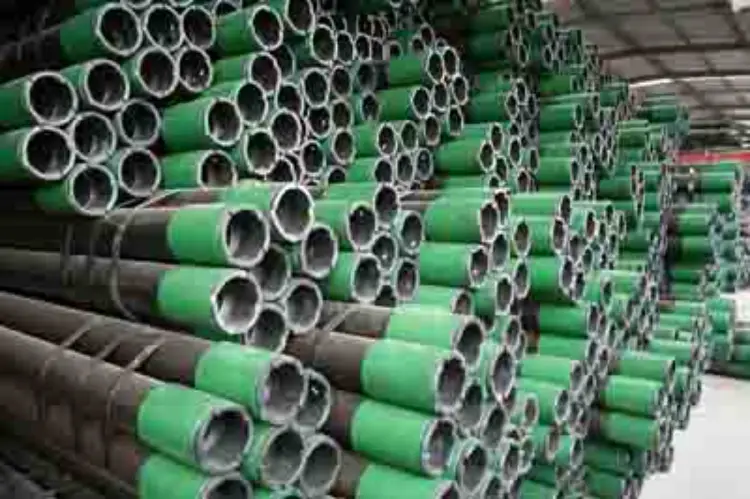
EN10216-2 16Mo3 Seamless Steel Tubes Material for Pressure Purposes
EN10216-2 16Mo3 Seamless Steel Tubes for Pressure Purposes: Full Material Data & Equivalents
Comprehensive material data for 16Mo3 seamless steel tubes to EN 10216-2, with chemical composition, mechanical and thermal properties, international equivalents, and application guidelines for pressure parts at elevated temperatures.
Hot rolling, cold drawing, heat treatment (normalizing, normalizing + tempering, quenching + tempering)
- Phone : +8618037372205
- Email : [email protected]
- WhatsApp: Contact via Whtsapp
- WeChat: +8618037372205
EN10216-2 16Mo3 Seamless Steel Tubes for Pressure Purposes Introduction
16Mo3 is a low-alloy molybdenum steel grade specified in EN 10216-2 for seamless tubes used in pressure applications. With a molybdenum content of 0.25–0.35%, it exhibits improved high-temperature strength and creep resistance up to approximately 500 °C compared to plain carbon steels. This grade is widely employed in boiler, superheater, heat exchanger, and pressure vessel construction. 16Mo3 is supplied in the normalized, normalized and tempered, or quenched and tempered condition, and is known for good weldability, toughness, and consistency of mechanical properties. It corresponds to material number 1.5415 and has a long history of use in European power generation and process plants.
EN10216-2 16Mo3 Seamless Steel Tubes for Pressure Purposes Chemical Composition
The chemical composition according to EN 10216-2:2013 for grade 16Mo3. Values refer to the ladle analysis. Product analysis deviations are allowed within the limits specified in the standard. Total aluminum content may be required for applications involving hydrogen service.
| Element | Content (%) | Notes |
|---|---|---|
| C | 0.12 – 0.20 | |
| Si | ≤ 0.35 | |
| Mn | 0.40 – 0.90 | |
| P | ≤ 0.025 | |
| S | ≤ 0.010 | |
| Cr | ≤ 0.30 | |
| Mo | 0.25 – 0.35 | |
| Ni | ≤ 0.30 | |
| Cu | ≤ 0.30 | |
| N | ≤ 0.012 | When Al is added, N binding may be required |
| Altot | ≥ 0.020 | If specified for hydrogen service |
EN10216-2 16Mo3 Seamless Steel Tubes for Pressure Purposes Thermal and Electrical Physical Properties
Physical properties for 16Mo3 steel at room temperature and elevated temperatures. These values are typical for the grade and are based on published datasheets for similar low-alloy molybdenum steels. They can be used for design calculations.
| Property | Typical Value | Unit | Test Condition |
|---|---|---|---|
| Density (ρ) | 7.85 | g/cm³ | 20 °C |
| Modulus of Elasticity (E) | 210 | GPa | 20 °C |
| Modulus of Elasticity (E) | 200 | GPa | 200 °C |
| Modulus of Elasticity (E) | 190 | GPa | 400 °C |
| Shear Modulus (G) | 81 | GPa | 20 °C |
| Poisson's Ratio (ν) | 0.3 | ||
| Thermal Expansion (α) | 11.1 | 10⁻⁶/K | 20 – 100 °C |
| Thermal Expansion (α) | 12.1 | 10⁻⁶/K | 20 – 200 °C |
| Thermal Expansion (α) | 12.9 | 10⁻⁶/K | 20 – 300 °C |
| Thermal Expansion (α) | 13.5 | 10⁻⁶/K | 20 – 400 °C |
| Thermal Expansion (α) | 13.9 | 10⁻⁶/K | 20 – 500 °C |
| Thermal Conductivity (λ) | 44 | W/(m·K) | 20 °C |
| Thermal Conductivity (λ) | 44 | W/(m·K) | 100 °C |
| Thermal Conductivity (λ) | 42 | W/(m·K) | 200 °C |
| Thermal Conductivity (λ) | 39 | W/(m·K) | 300 °C |
| Thermal Conductivity (λ) | 36 | W/(m·K) | 400 °C |
| Thermal Conductivity (λ) | 33 | W/(m·K) | 500 °C |
| Specific Heat Capacity (cp) | 460 | J/(kg·K) | 20 °C |
| Electrical Resistivity (ρe) | 0.20 | µΩ·m | 20 °C |
EN10216-2 16Mo3 Seamless Steel Tubes for Pressure Purposes Mechanical Properties at Room Temperature
Mechanical properties in accordance with EN 10216-2 for 16Mo3 seamless tubes in the normalized (+N), normalized and tempered (+NT), or quenched and tempered (+QT) condition. Depending on wall thickness and heat treatment, different minimum values apply. Impact tests are performed on longitudinal and transverse Charpy‑V specimens.
| Property | Specified Value | Unit | Test Condition |
|---|---|---|---|
| Yield Strength (ReH) | ≥ 280 | MPa | Wall thickness ≤ 16 mm (+N or +NT) |
| Yield Strength (ReH) | ≥ 270 | MPa | 16 mm < wall thickness ≤ 40 mm (+N or +NT) |
| Yield Strength (ReH) | ≥ 260 | MPa | 40 mm < wall thickness ≤ 60 mm (+N or +NT) |
| Yield Strength (ReH) | ≥ 300 | MPa | Wall thickness ≤ 16 mm (+QT) |
| Yield Strength (ReH) | ≥ 290 | MPa | 16 mm < wall thickness ≤ 40 mm (+QT) |
| Yield Strength (ReH) | ≥ 280 | MPa | 40 mm < wall thickness ≤ 60 mm (+QT) |
| Tensile Strength (Rm) | 450 – 600 | MPa | Wall thickness ≤ 60 mm (all conditions) |
| Elongation (A) | ≥ 22 (longitudinal) / ≥ 20 (transverse) | % | Gauge length 5.65√S0 |
| Charpy Impact (KV2) | ≥ 40 (longitudinal) | J | +20 °C, +N or +NT |
| Charpy Impact (KV2) | ≥ 27 (transverse) | J | +20 °C, +N or +NT |
| Charpy Impact (KV2) | ≥ 40 (longitudinal) / ≥ 27 (transverse) | J | +20 °C, +QT |
| Bend Test | Mandrel diameter ≥ 3 t | t = wall thickness, 180° bend |
EN10216-2 16Mo3 Seamless Steel Tubes for Pressure Purposes Completely Equivalent Material Standards and Alternative Grades
| Country/Region | Standard | Grade | Remarks |
|---|---|---|---|
| Europe | EN 10216-2 | 16Mo3 | Current standard; material number 1.5415 |
| International | ISO 9329-2:1997 | TS34 | Same chemical requirements |
| Germany | DIN 17175 | 15Mo3 | Superseded by EN 10216-2 16Mo3 |
| China | GB/T 5310 | 15MoG | Chemically equivalent seamless tube grade |
EN10216-2 16Mo3 Seamless Steel Tubes for Pressure Purposes Application Introduction
16Mo3 seamless tubes are primarily designed for pressure equipment operating at elevated temperatures up to about 500 °C. Their good workability and weldability make them a cost-effective choice over plain carbon steels when moderate creep resistance is required.
Product Applications: Water-tube boilers, Superheater and reheater tube banks, Shell-and-tube heat exchangers, Steam pipelines and headers, Pressure vessel nozzles and shells (tube components), Chemical reactor tubing
Processed into products: Boiler tubes, Superheater tubes, Economizer tubes, Heat exchanger tubes, Steam piping elbows and reducers (fabricated from tube), Flame tube for furnaces, Evaporator sections, Baffles and tube supports in heat exchangers
Application industries: Power generation (conventional thermal plants), Petrochemical and chemical processing, Oil and gas (downstream and refinery equipment), Industrial boiler manufacturing, Heat recovery steam generators (HRSG)
EN10216-2 16Mo3 Seamless Steel Tubes for Pressure Purposes Similar or Near-Equivalent Alternative Materials
| Country/Region | Standard | Grade | Remarks |
|---|---|---|---|
| USA | ASTM A335 | P1 | Higher Mo (0.44–0.65%); similar service temperature |
| USA | ASTM A209 | T1 | Boiler tube grade with Mo 0.44–0.65% |
| China | GB/T 5310 | 12CrMoG | Cr 0.40–0.70%, Mo 0.40–0.55%; somewhat higher creep strength |
Notes:
Welding: 16Mo3 is readily weldable using all common arc processes. Preheating is generally not required for thin walls, but may be applied for thicker sections (>10 mm) to avoid hydrogen cracking. Post-weld heat treatment (stress relieving) is often performed at 620–680 °C. Hydrogen service: When specified for hydrogen-containing atmosphere, a minimum total aluminium content (Altot ≥ 0.020%) may be required to ensure adequate resistance. Inspection & testing: According to EN 10216-2, tubes are subjected to ultrasonic or eddy current non-destructive testing, and may require specific pressure tests as ordered.
- Share



