
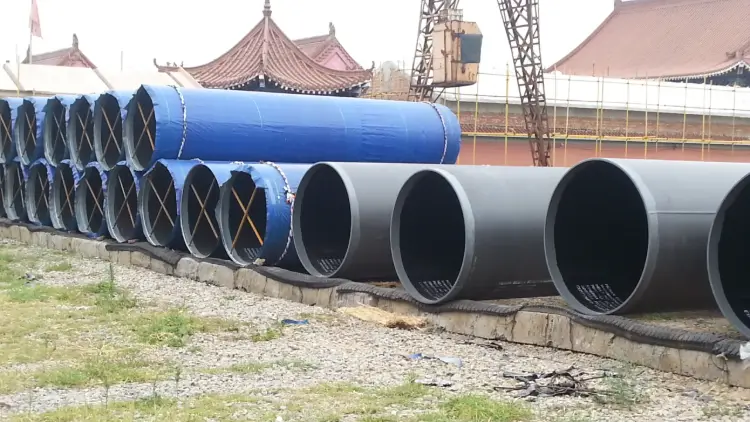
EN 10216-1 P235TR1 Seamless Steel Tube Material for Pressure Purposes
EN 10216-1 P235TR1 Seamless Steel Tube for Pressure Purposes - Superior Weldability & Reliable Strength
Comprehensive technical profile of P235TR1 seamless steel tube according to EN 10216-1, covering chemical composition, mechanical properties, physical data, international equivalents, and application guidance for pressure equipment.
Cold drawing, hot rolling, normalizing, bending, welding (with appropriate consumables)
- Phone : +8618037372205
- Email : [email protected]
- WhatsApp: Contact via Whtsapp
- WeChat: +8618037372205
EN 10216-1 P235TR1 Seamless Steel Tube for Pressure Purposes Introduction
P235TR1 is a non-alloy quality steel grade specified in EN 10216-1 for seamless tubes intended for pressure purposes at room and elevated temperatures. With a minimum yield strength of 235 MPa in the as-delivered condition (for wall thickness ≤ 16 mm), it offers an excellent balance of strength, ductility, and weldability. The 'TR1' designation indicates specific requirements for aluminum content and fine-grain practice, ensuring good toughness and resistance to brittle fracture. This grade is widely used in boilers, heat exchangers, and process piping systems where reliable performance under moderate pressure and temperature is essential. Its low carbon content and controlled impurity levels promote easy forming and joining without the need for pre- or post-weld heat treatment in many standard applications.
EN 10216-1 P235TR1 Seamless Steel Tube for Pressure Purposes Chemical Composition
The chemical composition conforms to the ladle analysis limits of EN 10216-1 for grade P235TR1. The steel is fully killed with a minimum total aluminum content to ensure fine grain structure and improved toughness. Residual elements are strictly controlled to avoid detrimental effects on weldability and service performance.
| Element | Standard Value (%) | Remarks |
|---|---|---|
| Carbon (C) | ≤ 0.16 | |
| Silicon (Si) | ≤ 0.35 | |
| Manganese (Mn) | ≤ 1.20 | For each reduction of 0.01% C below 0.16%, an increase of Mn by 0.04% above 1.20% is permitted, up to max. 1.60% |
| Phosphorus (P) | ≤ 0.025 | |
| Sulfur (S) | ≤ 0.020 | |
| Chromium (Cr) | ≤ 0.30 | Optional; may be agreed upon |
| Molybdenum (Mo) | ≤ 0.08 | Optional; may be agreed upon |
| Nickel (Ni) | ≤ 0.30 | Optional; may be agreed upon |
| Aluminium (Al total) | ≥ 0.020 | Required for fine-grain practice; Al/N ratio ≥ 2 if N ≥ 0.012% |
| Copper (Cu) | ≤ 0.30 | Optional; may be agreed upon |
| Niobium (Nb) | ≤ 0.010 | Not normally added |
| Titanium (Ti) | ≤ 0.040 | If used for deoxidation; Ti content to be reported |
| Vanadium (V) | ≤ 0.02 | Not normally added |
| Nitrogen (N) | ≤ 0.012 | Typically not reported unless specified |
| Other elements (total) | Negligible | Not specified; any deliberate additions require agreement |
EN 10216-1 P235TR1 Seamless Steel Tube for Pressure Purposes Thermal and Electrical Physical Properties
The physical properties are based on typical data for non-alloy carbon steel with a similar composition in the normalized condition. These values are provided for design calculations and are approximate; actual values may vary slightly with temperature and production route. All data are valid at 20°C unless a temperature range is given.
| Property | Typical Value | Unit | Test Condition / Remarks |
|---|---|---|---|
| Density (ρ) | 7.85 | kg/dm³ | At 20 °C |
| Elastic Modulus (E) | 210 | GPa | At 20 °C; decreases ~0.04%/°C with temperature |
| Shear Modulus (G) | 81 | GPa | At 20 °C |
| Poisson's Ratio (ν) | 0.30 | — | At 20 °C |
| Thermal Expansion Coefficient (α), 20–100 °C | 12.5 × 10⁻⁶ | K⁻¹ | Mean linear coefficient |
| Thermal Expansion Coefficient (α), 20–200 °C | 13.0 × 10⁻⁶ | K⁻¹ | |
| Thermal Expansion Coefficient (α), 20–300 °C | 13.5 × 10⁻⁶ | K⁻¹ | |
| Thermal Conductivity (λ) | 50 | W/(m·K) | At 20 °C; decreases with temperature (~40 at 300 °C) |
| Specific Heat Capacity (cp) | 460 | J/(kg·K) | At 20 °C; increases to ~530 at 300 °C |
| Electrical Resistivity (ρe) | 0.20 – 0.25 | Ω·mm²/m | At 20 °C |
| Melting Temperature | ≈ 1470 – 1520 | °C | Approximate range for low-carbon steel |
EN 10216-1 P235TR1 Seamless Steel Tube for Pressure Purposes Mechanical Properties
Mechanical properties are guaranteed for the as-delivered condition according to EN 10216-1. The values apply to wall thickness ≤ 16 mm unless otherwise stated. Tensile testing is performed in the longitudinal direction; transverse values may differ slightly. The grade exhibits good ductility and is resistant to brittle fracture; minimum impact energy values at 0°C are specified to ensure toughness.
| Property | Required Value | Unit | Test Condition / Remarks |
|---|---|---|---|
| Yield Strength (ReH) – t ≤ 16 mm | ≥ 235 | MPa | Room temperature |
| Yield Strength (ReH) – 16 < t ≤ 40 mm | ≥ 225 | MPa | Room temperature |
| Yield Strength (ReH) – 40 < t ≤ 60 mm | ≥ 215 | MPa | Room temperature |
| Tensile Strength (Rm) – all thicknesses | 360 – 500 | MPa | Room temperature |
| Elongation (A) – longitudinal | ≥ 25 | % | Proportional test piece, L₀ = 5.65√S₀ |
| Elongation (A) – transverse (if applicable) | ≥ 23 | % | Proportional test piece |
| Impact Energy (KV) at 0 °C – longitudinal | ≥ 27 | J | Charpy V-notch; average of three tests, one individual min. 70% |
| Impact Energy (KV) at 0 °C – transverse (if agreed) | ≥ 20 | J | Average; one individual min. 14 J |
| Bend Test – 180° (Mandrel Diameter) | 3 × t | — | t = wall thickness; no cracks allowed; elongation ≥ 22% |
| Bend Test – 180° (Mandrel Diameter) – if elongation ≥ 27% | 2 × t | — | Alternative condition when ductility is higher |
EN 10216-1 P235TR1 Seamless Steel Tube for Pressure Purposes Exact Equivalent Material Standards & Replaceable Grade Designations
| Country / Region | Standard | Grade | Remarks |
|---|---|---|---|
| International (ISO) | ISO 9329-1:1989 | PH 235 | Technically equivalent; for pressure purposes, same base composition |
| Germany | DIN 17175 (withdrawn) | St 35.8 | Historically identical; widely used as a substitute designation |
| European Norm | EN 10216-1:2013 | P235TR1 | Original standard; also available as P235TR2 with different Al/toughness requirements |
| France | NF A49-213 (withdrawn) | TU 37-b | Former national standard; now replaced by EN 10216-1 |
EN 10216-1 P235TR1 Seamless Steel Tube for Pressure Purposes Application Introduction
P235TR1 seamless tubes are designed for pressure-containing components operating at moderate temperatures (typically up to 400 °C in oxidizing atmospheres and higher under controlled conditions). Their excellent weldability, uniform mechanical properties, and fine-grain structure make them a preferred choice in the energy and process industries. Below is a summary of typical application areas, products, and components.
Product Applications: Boiler tubes and superheater tubes, Heat exchanger tubes (straight and U-bend), Economizer and evaporator tube bundles, Main steam piping and headers, Process piping for moderate pressure fluids, Hydraulic and pneumatic lines
Processed into products: Tube panels for furnace walls, Coiled tubing for heat recovery steam generators, Nozzle stubs and stub-end connections, Expansion loops and bends in piping systems, Welded fabrications (with matching weld consumables), Tube sheets after hot/cold forming
Application industries: Power Generation (conventional and cogeneration plants), Oil & Gas (refineries, petrochemical plants, gas transmission), Chemical & Process Industry (reactors, heat exchangers, piping), Industrial Boiler Manufacturing, Shipbuilding (steam and water piping), District Heating Systems
EN 10216-1 P235TR1 Seamless Steel Tube for Pressure Purposes Similar / Closely Matching Substitute Materials
| Country / Region | Standard | Grade | Remarks |
|---|---|---|---|
| USA | ASTM A106 / ASME SA-106 | Grade A | Commonly used seamless carbon steel pipe for high-temperature service; min. YS 205 MPa, Rm 330 MPa min. – slightly lower strength but often interchangeable for non-critical applications |
| China | GB/T 5310 | 20G | Seamless steel tubes for high-pressure boiler; similar composition with slightly higher C and Mn limits; YS ≥ 245 MPa |
| Japan | JIS G3456 | STPT 370 | Carbon steel pipes for high-temperature service; YS ≥ 215 MPa, Rm ≥ 370 MPa; comparable chemistry; often used in heat exchangers |
| European Norm | EN 10217-2 | P235GH | Welded pressure vessel steel with similar base chemistry; for comparison only as it is a plate/coil product |
| European Norm | EN 10028-2 | P235GH | Non-alloy steel for pressure vessels (plate); composition nearly identical to P235TR1, but in flat product form |
Notes:
Additional Remarks:
- For service above 400 °C, the creep properties must be considered; P235TR1 is not typically designed for creep-controlled applications, but the yield strength reduction factors in EN 10216-1 can be used for short-term elevated temperature design.
- Welding consumables should match the base material strength (e.g., E7018 / ER70S-6) with low hydrogen practices to avoid cold cracking.
- Post-weld heat treatment may be required for thick sections or when mandated by pressure vessel codes (e.g., EN 13445).
- Hardness testing is often required in the as-delivered condition; typical values are below 150 HBW.
- The material can be supplied with 3.1 or 3.2 certification according to EN 10204.
- Share



