
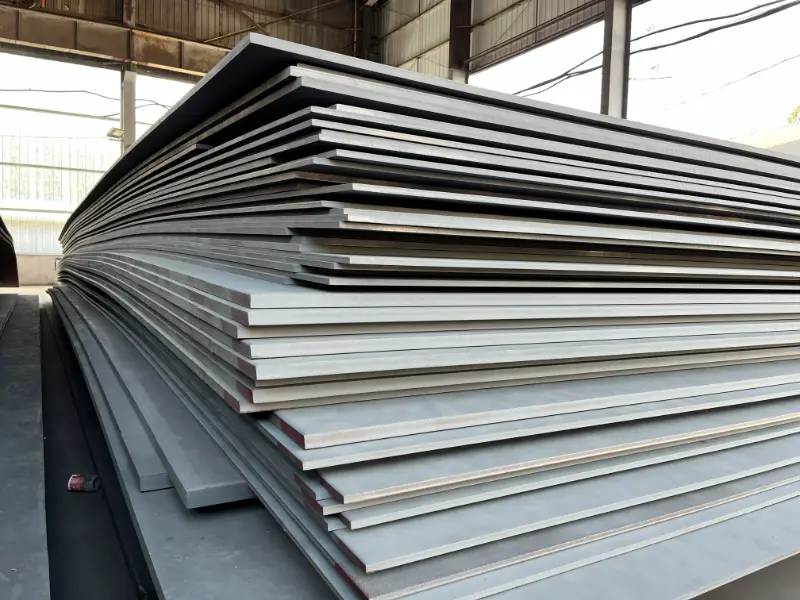
EN10216-2 10CrMo9-10 Material High-Temp Pressure Vessel Steel Tube Performance & Equivalents
EN10216-2 10CrMo9-10: High-Temp Pressure Vessel Steel Tube Performance & Equivalents
Comprehensive material data for EN10216-2 10CrMo9-10 seamless steel tubes: chemical composition, mechanical & thermal properties, international equivalents, and process recommendations.
Hot rolling, cold drawing, normalizing and tempering, welding.
- Phone : +8618037372205
- Email : [email protected]
- WhatsApp: Contact via Whtsapp
- WeChat: +8618037372205
EN10216-2 10CrMo9-10 Introduction
EN10216-2 10CrMo9-10 is a low-alloy chromium-molybdenum steel grade specifically designed for seamless tubes used in pressure applications at elevated temperatures. It belongs to the European standard EN 10216-2:2013 for non-alloy and alloy steel tubes with specified elevated temperature properties. This material offers a well-balanced combination of high-temperature strength, good creep resistance, and excellent weldability. Its microstructure is typically bainitic or ferritic-bainitic after appropriate heat treatment (normalizing and tempering). The alloying elements, primarily 2.0-2.5% Chromium and 0.9-1.1% Molybdenum, provide enhanced resistance to hydrogen attack and oxidation in steam and high-temperature hydrocarbon environments, making it a workhorse material for power generation and petrochemical industries.
EN10216-2 10CrMo9-10 Chemical Composition
The chemical composition of steel grade 10CrMo9-10 is strictly defined to achieve the required high-temperature strength and creep resistance. Chromium (Cr) and Molybdenum (Mo) are key alloying elements for improved heat resistance. Phosphorus (P) and Sulfur (S) are strictly controlled to ensure material purity and toughness. Other elements like Silicon (Si) and Manganese (Mn) act as deoxidizers and contribute to strength.
| Element | Standard Value (wt%) | Remarks |
|---|---|---|
| Carbon (C) | 0.08 - 0.15 | Key hardenability element |
| Silicon (Si) | ≤ 0.50 | Deoxidizer |
| Manganese (Mn) | 0.40 - 0.80 | Controls sulfide morphology |
| Phosphorus (P) | ≤ 0.020 | Maximum limit for toughness |
| Sulfur (S) | ≤ 0.010 | Maximum limit for cleanliness |
| Chromium (Cr) | 2.00 - 2.50 | Primary element for oxidation/corrosion resistance |
| Molybdenum (Mo) | 0.90 - 1.10 | Primary element for creep resistance |
| Nitrogen (N) | ≤ 0.012 | Controlled for fine grain size |
| Aluminum (Altot) | ≤ 0.040 | Grain refiner (*) |
| Copper (Cu) | ≤ 0.30 | Residual element limit |
| Titanium (Ti) | ≤ 0.04 | Residual element limit |
EN10216-2 10CrMo9-10 Thermal & Electrical Properties
These physical properties are representative for 10CrMo9-10 grade steel in the normalized and tempered condition. The coefficient of thermal expansion (α) guides design for thermal cycling, while thermal conductivity (λ) is essential for heat exchanger efficiency. Data varies with temperature; values at multiple points are provided for comprehensive engineering analysis.
| Property | Standard Value | Unit | Test Condition / Remarks |
|---|---|---|---|
| Density (ρ) | 7.85 | g/cm³ | at 20 °C |
| Elastic Modulus (E) | 211 | GPa | at 20 °C |
| Elastic Modulus (E) | 206 | GPa | at 100 °C |
| Elastic Modulus (E) | 200 | GPa | at 200 °C |
| Elastic Modulus (E) | 194 | GPa | at 300 °C |
| Elastic Modulus (E) | 186 | GPa | at 400 °C |
| Elastic Modulus (E) | 178 | GPa | at 500 °C |
| Shear Modulus (G) | 82 | GPa | at 20 °C, calculated from E and ν |
| Poisson's Ratio (ν) | 0.29 | - | at 20 °C |
| Thermal Expansion Coef. (α) | 10.8 x 10⁻⁶ | K⁻¹ | 20 °C to 100 °C range |
| Thermal Expansion Coef. (α) | 11.5 x 10⁻⁶ | K⁻¹ | 20 °C to 200 °C range |
| Thermal Expansion Coef. (α) | 12.1 x 10⁻⁶ | K⁻¹ | 20 °C to 300 °C range |
| Thermal Expansion Coef. (α) | 12.7 x 10⁻⁶ | K⁻¹ | 20 °C to 400 °C range |
| Thermal Expansion Coef. (α) | 13.2 x 10⁻⁶ | K⁻¹ | 20 °C to 500 °C range |
| Thermal Expansion Coef. (α) | 13.6 x 10⁻⁶ | K⁻¹ | 20 °C to 600 °C range |
| Thermal Conductivity (λ) | 38.0 | W/(m·K) | at 20 °C |
| Thermal Conductivity (λ) | 39.5 | W/(m·K) | at 100 °C |
| Thermal Conductivity (λ) | 39.0 | W/(m·K) | at 200 °C |
| Thermal Conductivity (λ) | 38.0 | W/(m·K) | at 300 °C |
| Thermal Conductivity (λ) | 36.0 | W/(m·K) | at 400 °C |
| Thermal Conductivity (λ) | 34.0 | W/(m·K) | at 500 °C |
| Specific Heat Capacity | 460 | J/(kg·K) | at 20 °C to 100 °C |
| Electrical Resistivity (ρe) | 0.25 x 10⁻⁶ | Ω·m | at 20 °C |
EN10216-2 10CrMo9-10 Mechanical Properties
The mechanical properties are specified for tubes in the normalized and tempered (+NT) delivery condition. Yield strength (ReH) and tensile strength (Rm) vary inversely with wall thickness. The minimum elongation (A) ensures sufficient ductility for forming and operational safety. Impact toughness (KV) is critical for pressure equipment and is verified by Charpy V-notch testing.
| Property | Standard Requirement | Unit | Condition / Remarks |
|---|---|---|---|
| Yield Strength (ReH) | ≥ 280 (t ≤ 16 mm) | MPa | Transverse test pieces, +NT temperature |
| Yield Strength (ReH) | ≥ 280 (16 < t ≤ 40 mm) | MPa | Transverse test pieces, +NT temperature |
| Yield Strength (ReH) | ≥ 280 (40 < t ≤ 60 mm) | MPa | Transverse test pieces, +NT temperature |
| Tensile Strength (Rm) | 480 - 630 (t ≤ 16 mm) | MPa | Transverse test pieces, +NT temperature |
| Tensile Strength (Rm) | 480 - 630 (16 < t ≤ 40 mm) | MPa | Transverse test pieces, +NT temperature |
| Tensile Strength (Rm) | 480 - 630 (40 < t ≤ 60 mm) | MPa | Transverse test pieces, +NT temperature |
| Elongation (A) | ≥ 22 (longitudinal) / ≥ 20 (transverse) | % | Gauge length 5.65√S₀ |
| Impact Energy (KV) | ≥ 40 (longitudinal, at +20 °C) | J | Minimum average of 3 specimens |
| Impact Energy (KV) | ≥ 27 (transverse, at +20 °C) | J | Minimum average of 3 specimens |
| Hardness | ≤ 170 HB / ≤ 180 HV | - | For information only, not a test requirement |
EN10216-2 10CrMo9-10 Direct Equivalent & Replacement Materials
| Country/Region | Standard | Grade/Designation | Remarks |
|---|---|---|---|
| International | ISO 9329-2 | 10CrMo9-10 | Internationally harmonized standard grade |
| USA | ASTM A213/A213M | T22 | Seamless Ferritic and Austenitic Alloy-Steel Boiler Tubes |
| USA | ASTM A335/A335M | P22 | Seamless Ferritic Alloy-Steel Pipe for High-Temperature Service |
| China | GB/T 5310 | 12Cr2MoG | Seamless steel tubes and pipes for high pressure boiler |
| Japan | JIS G3458 | STPA 24 | Alloy steel pipes for high temperature service |
| Germany (withdrawn) | DIN 17175 | 10CrMo910 | Historic predecessor standard, technically equivalent |
EN10216-2 10CrMo9-10 Application Introduction
EN10216-2 10CrMo9-10 is the premier choice for high-temperature, high-pressure steam and hydrogen services. Its excellent creep strength up to approximately 600°C makes it indispensable in modern power plants and refineries. The material's good weldability and formability facilitate its use in complex engineering structures, provided appropriate post-weld heat treatment (PWHT) is applied.
Product Applications: Superheater and reheater tube bundles, Boiler tubes and headers, Heat exchanger tubes, High-pressure steam piping, Hydrogen transfer piping, Cracking furnace tubes
Processed into products: Boiler drums and tube plates, U-tube bundles for heat exchangers, High-temperature flanges and fittings, Welded pipelines with matching filler metal, Forged manifolds and outlets
Application industries: Conventional and nuclear thermal power generation, Petrochemical and chemical processing, Oil refining (hydrocracking, reforming units), Industrial gas production (steam reformers), Pressure vessel and boiler manufacturing
EN10216-2 10CrMo9-10 Near-Match & Similar Performance Alternatives
| Country/Region | Standard | Grade/Designation | Remarks |
|---|---|---|---|
| EU | EN 10216-2 | 13CrMo4-5 (1.7335) | Lower Cr (0.70-1.15%) and Mo (0.40-0.60%) content, resulting in somewhat lower high-temperature strength and creep resistance compared to 10CrMo9-10. Suitable for lower temperature/pressure applications. |
| EU | EN 10216-2 | X11CrMo5 (1.7362) | Higher Cr (4.0-6.0%) and Mo (0.45-0.65%) content, offering superior corrosion resistance in hot hydrogen services but lower toughness. Often used in petrochemical refinery services. |
| USA | ASTM A213 | T11 | Contains 1.00-1.50% Cr and 0.44-0.65% Mo. It is a popular low-alloy steel for boilers and heat exchangers but with lower oxidation resistance than P22/T22. |
| USA | ASTM A213 | T5 | Contains 4.00-6.00% Cr and 0.45-0.65% Mo. Provides better corrosion resistance at higher temperatures but is less readily available and more expensive than T22. |
Notes:
Welding must be performed using matching filler metals (e.g., AWS A5.28 ER90S-B3 or E9018-B3 electrodes) followed by a post-weld heat treatment (PWHT) typically at 680-750°C to restore ductility and reduce residual stresses. The material is susceptible to temper embrittlement during prolonged service in the 370-575°C range if impurity elements (P, Sn, Sb, As) are not adequately controlled. Hydrogen attack resistance is guaranteed by the Nelson curves, and the 2.25Cr-1Mo grade is rated for hot hydrogen service up to specific temperature and partial pressure limits. For detailed information on ordering and testing, refer to the full EN 10216-2:2013 standard and associated delivery condition specifications.
- Share



