
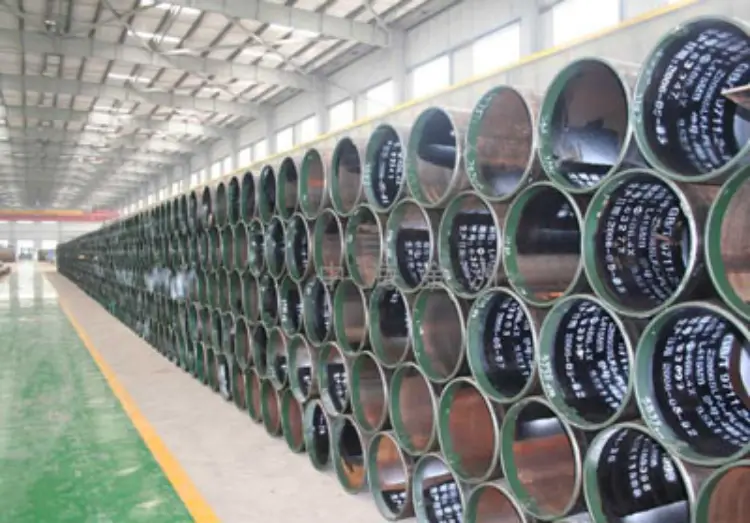
ASME SA213 T5 Seamless Boiler Tube Material
ASME SA213 T5 Seamless Alloy Boiler Tubes – 5Cr-0.5Mo Steel Properties & Equivalent Grades
Complete material data for ASME SA213 T5 alloy steel seamless boiler tubes: chemical composition limits, mechanical properties, thermal and electrical physical properties, international equivalent standards, and detailed application guidance.
Hot rolling, cold drawing, normalizing and tempering, welding (with precautions), bending
- Phone : +8618037372205
- Email : [email protected]
- WhatsApp: Contact via Whtsapp
- WeChat: +8618037372205
ASME SA213 T5 Seamless Boiler Tube Introduction
ASME SA213 T5 is a seamless ferritic alloy steel tube grade widely used in high-temperature service. With a nominal composition of 5% chromium and 0.5% molybdenum, it offers improved creep strength, oxidation resistance, and hydrogen attack resistance compared to carbon steels. The alloy is designed for boiler, superheater, and heat exchanger applications under the ASME Boiler and Pressure Vessel Code. Key features include:
- Good high-temperature mechanical properties up to approximately 600°C
- Resistance to graphitization and scaling in steam environments
- Excellent weldability when proper procedures are followed
- Supplied in normalized and tempered condition to optimize microstructure and toughness
T5 tubes are produced by hot finishing or cold drawing, ensuring dimensional accuracy and surface quality. This grade is equivalent to ASTM A213 T5, ASTM A335 P5 (pipe), and several international designations, making it globally available for power generation and petrochemical industries.
ASME SA213 T5 Seamless Boiler Tube Chemical Composition
The chemical composition of T5 is tightly controlled to ensure the required high-temperature properties. Chromium (4.00-6.00%) provides oxidation resistance, while molybdenum (0.45-0.65%) enhances creep strength through solid solution strengthening and carbide stabilization. Low carbon content (≤0.15%) helps maintain weldability and ductility. Phosphorus and sulfur are restricted to minimize embrittlement. Residual elements like nickel and copper are not specified but typically remain low. The composition limits are identical to ASTM A213 T5 and EN X11CrMo5.
| Chemical Element | Standard Value (wt%) | Remarks |
|---|---|---|
| Carbon (C) | ≤ 0.15 | |
| Manganese (Mn) | 0.30 – 0.60 | |
| Phosphorus (P) | ≤ 0.025 | |
| Sulfur (S) | ≤ 0.025 | |
| Silicon (Si) | ≤ 0.50 | |
| Chromium (Cr) | 4.00 – 6.00 | Key element for oxidation resistance and strengthening |
| Molybdenum (Mo) | 0.45 – 0.65 | Enhances creep strength and temper resistance |
ASME SA213 T5 Seamless Boiler Tube Thermal and Electrical Physical Properties
The physical properties listed are typical values for 5Cr-0.5Mo alloy steel in the normalized and tempered condition. These data are not mandatory requirements of ASME SA213 but provide essential information for design and engineering calculations. Thermal expansion and thermal conductivity vary significantly with temperature, and multi-point values are provided. Density remains nearly constant at 7.80 g/cm³. The electrical resistivity is moderate, reflecting the alloy content. For precise design, consult the manufacturer or specific product specifications.
| Property | Typical Value | Unit | Test Condition / Temperature |
|---|---|---|---|
| Density (ρ) | 7.80 | g/cm³ | At 20°C |
| Modulus of Elasticity (E) | 210 | GPa | At 20°C |
| Poisson's Ratio (ν) | 0.29 – 0.30 | — | At 20°C |
| Mean Coefficient of Thermal Expansion (α) | 11.2 | 10-6/K | 20–100°C |
| Mean Coefficient of Thermal Expansion (α) | 11.9 | 10-6/K | 20–200°C |
| Mean Coefficient of Thermal Expansion (α) | 12.5 | 10-6/K | 20–300°C |
| Mean Coefficient of Thermal Expansion (α) | 13.0 | 10-6/K | 20–400°C |
| Mean Coefficient of Thermal Expansion (α) | 13.5 | 10-6/K | 20–500°C |
| Mean Coefficient of Thermal Expansion (α) | 13.9 | 10-6/K | 20–600°C |
| Thermal Conductivity (λ) | 36 | W/(m·K) | At 100°C |
| Thermal Conductivity (λ) | 37 | W/(m·K) | At 200°C |
| Thermal Conductivity (λ) | 36 | W/(m·K) | At 300°C |
| Thermal Conductivity (λ) | 34 | W/(m·K) | At 400°C |
| Thermal Conductivity (λ) | 31 | W/(m·K) | At 500°C |
| Thermal Conductivity (λ) | 28 | W/(m·K) | At 600°C |
| Specific Heat Capacity (cp) | 460 | J/(kg·K) | At 20°C (typical value for range 20–600°C) |
| Electrical Resistivity (ρe) | ~0.55 | μΩ·m | At 20°C |
ASME SA213 T5 Seamless Boiler Tube Mechanical Properties
Mechanical property requirements are verified by longitudinal tensile tests on finished tubes. The minimum tensile strength of 415 MPa (60 ksi) and yield strength of 205 MPa (30 ksi) ensure adequate load-bearing capacity at elevated temperatures. The 30% minimum elongation in 50 mm gauge length guarantees sufficient ductility for bending and flaring operations. Hardness values are not part of the standard but typically range between 130 and 170 HBW. These properties are obtained after final normalizing and tempering. All data comply with ASME SA213/SA213M.
| Property | Standard Requirement | Unit | Test Condition |
|---|---|---|---|
| Tensile Strength (Rm) | ≥ 415 | MPa | Room temperature, longitudinal specimen |
| Yield Strength (ReH or Rp0.2) | ≥ 205 | MPa | Room temperature, 0.2% offset method |
| Elongation (A) | ≥ 30 | % | Gauge length 50 mm (2 in.) |
ASME SA213 T5 Seamless Boiler Tube Completely Equivalent Material Standards & Substitutable Grades
| Country/Region | Standard | Grade/Designation | Remarks |
|---|---|---|---|
| USA | ASME SA213/SA213M | T5 | Seamless boiler and heat exchanger tubes; identical to current material |
| USA | ASTM A213/A213M | T5 | Same grade for general use |
| USA | ASTM A335/A335M | P5 | Seamless pipe version of the same 5Cr-0.5Mo alloy |
| EU | EN 10216-2 | X11CrMo5 (1.7362) | Seamless steel tubes for pressure purposes; chemical and mechanical requirements fully interchangeable |
| Germany | DIN 17175 | X11CrMo5 | Historical equivalent; covered by EN 10216-2 |
| China | GB/T 5310 | 12Cr5MoG | Seamless steel tubes for high-pressure boiler; slight C variation but functionally equivalent |
| Japan | JIS G3462 | STBA25 | Alloy steel boiler and heat exchanger tubes; equivalent to T5 |
ASME SA213 T5 Seamless Boiler Tube Application Introduction
ASME SA213 T5 seamless tubes are engineered for demanding high-temperature and corrosive environments. The 5Cr-0.5Mo alloy provides a reliable balance of mechanical strength, oxidation resistance, and fabricability. Typical service temperatures range from 400°C to 600°C, with occasional excursions up to 650°C. The material is most commonly applied in:
- Power generation boilers (waterwall, superheater, reheater, economizer tubes)
- Heat recovery steam generators (HRSG)
- Refinery furnace tubes and piping (crude, vacuum, coker units)
- Petrochemical process heaters
- High-temperature heat exchangers for chemical plants
The normalized and tempered condition ensures excellent ductility for tube expansion into tubesheets and moderate bending. T5 can be joined by most arc welding processes and is normally post-weld heat treated to avoid cracking.
Product Applications: Fossil fuel-fired boiler tubes, Superheater and reheater tube bundles, Heat recovery steam generator tubes, Shell-and-tube heat exchangers, High-pressure process piping spools, Furnace coils and convection sections
Processed into products: Waterwall panels and steam generating tubes, Superheater outlet pendants and headers, Reheater tubes in hot reheat circuits, Heat exchanger U-tubes and straight tubes, Furnace radiant section tubes, Economizer finned tubes, Low-temperature tube-to-tubesheet joints in heat exchangers
Application industries: Power Generation (conventional & nuclear), Oil & Gas Refining, Petrochemical Processing, Chemical Industry, Industrial Boilers and Cogeneration
ASME SA213 T5 Seamless Boiler Tube Similar / Alternative Materials
| Country/Region | Standard | Grade/Designation | Remarks |
|---|---|---|---|
| USA | ASME SA213 | T9 | 9Cr-1Mo steel; higher oxidation limit and better high-temperature strength but less resistance to chloride stress corrosion; can substitute T5 in more severe environments |
| USA | ASME SA213 | T11 | 1.25Cr-0.5Mo steel; lower alloy content than T5; used where less corrosion resistance is acceptable, more economical |
| USA | ASME SA213 | T22 | 2.25Cr-1Mo steel; slightly lower chromium but higher molybdenum; widely used in similar temperature ranges with good creep strength |
| USA | ASME SA213 | T91 | 9Cr-1Mo-V-Nb (modified); significantly higher creep strength, allowing thinner walls; requires post weld heat treatment; not a direct substitute without design review |
| EU | EN 10216-2 | 10CrMo9-10 (1.7380) | 2.25Cr-1Mo grade, similar application but lower Cr; may be used when T5 is unavailable, with attention to oxidation limits |
| Japan | JIS G3462 | STBA24 | 2.25Cr-1Mo, similar to T22; alternative for moderate service conditions |
Notes:
This data sheet is compiled from ASME SA213/SA213M, ASTM A213, and equivalent international standards. Physical property values are typical reference data and may vary slightly with heat treatment and product form. For critical design, verify values against the current edition of the relevant standard or obtain specific certified material test reports. T5 products are normally supplied in normalized and tempered condition, but other heat treatments (e.g., isothermal anneal) may be specified.
- Ultrasonic or eddy current testing is often required.
- Maximum service temperature in oxidation environments: approximately 600°C; for creep-limited design, allowable stresses diminish above 550°C.
- Supplementary requirements like impact testing and hardness limits can be agreed upon at ordering.
When replacing T5 with similar grades, a full engineering review of corrosion allowance and strength calculations is mandatory. All dimensional tolerances shall comply with ASME SA450/SA450M.
- Share



