
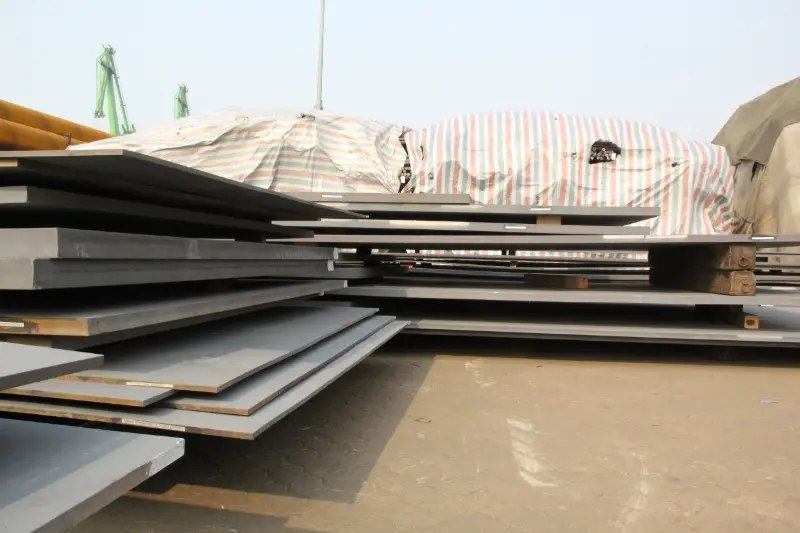
EN 10149-3 S315NC Hot Rolled Steel
S315NC Hot Rolled Steel - High Yield Strength for Cold Forming to EN 10149-3
Detailed material data for S315NC hot rolled steel coil according to BS EN 10149-3. Chemical composition, mechanical properties, thermal and electrical data, international equivalents, and application guidance.
Cold forming, bending, cutting, welding, punching, deep drawing (limited)
- Phone : +8618037372205
- Email : [email protected]
- WhatsApp: Contact via Whtsapp
- WeChat: +8618037372205
EN 10149-3 S315NC Hot Rolled Steel Introduction
S315NC is a high-strength, low-alloy (HSLA) hot rolled steel specifically designed for cold forming applications. It conforms to European standard BS EN 10149-3, which covers technical delivery conditions for flat products made of high yield strength steels for cold forming. The designation 'S' indicates structural steel, '315' refers to the minimum yield strength of 315 MPa for thicknesses ≤16 mm, and 'NC' signifies a steel type suitable for cold forming with a fine-grain, aluminium-killed or normalized structure. This grade offers an
- excellent combination of strength and formability,
- good weldability,
- and consistent mechanical properties
thanks to controlled rolling or normalizing. It is widely used in automotive, construction, and mechanical engineering sectors for manufacturing lightweight, load-bearing components.
EN 10149-3 S315NC Hot Rolled Steel Chemical Composition
The chemical composition of S315NC steel is defined to achieve fine grain strengthening and good cold formability. The limits below are in accordance with EN 10149-3. The steel is aluminium-killed with a minimum total aluminium content and may contain micro-alloying elements such as niobium, vanadium, or titanium for grain refinement and precipitation hardening. Residual elements are controlled to ensure weldability and toughness.
| Element | Standard Value (max) | Remarks |
|---|---|---|
| Carbon (C) | 0.10% | Heat analysis |
| Silicon (Si) | 0.50% | Heat analysis |
| Manganese (Mn) | 1.30% | Heat analysis |
| Phosphorus (P) | 0.030% | Heat analysis |
| Sulfur (S) | 0.025% | Heat analysis |
| Aluminium (Al total) | 0.015% min | Required for grain refinement |
| Niobium (Nb) | 0.09% | Optional micro-alloy |
| Vanadium (V) | 0.20% | Optional micro-alloy |
| Titanium (Ti) | 0.15% | Optional micro-alloy |
EN 10149-3 S315NC Hot Rolled Steel Physical Properties
The thermal and electrical properties listed are typical for low-alloyed structural steels and may vary slightly depending on the exact composition and microstructural condition. These values are not part of the mandatory technical delivery requirements but serve as useful references for design and processing.
| Property | Typical Value | Unit | Condition / Temperature |
|---|---|---|---|
| Density (ρ) | 7.85 | g/cm³ | 20 °C |
| Modulus of elasticity (E) | 210 | GPa | 20 °C |
| Shear modulus (G) | approx. 80 | GPa | 20 °C |
| Poisson's ratio (ν) | 0.3 | - | 20 °C |
| Thermal expansion coefficient (α) | 12.0 × 10⁻⁶ | K⁻¹ | 20 – 100 °C |
| Thermal conductivity (λ) | 50 | W/(m·K) | 20 °C |
| Specific heat capacity (cp) | 460 | J/(kg·K) | 20 °C |
| Electrical resistivity (ρe) | approx. 0.15 | Ω·mm²/m | 20 °C |
EN 10149-3 S315NC Hot Rolled Steel Mechanical Properties
Mechanical properties are guaranteed by the producer. Values depend on the product thickness as specified in EN 10149-3. The tests are performed on transverse specimens unless otherwise agreed.
- Yield strength (ReH) is the minimum upper yield strength.
- Tensile strength (Rm) and elongation are measured at room temperature.
- A80 applies to specimens with 80 mm gauge length (thickness ≤8 mm), A5 for 5.65√So gauge length (thickness >8 mm).
- Cold bending tests use a 180° bend with indicated mandrel diameters.
Impact properties are not normally specified for S315NC; the material is delivered in a condition suitable for cold forming.
| Property | Standard Requirement | Unit | Test Condition |
|---|---|---|---|
| Yield strength (ReH) | ≥ 315 | MPa | Thickness ≤ 16 mm, transverse |
| Yield strength (ReH) | ≥ 305 | MPa | 16 mm < thickness ≤ 40 mm, transverse |
| Yield strength (ReH) | ≥ 285 | MPa | 40 mm < thickness ≤ 63 mm, transverse |
| Tensile strength (Rm) | 390 – 510 | MPa | Thickness ≤ 16 mm, transverse |
| Tensile strength (Rm) | 390 – 510 | MPa | Thickness >16 mm ≤ 40 mm |
| Tensile strength (Rm) | 390 – 510 | MPa | Thickness >40 mm ≤ 63 mm |
| Elongation (A80) | ≥ 24 | % | Thickness ≤ 8 mm, gauge length 80 mm |
| Elongation (A5) | ≥ 26 | % | Thickness > 8 mm, gauge length 5.65√So |
| Bend test (180°) | mandrel dia. = 0.5t | - | Thickness ≤ 16 mm, no cracks |
| Bend test (180°) | mandrel dia. = 1.0t | - | 16 mm < thickness ≤ 40 mm |
| Bend test (180°) | mandrel dia. = 1.5t | - | 40 mm < thickness ≤ 63 mm |
EN 10149-3 S315NC Hot Rolled Steel Fully Equivalent Material Standards and Substitution Grades
| Country/Region | Standard | Grade | Remarks |
|---|---|---|---|
| Europe | EN 10149-3 | S315NC | Identical grade; hot rolled coils for cold forming |
| Germany | DIN EN 10149-3 | S315NC | Identical, national adoption |
| France | NF EN 10149-3 | S315NC | Identical, national adoption |
| Italy | UNI EN 10149-3 | S315NC | Identical, national adoption |
| United Kingdom | BS EN 10149-3 | S315NC | Original standard, identical |
| Sweden | SS-EN 10149-3 | S315NC | National adoption, identical |
EN 10149-3 S315NC Hot Rolled Steel Application Introduction
S315NC is optimized for cold forming operations that require a combination of high strength, consistent thickness tolerances, and good surface quality. It is typically supplied as pickled and oiled coils to facilitate immediate press-forming without additional descaling. The fine grain structure allows for bending, drawing, and moderate stretching without cracking.
- Welding: All common fusion and resistance welding methods are applicable; preheating is generally not necessary.
- Surface treatment: Suitable for painting, powder coating, and subsequent hot-dip galvanizing.
- Post-forming: No heat treatment required after cold forming unless high residual stress must be relieved.
Product Applications: Cold roll-formed profiles (C-, U-, Z-sections), Stamped and pressed automotive components, Welded hollow sections and precision tubes, Agricultural equipment frames, Storage rack systems
Processed into products: Longitudinal and transverse chassis members, Suspension control arms and brackets, Reinforcement panels and gussets, Seat tracks and frame rails, Cold-formed brackets and flanges for machinery
Application industries: Automotive (chassis, body-in-white, suspension), Construction (lightweight steel framing, modular components), Agricultural machinery (frames, structural arms), Railway (brackets, carrier profiles), Material handling (pallet racks, shelving)
EN 10149-3 S315NC Hot Rolled Steel Similar or Closely Matching Substitute Materials
| Country/Region | Standard | Grade | Analogy and Remarks |
|---|---|---|---|
| Europe | EN 10149-2 | S315MC | Thermo-mechanically rolled variant with same minimum yield strength but slightly different formability; may be substituted if normalizing is not required. |
| Europe | EN 10025-3 | S315N | Normalized structural steel with impact properties; higher toughness but less optimized for severe cold forming. |
| USA | ASTM A572 / A1011 | Grade 50 (Type 2) / HSLAS Grade 340 | Yield strength ~345 MPa; similar high-strength low-alloy steel for structural applications; requires adaptation for cold forming. |
| Japan | JIS G3135 | SPFC 490Y | Cold-shaped steel with yield point 315 MPa (similar SPFC 490Y); good formability; close in strength but not a direct equivalent. |
| China | GB/T 1591 | Q345C (rolled condition) | Higher yield (~345 MPa) structural steel; comparable if formability adjustments are made. |
Notes:
S315NC is not typically certified for low-temperature impact toughness. If impact requirements are needed, alternative grades such as S315MC with agreed Charpy values or S315N according to EN 10025-3 should be considered. The material is delivered with a surface condition that allows for immediate painting or coating after degreasing. Third-party inspection certificates (e.g., EN 10204 type 3.1) are usually issued upon request.
For heavy forming operations, users are advised to consult the manufacturer for forming limit diagrams and to verify springback behaviour in advance.
- Share



