
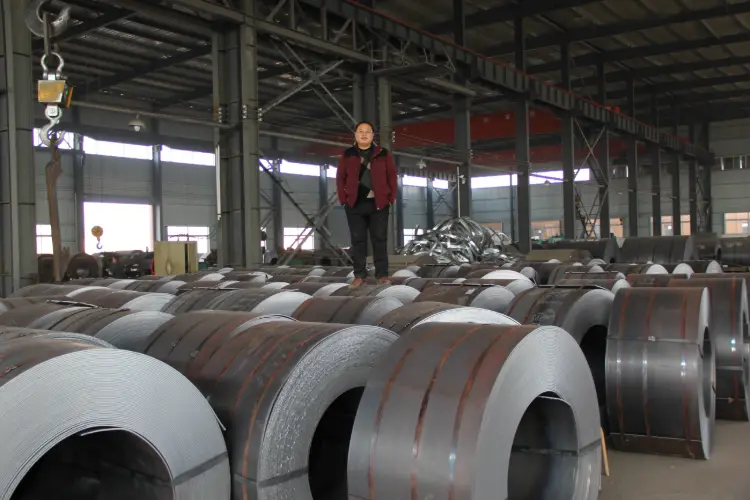
BS EN 10149-2 S355NC Hot Rolled Steel Coil
BS EN 10149-2 S355NC Hot Rolled Steel Coil: High-Strength Structural Steel for Cold Forming
Comprehensive datasheet of BS EN 10149-2 S355NC hot-rolled coil, including chemical composition, mechanical and thermal properties, equivalents, and applications for cold forming.
Cold forming, bending, roll forming, stamping, drawing, welding, machining, cutting
- Phone : +8618037372205
- Email : [email protected]
- WhatsApp: Contact via Whtsapp
- WeChat: +8618037372205
BS EN 10149-2 S355NC Hot Rolled Steel Coil Introduction
S355NC is a hot-rolled, fine-grain structural steel for cold forming, covered by the European standard EN 10149-2 (Normalized or normalized rolled steels). This steel offers a minimum yield strength of 355 MPa, excellent formability, and good weldability. It is produced in a normalized condition, ensuring homogeneous mechanical properties and fine grain size.
Although sometimes incorrectly referenced under EN 10149-3, the correct standard for the NC grade is part 2, while part 3 applies to thermomechanically rolled grades (MC). The material is supplied as hot-rolled coil, plate, or strip and is widely used in automotive, construction, and engineering sectors where cold forming is essential.
BS EN 10149-2 S355NC Hot Rolled Steel Coil Chemical Composition
The chemical composition of S355NC is designed for high strength and good formability through microalloying. Aluminium is added for deoxidation and grain refinement, while niobium, vanadium, and titanium provide precipitation strengthening and grain size control. Low sulphur and phosphorus levels ensure improved toughness and weldability. Values are maximum limits unless stated otherwise.
| Chemical Element | Standard Value (%) | Remark |
|---|---|---|
| Carbon (C) | ≤ 0.20 | |
| Silicon (Si) | ≤ 0.50 | |
| Manganese (Mn) | ≤ 1.50 | |
| Phosphorus (P) | ≤ 0.025 | |
| Sulphur (S) | ≤ 0.015 | |
| Aluminium (Al total) | ≥ 0.015 | Fully killed steel |
| Niobium (Nb) | ≤ 0.09 | |
| Vanadium (V) | ≤ 0.20 | |
| Titanium (Ti) | ≤ 0.15 | |
| Nb+V+Ti combined | ≤ 0.22 |
BS EN 10149-2 S355NC Hot Rolled Steel Coil Thermal and Electrical Physical Properties
Typical physical properties for S355NC low-carbon microalloyed structural steel. These values are representative of fine-grain ferritic steels and should be used for design calculations involving thermal expansion, heat transfer, or electrical resistance. Actual values can vary slightly with processing and temperature.
| Property | Typical Value | Unit | Condition / Temperature |
|---|---|---|---|
| Density (ρ) | 7850 | kg/m³ | Room temperature |
| Elastic modulus (E) | 210 | GPa | Room temperature |
| Shear modulus (G) | 81 | GPa | Estimated from E ≈ 210 GPa and ν ≈ 0.30 |
| Poisson's ratio (ν) | 0.30 | — | Room temperature |
| Coefficient of thermal expansion (α) | 12.0 | 10⁻⁶/K | 20 – 100 °C |
| Thermal conductivity (λ) | 50 | W/(m·K) | At 20 °C |
| Specific heat capacity (c) | 460 | J/(kg·K) | At 20 °C |
| Electrical resistivity (ρ_e) | 0.20 | μΩ·m | At 20 °C |
BS EN 10149-2 S355NC Hot Rolled Steel Coil Mechanical Properties
The mechanical properties below apply to the as-delivered hot-rolled condition in transverse direction. S355NC guarantees a minimum yield strength of 355 MPa in thicknesses up to 16 mm, combined with good ductility and toughness for cold forming applications. Charpy impact tests at -20°C confirm suitability for welded structures used at low ambient temperatures.
| Property | Standard Required Value | Unit | Test Condition / Remarks |
|---|---|---|---|
| Yield strength (ReH) | ≥ 355 | MPa | Thickness ≤ 16 mm, transverse |
| Yield strength (ReH) | ≥ 345 | MPa | Thickness 16 < t ≤ 40 mm, transverse |
| Yield strength (ReH) | ≥ 335 | MPa | Thickness 40 < t ≤ 63 mm, transverse |
| Tensile strength (Rm) | 430 – 550 | MPa | Thickness ≤ 16 mm, transverse |
| Tensile strength (Rm) | 410 – 550 | MPa | Thickness 16 < t ≤ 40 mm, transverse |
| Elongation after fracture (A5) | ≥ 22 | % | Thickness 3 < t ≤ 16 mm, transverse |
| Elongation after fracture (A80) | ≥ 19 | % | Thickness 2 < t ≤ 3 mm, transverse |
| Bend test (180° bend) | Mandrel diameter d = 1.5 × t | — | Thickness ≤ 16 mm, no cracks |
| Bend test (180° bend) | Mandrel diameter d = 2.0 × t | — | Thickness 16 < t ≤ 40 mm, no cracks |
| Charpy impact energy (KV) at -20°C | ≥ 40 | J | Thickness ≤ 16 mm, transverse |
| Charpy impact energy (KV) at -20°C | ≥ 27 | J | Thickness 16 < t ≤ 40 mm, transverse |
BS EN 10149-2 S355NC Hot Rolled Steel Coil Exactly Equivalent Standards and Substitutable Grades
| Country/Region | Standard | Grade | Remark |
|---|---|---|---|
| Europe (EU/EFTA) | EN 10149-2 | S355NC | Harmonized European standard, available as BS EN 10149-2, DIN EN 10149-2, NF EN 10149-2, etc. |
BS EN 10149-2 S355NC Hot Rolled Steel Coil Application Introduction
Thanks to its balanced combination of strength, ductility, and weldability, S355NC is the material of choice in many cold-formed structural applications. The normalized fine-grain microstructure ensures reliable bending and stamping behaviour even in thick sections.
Product Applications: Vehicle chassis and frames, Cold-formed hollow sections, Crane booms and outriggers, Structural purlins and rails
Processed into products: Longitudinal members and side rails, Cross beams and reinforcement brackets, Cold-drawn profiles and sections, Hydraulic cylinder bodies
Application industries: Automotive, Construction and Infrastructure, Agricultural Machinery, Material Handling Equipment
BS EN 10149-2 S355NC Hot Rolled Steel Coil Materials with Similar Properties
| Country/Region | Standard | Grade | Remark |
|---|---|---|---|
| Europe | EN 10149-3 | S355MC | Thermomechanically rolled; similar yield strength but enhanced formability, particularly at thinner gauges; impact temperature -20 °C |
| Europe | EN 10025-3 | S355N | Normalized structural steel; equivalent yield strength and similar toughness; not specifically optimized for cold forming but widely used in welded structures |
| Europe | EN 10025-2 | S355J2 | Hot-rolled structural steel; minimum yield 355 MPa, impact at -20 °C; lower formability compared to NC grades, suitable for less demanding cold work |
Notes:
Available surface conditions: as rolled, pickled, or oiled. Dimensional tolerances according to EN 10051. The steel can be joined by all common welding methods; pre-heating is not normally required for smaller thicknesses. For cold forming, careful attention to bending radii is recommended to avoid cracking, especially when processing at low temperatures.
- Share



