
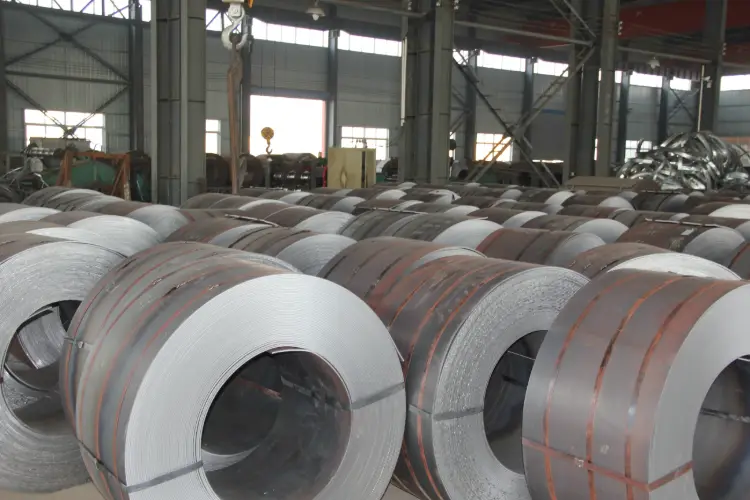
BS EN 10149-3 S260NC Hot Rolled Steel Coil
BS EN 10149-3 S260NC Hot Rolled Steel Coil | High-Strength Cold Forming Grade
Detailed material data for S260NC hot rolled steel according to BS EN 10149-3: chemical composition, mechanical properties, physical properties, equivalent grades and application guide.
Cold forming (bending, profiling, drawing, deep drawing, roll forming), stamping, welding (all common methods), moderate machining, hot-dip galvanizing
- Phone : +8618037372205
- Email : [email protected]
- WhatsApp: Contact via Whtsapp
- WeChat: +8618037372205
BS EN 10149-3 S260NC Hot Rolled Steel Coil Introduction
S260NC is a thermomechanically rolled (normalised rolled) high-yield-strength steel for cold forming, specified in the European standard BS EN 10149-3:2013. This grade is designed for structural components that require good formability combined with a minimum yield strength of 260 MPa in the as-delivered condition.
The "NC" designation indicates a fine-grain microstructure achieved through normalised rolling, which provides an excellent balance of strength, toughness and weldability. Typical applications include automotive structural and chassis parts, cold-formed profiles, and general mechanical engineering components. The material is supplied in coil, strip, sheet or plate form and can be processed by bending, drawing, stamping, and welding. Its controlled chemical composition (low carbon, micro-alloyed) ensures consistent mechanical properties across the thickness range.
BS EN 10149-3 S260NC Hot Rolled Steel Coil Chemical Composition of S260NC
The chemical composition of S260NC is carefully controlled to achieve the required mechanical properties and weldability. Key features are a low carbon content for good formability and toughness, a moderate manganese level for strength, and microalloying additions (niobium, vanadium, titanium) for grain refinement and precipitation hardening. The total aluminium content guarantees effective deoxidation and a fine-grain structure.
| Chemical Element | Standard Value (wt%) | Remarks |
|---|---|---|
| Carbon (C) | ≤ 0.16 | Ladle analysis; reduces carbon equivalent and improves weldability |
| Silicon (Si) | ≤ 0.50 | - |
| Manganese (Mn) | ≤ 1.50 | Provides strength and solid-solution hardening |
| Phosphorus (P) | ≤ 0.025 | Kept low for toughness and formability |
| Sulfur (S) | ≤ 0.020 | Low sulfur ensures good cold formability |
| Aluminium (Alt) | ≥ 0.015 | Total aluminium; sufficient to obtain fine-grain structure |
| Niobium (Nb) | ≤ 0.09 | Microalloying for grain refinement and precipitation strengthening |
| Vanadium (V) | ≤ 0.20 | Optional microalloying for strength |
| Titanium (Ti) | ≤ 0.15 | Optional microalloying; forms stable carbides/nitrides |
| Nitrogen (N) | Not specified | Typically ≤ 0.012% for products with sufficient aluminium content |
BS EN 10149-3 S260NC Hot Rolled Steel Coil Physical Properties of S260NC
The physical properties below are typical reference values for normalised-rolled low-carbon structural steels with similar composition. They are not part of the delivery standard but are useful for design calculations (thermal expansion, heat conduction, electrical applications). Actual values may vary slightly depending on the exact heat treatment and chemical composition.
| Physical Property | Typical Value | Unit | Test Condition / Remarks |
|---|---|---|---|
| Density (ρ) | 7.85 | g/cm³ | At 20 °C |
| Young Modulus (E) | 210 | GPa | At 20 °C, dynamic method |
| Shear Modulus (G) | ≈81 | GPa | Calculated from E and Poisson ratio |
| Poisson ratio (ν) | 0.3 | — | Elastic range, at 20 °C |
| Coefficient of thermal expansion (α) | 12.0 × 10⁻⁶ | K⁻¹ | Temperature range 20–100 °C; value for 20–200 °C: 12.5; 20–300 °C: 13.0 |
| Thermal conductivity (λ) | 52 | W/(m·K) | At 20 °C; decreases to ~45 at 200 °C |
| Specific heat capacity (cp) | 460 | J/(kg·K) | At 20 °C; increases to ~500 at 200 °C |
| Electrical resistivity (ρe) | ≈0.20 | µΩ·m | At 20 °C; value typical for low-carbon steels |
BS EN 10149-3 S260NC Hot Rolled Steel Coil Mechanical Properties of S260NC
The mechanical properties listed below apply to test pieces taken transverse to the rolling direction, unless otherwise specified. The material meets the requirements for normalised-rolled delivery condition. Guaranteed values are valid for thicknesses up to 16 mm; for larger thicknesses, slightly reduced minimum values may apply according to the product standard. The bending test is performed with a 180° bend around a prescribed mandrel diameter; no cracks should appear.
| Property | Required Value | Unit | Test Condition / Remarks |
|---|---|---|---|
| Upper yield strength (ReH) | 260 – 380 | MPa | For nominal thickness ≤ 16 mm, transverse direction |
| Tensile strength (Rm) | 370 – 490 | MPa | For nominal thickness ≤ 16 mm, transverse |
| Elongation after fracture (A) | ≥ 24 | % | Gauge length L₀ = 80 mm, thickness ≤ 16 mm, transverse |
| Bend test (180° bend, through angle) | No cracks | Mandrel diameter: 0.5 × t (for t ≤ 16 mm). For t > 16 mm: 1.0 × t | |
| Impact energy (KV₂, Charpy-V) | ≥ 40 (longitudinal) | J | At -20 °C. For thickness ≥ 6 mm. Transverse values are 70% of longitudinal |
| Upper yield strength (ReH) | 250 – 380 | MPa | For thickness 16 < t ≤ 40 mm, transverse |
| Tensile strength (Rm) | 370 – 490 | MPa | For thickness 16 < t ≤ 40 mm, transverse |
| Elongation after fracture (A) | ≥ 23 | % | For thickness 16 < t ≤ 40 mm, transverse |
BS EN 10149-3 S260NC Hot Rolled Steel Coil Exact Equivalent Standards and Grade Designations
| Country / Region | Standard | Grade | Remarks |
|---|---|---|---|
| European Union (EN) | EN 10149-3 | S260NC | Direct equivalent; identical specification |
| United Kingdom (BS) | BS EN 10149-3 | S260NC | Adopted European standard |
| Germany (DIN) | DIN EN 10149-3 | S260NC | National adoption |
| France (NF) | NF EN 10149-3 | S260NC | National adoption |
| Italy (UNI) | UNI EN 10149-3 | S260NC | National adoption |
| Spain (UNE) | UNE EN 10149-3 | S260NC | National adoption |
| Sweden (SS) | SS EN 10149-3 | S260NC | National adoption |
| Poland (PN) | PN-EN 10149-3 | S260NC | National adoption |
| Austria (ÖNORM) | ÖNORM EN 10149-3 | S260NC | National adoption |
| Netherlands (NEN) | NEN-EN 10149-3 | S260NC | National adoption |
BS EN 10149-3 S260NC Hot Rolled Steel Coil Application Introduction
S260NC is a versatile hot-rolled steel for cold-formed structural components. Its balanced combination of strength, formability and weldability makes it a preferred choice for weight-optimised designs. Typical application areas are listed below.
Product Applications: Vehicle chassis frames and subframes, Longitudinal beams and cross members, Bumpers and impact beams, Suspension components (control arms, spring seats), Cold-formed open and hollow sections, Structural tubes and pipes, Storage racks and pallets, Agricultural equipment frames and hitches
Processed into products: Automotive: engine cradles, seat brackets, door impact beams, wheel houses, Truck: side members of frame, cross-members, mounting brackets, Construction machinery: boom arms, stabiliser legs, cab structures, Railway: bogie frames, coupling boxes, floor panel stiffeners, General engineering: welded brackets, levers, flanges, housings, Pressed and drawn parts such as drums, end plates, hubs
Application industries: Automotive industry (passenger cars, commercial vehicles), Truck and trailer manufacturing, Agricultural and construction machinery, Railway vehicle construction, General mechanical engineering, Steel construction and building industry (secondary members), Pressure vessel and tank fabrication (moderate service), Furniture and shelving systems
BS EN 10149-3 S260NC Hot Rolled Steel Coil Similar and Alternative Materials
| Country / Region | Standard | Grade | Remarks |
|---|---|---|---|
| European Union | EN 10025-2 | S275JR / S275J0 | Hot-rolled structural steel; higher yield (275 MPa) but lower formability; impact properties differ |
| European Union | EN 10149-2 | S315MC | Thermomechanically rolled; higher strength (315 MPa min); similar formability and weldability |
| European Union | EN 10149-2 | S355MC | Thermomechanically rolled; still higher strength; suitable when greater load-bearing capacity is required |
| Germany | DIN 17102 | StE 255 | Historical German grade; similar concept, yield 255 MPa; replaced by EN 10149-3 S260NC |
| USA | ASTM A1011/A1011M | HSLAS Grade 50 [345] Class 2 | Yield 345 MPa; often used for similar applications but higher strength; requires adjustment of forming parameters |
| Japan | JIS G3134 | SPFH540 | Hot-rolled high-strength steel sheet for automobile structural use; yield approx. 325 MPa; similar application field |
| China | GB/T 1591 | Q345B | High-strength low-alloy structural steel; yield 345 MPa; not a direct substitute, requires design review |
Notes:
Welding: S260NC can be welded by all common arc welding processes (MAG, MMA, SAW, TIG). A preheat temperature is generally not required for thicknesses below 30 mm, provided the heat input is adequate. Low-hydrogen procedures are recommended to avoid hydrogen cold cracking. When matching strength fillers are used, the design must consider the softening in the heat-affected zone.
Surface condition: As-rolled surface with a tight oxide scale. Suitable for subsequent hot-dip galvanizing or painting after appropriate surface preparation (pickling, blasting).
Forming recommendations: The minimum bending radius should be chosen according to the thickness and the given 0.5t specification; for severe forming operations, a check against the forming limit diagram is advisable. The material shows no stretcher strain marks, enabling direct paint application without additional finishing.
Certification: Inspection certificates according to EN 10204 type 2.2 or 3.1 are available from the manufacturer; EN 10149-3 requires the stamping of the steel grade, heat number, and manufacturer symbol on the product.
- Share



