
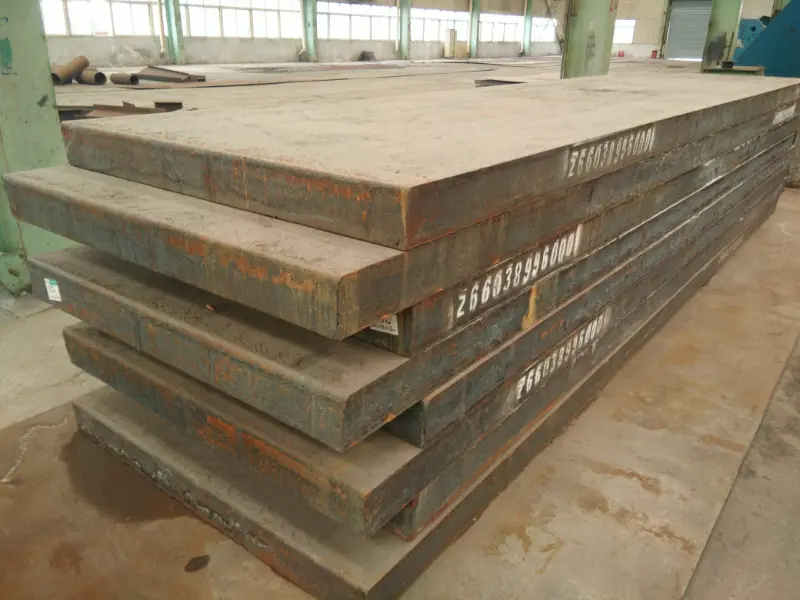
EN 10149-2 S420MC Steel
S420MC Steel: High-strength hot-rolled coil for cold forming per EN 10149-2
Comprehensive data sheet for S420MC thermomechanically rolled steel for cold forming. Includes chemical composition, mechanical properties, physical characteristics, and application guidance.
Cold forming, bending, profiling, deep drawing, stamping, welding, laser/plasma cutting
- Phone : +8618037372205
- Email : [email protected]
- WhatsApp: Contact via Whtsapp
- WeChat: +8618037372205
EN 10149-2 S420MC Steel Introduction
S420MC is a thermomechanically rolled, high-strength low-alloy steel for cold forming, specified in EN 10149-2:2013. It offers a minimum yield strength of 420 MPa with good cold formability, weldability, and a fine-grained microstructure.
Key features:
- Excellent combination of high strength and ductility
- Consistent mechanical properties across the coil
- Optimized for bending, profiling and deep drawing operations
- Suitable for automotive structural and safety components
- Available in a range of thicknesses up to 16 mm (typical hot-rolled coil dimensions)
EN 10149-2 S420MC Steel Chemical composition
The chemical composition of S420MC according to EN 10149-2:2013, heat analysis, maximum values unless otherwise indicated. Niobium, titanium, vanadium, and aluminium may be added singly or in combination for grain refinement and precipitation strengthening. The steel shall contain at least one of the grain-refining elements Nb, Ti, or V.
| Element | Standard value (%) | Remarks |
|---|---|---|
| Carbon (C) | ≤ 0.12 | |
| Silicon (Si) | ≤ 0.50 | |
| Manganese (Mn) | ≤ 1.60 | |
| Phosphorus (P) | ≤ 0.025 | |
| Sulfur (S) | ≤ 0.015 | |
| Aluminium (Al) | ≥ 0.015 | total aluminium |
| Niobium (Nb) | ≤ 0.09 | grain refiner (optional) |
| Titanium (Ti) | ≤ 0.15 | grain refiner (optional) |
| Vanadium (V) | ≤ 0.20 | grain refiner (optional) |
| Molybdenum (Mo) | ≤ 0.10 | optional |
| Boron (B) | ≤ 0.005 | optional |
EN 10149-2 S420MC Steel Thermal and electrical physical properties
Typical physical properties for low-carbon HSLA steel similar to S420MC. These values are not mandatory in the standard but are provided for design calculations. Slight variations may occur depending on actual chemistry and processing.
| Property | Typical value | Unit | Conditions / Remarks |
|---|---|---|---|
| Density (ρ) | 7.85 | kg/dm³ | at room temperature |
| Modulus of elasticity (E) | 210 | GPa | at room temperature; dynamic approx. 212 GPa |
| Shear modulus (G) | ~80 | GPa | |
| Poisson's ratio (ν) | 0.3 | - | |
| Thermal expansion coefficient (α) | 12.0 × 10⁻⁶ | K⁻¹ | 20 – 100 °C |
| Thermal conductivity (λ) | ~50 | W/(m·K) | at 20 °C |
| Specific heat capacity (cp) | ~460 | J/(kg·K) | at 20 °C |
| Electrical resistivity (ρₑ) | 0.15 – 0.25 | Ω·mm²/m | at 20 °C |
EN 10149-2 S420MC Steel Mechanical properties
Mechanical properties in the delivery condition according to EN 10149-2:2013. Testing is performed on transverse specimens unless otherwise agreed. For thicknesses > 16 mm, different values may apply; the S420MC grade is typically supplied up to 16 mm. For thickness range 3 – 16 mm, the yield strength, tensile strength and elongation requirements apply as shown below. The bending test must be performed without cracking.
| Property | Requirement | Unit | Test conditions |
|---|---|---|---|
| Yield strength (ReH) | ≥ 420 | MPa | Transverse direction, t ≤ 16 mm |
| Tensile strength (Rm) | 480 – 620 | MPa | Transverse direction, t ≤ 16 mm |
| Elongation after fracture (A80) | ≥ 17 | % | Transverse direction, l₀=80 mm, t ≥ 3 mm |
| Elongation after fracture (A80) | ≥ 19 | % | Longitudinal direction, l₀=80 mm, t ≥ 3 mm |
| Bending test (bend angle 180°) | Mandrel diameter = 0.8 × t | - | t ≤ 16 mm; t=specimen thickness, no cracks |
EN 10149-2 S420MC Steel Completely equivalent material standards and replaceable designations
The following standards specify the same S420MC grade with identical technical requirements as BS EN 10149-2:2013. Substitution within these standards is seamless.
| Country / Region | Standard | Designation | Remarks |
|---|---|---|---|
| United Kingdom | BS EN 10149-2:2013 | S420MC | Original standard |
| Germany | DIN EN 10149-2 | S420MC | Identical technical content |
| France | NF EN 10149-2 | S420MC | Identical technical content |
| Italy | UNI EN 10149-2 | S420MC | Identical technical content |
| Spain | UNE EN 10149-2 | S420MC | Identical technical content |
| International (ISO) | ISO 6930-2:2004 | HCT420C | Very close match; confirm with actual specification |
EN 10149-2 S420MC Steel Application Introduction
S420MC is specifically designed for structural components that require high strength during service while being produced by cold forming operations. The thermomechanical rolling process refines the grain and provides excellent resistance to brittle fracture at typical operating temperatures (−20 °C to +50 °C).
Design considerations:
- Suitable for thickness-reduced designs when weight savings are critical
- Good weldability with standard methods (MIG/MAG, spot and laser welding)
- Surface condition may require pickling and oiling before forming
- Coating (e.g., zinc, organic coatings) can be applied after forming
Product Applications: Cold-formed sections, Roll-formed profiles, Stamped and deep-drawn parts, Laser-welded blanks, Hydroformed tubes
Processed into products: Longitudinal frame rails, Cross members and subframes, Suspension control arms, Wheel disc blanks, Bumper reinforcements, Seat frames, Door impact beams, Agricultural implement beams, Scaffolding pipes and couplers
Application industries: Automotive manufacturing (Body-in-white, chassis, suspension), Construction equipment (platforms, scaffolding), Agricultural machinery (frames, arms), Railway vehicles (structural panels), General engineering (brackets, supports)
EN 10149-2 S420MC Steel Materials with similar properties and alternative designations
The following grades offer comparable yield strength or cold-formability characteristics, but may differ in chemical composition, delivery condition, or standard. They should be evaluated case by case before substitution.
| Country / Region | Standard | Designation | Remarks |
|---|---|---|---|
| Europe | EN 10149-2 | S355MC | Lower strength (≤355 MPa), slightly better formability; often interchangeable for less loaded parts |
| Europe | EN 10149-2 | S500MC | Higher strength (≥500 MPa]; reduced elongation; may require greater bending force |
| Europe | EN 10149-2 | S460MC | Intermediate strength (≥460 MPa]; balanced forming and load capacity |
| USA | ASTM A1011/A1011M | HSLAS Grade 50 [340] | Lower minimum yield strength (340 MPa); not fully equivalent but may be considered for some applications |
| Japan | JIS G 3134 | SPFH 540 | Similar strength level; confirm chemical and delivery condition requirements |
Notes:
Additional information:
- Mechanical properties are guaranteed for a limited time after delivery (usually 6 months) if stored in ambient conditions.
- For thicknesses below 3 mm, elongation values may be agreed at the time of ordering; the standard does not prescribe A80 below 3 mm.
- The steel can be supplied with a specially controlled surface condition (e.g., pickled, oiled, or with a specific roughness) for demanding forming operations.
- Cold forming work-hardens the material; if subsequent heat treatment is required, consult the producer because the strength may revert to pre-rolling levels.
- EN 10149-2:2013 also specifies that the steel shall be fully killed and have a fine grain structure.
- Share



