
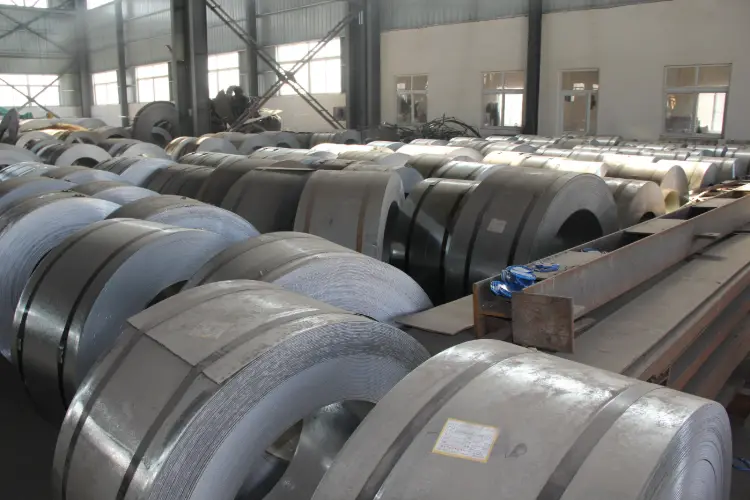
DNV Grade E Shipbuilding Steel Coil
DNV Grade E Shipbuilding Steel Coil - Chemical, Mechanical & Physical Data
Comprehensive technical data for DNV Grade E steel, including chemical composition, mechanical and physical properties, international equivalents, and application guidance for ship hull structures.
Welding, gas cutting, cold forming, hot forming, machining
- Phone : +8618037372205
- Email : [email protected]
- WhatsApp: Contact via Whtsapp
- WeChat: +8618037372205
DNV Grade E Shipbuilding Steel Coil Introduction
DNV Grade E is a normal strength hull structural steel governed by the DNV GL Rules for Ships. It is intended for critical shipbuilding applications requiring good weldability, ductility, and guaranteed notch toughness at -40 °C. The steel is typically supplied as hot-rolled coils, plates, or sections in normalized or thermo-mechanically controlled processed (TMCP) condition. Grade E offers a minimum yield strength of 235 MPa and tensile strength in the range of 400–520 MPa, with elongation not less than 22% for thicknesses up to 50 mm. Its low carbon equivalent ensures reliable welding without preheating under normal conditions. The material finds extensive use in hull shells, decks, bulkheads, and structural components of ocean-going vessels, offshore platforms, and marine equipment. Strict compliance with DNV certification guarantees traceability, mechanical testing, and dimensional tolerances accepted by major classification societies.
DNV Grade E Shipbuilding Steel Coil Chemical Composition
Typical limits according to DNV rules for normal strength Grade E. The steel is fully killed and made with fine grain practice. Elements such as aluminum, niobium, vanadium may be added for grain refinement and are reflected in the certificate only when intentionally added. All values are maximum unless a range is given.
| Chemical Element | Standard Value (wt%) | Remarks |
|---|---|---|
| Carbon (C) | ≤ 0.18 | Ladle analysis |
| Manganese (Mn) | 0.70 – 1.50 | For thickness ≤ 50 mm; may be adjusted for thicker sections |
| Silicon (Si) | 0.10 – 0.50 | Fully killed steel |
| Phosphorus (P) | ≤ 0.035 | |
| Sulfur (S) | ≤ 0.035 | |
| Aluminum (Al) | ≥ 0.015 (when added) | Acid-soluble aluminum; indicates fully killed practice |
| Nitrogen (N) | ≤ 0.009 (typically) | Unless otherwise agreed |
| Copper (Cu) | ≤ 0.35 | Residual element |
| Chromium (Cr) | ≤ 0.20 | Residual element |
| Nickel (Ni) | ≤ 0.40 | Residual element |
| Molybdenum (Mo) | ≤ 0.08 | Residual element |
DNV Grade E Shipbuilding Steel Coil Thermal & Electrical Physical Properties
Physical properties represent typical values for carbon-manganese steel of this grade at room temperature unless otherwise stated. These values are not mandatory requirements but are widely accepted for engineering calculations.
| Property | Typical Value | Unit | Test Conditions / Remarks |
|---|---|---|---|
| Density (ρ) | 7.85 | g/cm³ | At 20 °C |
| Modulus of Elasticity (E) | 210 | GPa | At 20 °C, dynamic method |
| Shear Modulus (G) | 81 | GPa | Calculated from E and ν |
| Poisson's Ratio (ν) | 0.3 | — | Within elastic range |
| Thermal Expansion Coefficient (α) | 11.7 | 10⁻⁶/K | Between 20 °C and 100 °C |
| Thermal Expansion Coefficient (α) | 12.5 | 10⁻⁶/K | Between 20 °C and 200 °C |
| Thermal Expansion Coefficient (α) | 13.5 | 10⁻⁶/K | Between 20 °C and 400 °C |
| Thermal Conductivity (λ) | 52 | W/(m·K) | At 20 °C |
| Specific Heat Capacity | 460 | J/(kg·K) | At 20 °C |
| Electrical Resistivity (ρ_e) | 0.15 | μΩ·m | At 20 °C |
DNV Grade E Shipbuilding Steel Coil Mechanical Properties
Mechanical properties as required by DNV rules for Grade E (normal strength). Tests are performed on tensile specimens taken from finished products. Impact testing is carried out with Charpy V-notch specimens at -40 °C. Values apply to thicknesses up to 50 mm; for greater thicknesses, slightly reduced limits may be agreed.
| Property | Standard Requirement | Unit | Test Conditions |
|---|---|---|---|
| Yield Strength (ReH) | ≥ 235 | MPa | Transverse / longitudinal, t ≤ 50 mm |
| Yield Strength (ReH) | ≥ 225 | MPa | 50 < t ≤ 70 mm |
| Yield Strength (ReH) | ≥ 215 | MPa | 70 < t ≤ 100 mm |
| Tensile Strength (Rm) | 400 – 520 | MPa | All thicknesses |
| Elongation (A5) | ≥ 22 | % | t ≤ 50 mm, gauge length 5.65√So |
| Elongation (A5) | ≥ 21 | % | 50 < t ≤ 70 mm |
| Elongation (A5) | ≥ 20 | % | 70 < t ≤ 100 mm |
| Bend Test | 180°; no cracks | — | Bend diameter = 3a (a = specimen thickness), t ≤ 50 mm |
| Bend Test | 180°; no cracks | — | Bend diameter = 3a, t > 50 mm by agreement |
| Impact Energy (KV) | ≥ 27 (longitudinal) | J | -40 °C, Charpy V-notch, 10x10 mm |
| Impact Energy (KV) | ≥ 20 (transverse) | J | -40 °C, Charpy V-notch, 10x10 mm |
DNV Grade E Shipbuilding Steel Coil Equivalent Standards & Replaceable Grades
| Country/Region | Standard | Grade | Remarks |
|---|---|---|---|
| International (IACS) | IACS UR W11 | Normal Strength Grade E | Common minimum requirements for all classification societies |
| USA | ABS Rules | ABS Grade E | American Bureau of Shipping |
| UK | LR Rules | LR Grade E | Lloyd's Register |
| France | BV Rules | BV Grade E | Bureau Veritas |
| China | CCS Rules | CCS Grade E | China Classification Society |
| Japan | NK Rules | NK Grade E (KE) | Nippon Kaiji Kyokai |
| South Korea | KR Rules | KR Grade E | Korean Register |
| Italy | RINA Rules | RINA Grade E | Registro Italiano Navale |
| India | IRS Rules | IRS Grade E | Indian Register of Shipping |
| Russia | RMRS Rules | RMRS Grade E | Russian Maritime Register of Shipping |
DNV Grade E Shipbuilding Steel Coil Application Introduction
DNV Grade E is designed for welded structures in shipbuilding and marine environments. Its guaranteed low-temperature toughness makes it suitable for shell plating, strength decks, and critical stiffeners exposed to cold climates. The material is easily formed, cut, and welded using conventional shipyard processes.
Product Applications: Hull shells and bottom plating, Main decks and strength decks, Transverse and longitudinal bulkheads, Stiffeners, frames, girders, beams, Offshore platform decks and legs, Tanks for ballast or fuel (non-corrosive service)
Processed into products: Cut and welded panels for ship modules, Bent and rolled plate sections for hull curvature, Machined foundation plates for engines and machinery, Bracket and gusset plates, Hatch coamings and mast houses, Offshore wind transition pieces
Application industries: Shipbuilding (merchant vessels, naval ships, passenger ships), Offshore oil & gas platforms, Marine engineering & port infrastructure, Heavy steel fabrication, Wind turbine support structures (offshore)
DNV Grade E Shipbuilding Steel Coil Similar or Alternative Materials
| Country/Region | Standard | Grade | Remarks |
|---|---|---|---|
| European Union | EN 10025-2 | S235J2+N | Similar yield/tensile, Charpy at -20 °C; may require supplementary testing for -40 °C to match Grade E toughness |
| USA | ASTM A131 / A131M | A131 Grade E | Standard specification for structural steel for ships; matches DNV Grade E (same toughness class) |
| USA | ASTM A36 / A36M | A36 | Comparable strength but without guaranteed low-temperature toughness; not suitable for critical hull components at low temperature |
| China | GB 712 | CCS E / A E | Chinese shipbuilding steel, equivalent to DNV Grade E when certified by CCS |
| International | ISO 630-2 | S235C | Structural steel with impact tested at 0 °C only; lower toughness than Grade E |
Notes:
Certification: Steel must be produced by an approved manufacturer and certified with DNV inspection and stamping. Tolerances: Thickness, width, and flatness according to DNV or EN 10029/10051. Weldability: Carbon equivalent (CE) typically ≤ 0.38% ensures good weldability without preheat for moderate thicknesses. Corrosion protection: Not inherently corrosion resistant; requires painting or cathodic protection in seawater service. Heat treatment: Normalizing or TMCP is mandatory for Grade E to achieve fine-grain structure. Stress relieving may be applied after severe forming.
- Share



