
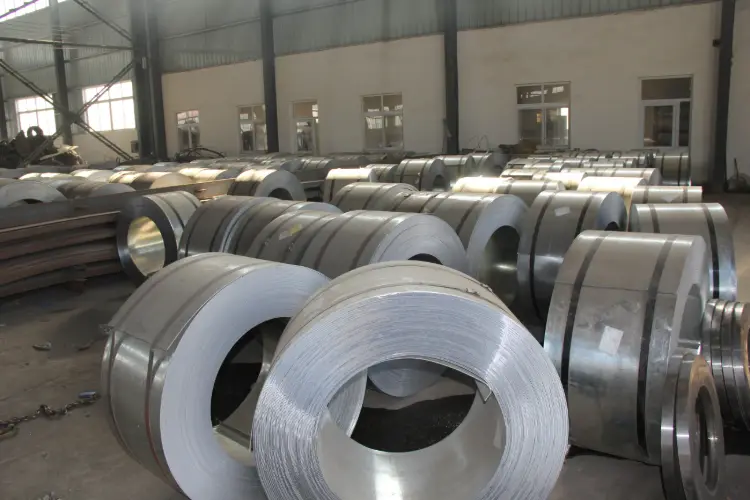
DNV Grade D Shipbuilding Steel Coil
DNV Grade D Shipbuilding Steel Coil: Chemical, Mechanical & Physical Properties Guide
Comprehensive material data for DNV Grade D shipbuilding steel coil: chemical composition per DNV rules, mechanical properties (yield, tensile, impact), physical properties, and international equivalent grades (ABS, LR, BV, CCS, etc.)
Hot rolling, normalizing, TMCP, cutting, forming, welding
- Phone : +8618037372205
- Email : [email protected]
- WhatsApp: Contact via Whtsapp
- WeChat: +8618037372205
DNV Grade D Shipbuilding Steel Coil Introduction
DNV Grade D is a normal-strength hull structural steel specified by the DNV classification society (now DNV GL) for shipbuilding and marine applications. It is supplied as hot-rolled coil and plate, featuring a minimum yield strength of 235 MPa in thicknesses up to 100 mm. Grade D is characterized by good weldability, moderate strength, and guaranteed impact toughness at 0°C. It is widely used for primary and secondary structural members in vessels and offshore structures. The steel is produced via conventional rolling, normalizing, or thermomechanical controlled processing (TMCP) and is delivered in normalized or as-rolled condition depending on thickness and customer requirements. Equivalent grades under other IACS classification societies (ABS Grade D, LR Grade D, BV D, CCS D, etc.) allow seamless substitution.
DNV Grade D Shipbuilding Steel Coil Chemical Composition
The chemical composition of DNV Grade D steel is designed to ensure adequate strength, weldability, and impact toughness at 0°C. Carbon is restricted to improve weldability, and manganese provides solid-solution strengthening. Micro-alloying elements may be added for grain refinement if TMCP is applied, but the analysis must comply with the limits below. Deoxidation is usually fully killed with silicon and aluminum. All values are maximum unless a range or minimum is indicated.
| Element | Standard Requirement (%) | Remarks |
|---|---|---|
| Carbon (C) | ≤ 0.21 | For merchant ship plate; lower for thicker sections or TMCP |
| Manganese (Mn) | ≥ 0.60 (≥ 2.5×C for t ≤ 12.5 mm) | Minimum improves strength and toughness |
| Silicon (Si) | ≤ 0.35 | Deoxidizer; typical residual range 0.15–0.30% |
| Phosphorus (P) | ≤ 0.035 | Stricter control for better toughness |
| Sulfur (S) | ≤ 0.035 | Low sulfur for cleanliness and through-thickness properties |
| Aluminum (Al) (total) | ≥ 0.020 (if fixed nitrogen) | Used for grain refinement; acid-soluble aluminum may be specified |
| Nitrogen (N) | ≤ 0.009 | If aluminum is present, higher nitrogen may be allowed |
| Copper (Cu) | ≤ 0.30 | Residual element |
| Chromium (Cr) | ≤ 0.20 | Residual element |
| Nickel (Ni) | ≤ 0.20 | Residual element |
| Molybdenum (Mo) | ≤ 0.08 | Residual element |
| Residual elements (Cr+Ni+Cu+Mo) | ≤ 0.50 | Combined limit for residual alloying elements |
DNV Grade D Shipbuilding Steel Coil Thermal and Electrical Physical Properties
The following data are typical for normal-strength structural steels similar to DNV Grade D and can be used for engineering calculations. Slight variations may occur depending on exact composition, heat treatment, and temperature. Values are provided for guidance and are not part of the DNV specification.
| Property | Typical Value | Unit | Test Condition / Temperature |
|---|---|---|---|
| Density (ρ) | 7.85 | kg/dm³ (g/cm³) | 20°C |
| Elastic Modulus (E) | 210 | GPa | Room temperature |
| Shear Modulus (G) | 81 | GPa | Room temperature (calculated from E and ν) |
| Poisson's Ratio (ν) | 0.30 | — | Room temperature, elastic range |
| Thermal Expansion Coefficient (α) | 11.5 × 10⁻⁶ | K⁻¹ | 20–100°C |
| Thermal Expansion Coefficient (α) | 12.2 × 10⁻⁶ | K⁻¹ | 20–200°C |
| Thermal Expansion Coefficient (α) | 12.9 × 10⁻⁶ | K⁻¹ | 20–300°C |
| Thermal Expansion Coefficient (α) | 13.5 × 10⁻⁶ | K⁻¹ | 20–400°C |
| Thermal Conductivity (λ) | 52 | W/(m·K) | 20°C |
| Thermal Conductivity (λ) | 50 | W/(m·K) | 100°C |
| Thermal Conductivity (λ) | 46 | W/(m·K) | 200°C |
| Thermal Conductivity (λ) | 42 | W/(m·K) | 300°C |
| Specific Heat Capacity (cp) | 460 | J/(kg·K) | 20–100°C (approx.) |
| Electrical Resistivity (ρe) | 0.18 – 0.22 | Ω·mm²/m (×10⁻⁶ Ω·m) | 20°C |
DNV Grade D Shipbuilding Steel Coil Mechanical Properties
Mechanical properties are determined on test pieces taken from the final product in the delivery condition. The values below comply with DNV rules for Grade D shipbuilding steel. Impact tests are performed on longitudinal Charpy-V notch specimens at 0°C. The bending test is carried out with the mandrel diameter depending on plate thickness. All values are minimum unless noted.
| Property | Required Value | Unit | Test Condition |
|---|---|---|---|
| Yield Strength (ReH) | ≥ 235 | MPa | Thickness ≤ 50 mm, transverse, room temperature |
| Yield Strength (ReH) | ≥ 225 | MPa | Thickness 50–70 mm, transverse, room temperature |
| Yield Strength (ReH) | ≥ 215 | MPa | Thickness 70–100 mm, transverse, room temperature |
| Tensile Strength (Rm) | 400 – 520 | MPa | Thickness ≤ 70 mm, transverse, room temperature |
| Tensile Strength (Rm) | 390 – 520 | MPa | Thickness 70–100 mm, transverse, room temperature |
| Elongation (A5) | ≥ 22 | % | Thickness ≤ 50 mm, gauge length 5.65√S₀, transverse |
| Elongation (A5) | ≥ 21 | % | Thickness 50–70 mm, transverse |
| Elongation (A5) | ≥ 20 | % | Thickness 70–100 mm, transverse |
| Impact Energy (KV) (longitudinal) | ≥ 27 (average of 3 specimens, 20 J single min.) | J | 0°C, Charpy-V, full-size specimens (10×10 mm), longitudinal |
| Bending Test (mandrel diameter) | 3 × t (for t ≤ 20 mm) | — | Bend to 180° without cracking; t = specimen thickness |
| Bending Test (mandrel diameter) | 3.5 × t (for t 20–40 mm) | — | Bend to 180° without cracking |
| Bending Test (mandrel diameter) | 4 × t (for t > 40 mm) | — | Bend to 180° without cracking |
DNV Grade D Shipbuilding Steel Coil Fully Equivalent Material Standards and Substitute Grades
| Country / Society | Standard / Rule | Grade Designation | Remarks |
|---|---|---|---|
| DNV GL (International) | DNV GL Part 2 Ch.2 | Grade D | Original specification |
| American Bureau of Shipping (ABS) | ABS Rules Part 2, Chapter 1 | ABS Grade D | Equivalent under IACS Unified Requirements |
| Lloyd's Register (LR) | LR Rules Pt.3 Ch.2 | LR Grade D | Same notch toughness at 0°C |
| Bureau Veritas (BV) | BV Rules Pt.2 Ch.2 | BV D | Direct equivalent |
| China Classification Society (CCS) | CCS Rules Pt.3 Ch.2 | CCS D | Same chemical and mechanical limits |
| Nippon Kaiji Kyokai (ClassNK) | NK Rules Pt.K | NK Grade D | Identical to IACS UR W11 |
| Korean Register (KR) | KR Rules Pt.2 Ch.2 | KR Grade D | Equivalent |
| Registro Italiano Navale (RINA) | RINA Rules Pt.B Ch.2 | RINA Grade D | Equivalent |
| Russian Maritime Register (RS) | RS Rules Pt.3 Ch.2 | RS Grade D | Equivalent |
| Indian Register of Shipping (IRS) | IRS Rules Pt.2 Ch.2 | IRS Grade D | Equivalent |
DNV Grade D Shipbuilding Steel Coil Application Introduction
DNV Grade D steel coil and plate are designed for structural components in shipbuilding and offshore structures that must perform reliably at service temperatures down to 0°C. The material offers an excellent balance of strength, weldability, and cost-effectiveness. Typical processing includes cold forming, bending, cutting, and welding with standard shipyard procedures.
Product Applications: Hull plates and stiffeners for container ships, bulk carriers, tankers, and passenger vessels, Ship decks, shell plating, and bottom plating, Longitudinal and transverse framing members, Offshore platform topsides and substructures, Barges and floating docks, Steel coils for manufacturing corrugated bulkheads
Processed into products: Hull shells and inner bottom plates, Bulkhead plates and stiffeners, Web frames and floor plates, Deck stringers and deck beams, Hatch coamings and covers, Keel plates and stern frames, Ship-timber beams and brackets, Crane pedestal base plates (marine), Wind turbine transition pieces (marine sections)
Application industries: Shipbuilding (hull structures, decks, bulkheads, superstructures), Offshore oil & gas (platform decks, modules, bridges), Marine engineering (docks, floating structures, pontoons), Bridge construction (secondary members), Wind turbine towers (foundation structures in marine environment)
DNV Grade D Shipbuilding Steel Coil Similar or Alternative Materials with Related Performance
| Country / Society | Standard / Rule | Grade Designation | Remarks |
|---|---|---|---|
| DNV GL | DNV GL Pt.2 Ch.2 | Grade A | Normal-strength ship steel with impact test at 20°C; lower toughness |
| DNV GL | DNV GL Pt.2 Ch.2 | Grade B | Normal-strength ship steel with impact test at 0°C; similar to D but less stringent QC |
| DNV GL | DNV GL Pt.2 Ch.2 | Grade E | Normal-strength ship steel with impact test at -40°C; higher toughness |
| DNV GL | DNV GL Pt.2 Ch.2 | AH32/ DH32 | Higher-strength (min. yield 315 MPa) hull steels; impact at 0°C for DH32 |
| EN | EN 10025-2 | S235J2 | Structural steel with similar strength and -20°C impact; not specifically for shipbuilding |
| ASTM | ASTM A131/ A131M | Grade D | American shipbuilding grade D, similar to ABS Grade D |
Notes:
The data presented comply with the latest IACS Unified Requirements W11 for Normal-Strength Hull Structural Steel. For components requiring improved ductility through thickness, the material can be ordered as Z25, Z35 per DNV rules. Actual material certificates should be checked for precise heat analysis and mechanical test results. When substituting with other classification societies' Grade D, ensure the edition of the respective rules matches the design specification.
- Share



