
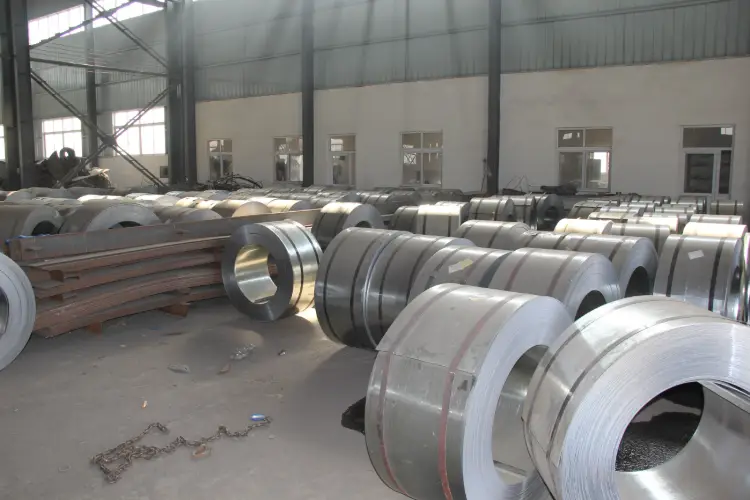
DNV Grade B Shipbuilding Steel Coil
DNV Grade B Shipbuilding Steel Coil: Composition, Properties & Global Equivalents
Complete material data for DNV Grade B shipbuilding steel coil according to DNV rules, including chemical composition, mechanical and physical properties, international equivalents, similar materials, and application guide.
Hot rolling, normalizing, controlled rolling, cold forming, welding, cutting, punching
- Phone : +8618037372205
- Email : [email protected]
- WhatsApp: Contact via Whtsapp
- WeChat: +8618037372205
DNV Grade B Shipbuilding Steel Coil Introduction
DNV Grade B is a normal–strength hull structural steel specified in the Det Norske Veritas (DNV) rules for classification of ships. It is a fully killed, fine–grain steel with a minimum yield strength of 235 MPa in the hot–rolled or normalized condition. The steel is designed for good weldability and adequate notch toughness at 0 °C, making it suitable for primary and secondary structural members in ship hulls and offshore units. Its balanced chemistry, with controlled carbon, manganese, and residual elements, ensures reliable performance in demanding marine environments.
Key features:
- Minimum yield strength 235 MPa (thk ≤ 100 mm)
- Charpy V–notch impact energy ≥ 27 J at 0 °C (longitudinal)
- Good cold formability and weldability
- Available as coils, plates, and cut–to–length sheets
DNV Grade B Shipbuilding Steel Coil Chemical Composition
The chemical composition according to DNV Rules, Part 2 Chapter 1, Section 2, Table 1. Steel must be killed and either fine–grain treated or contain a minimum of 0.015 % acid–soluble aluminium. Carbon equivalent (CEV) may be restricted depending on thickness and application. For thickness ≤ 100 mm the CEV typically does not exceed 0.38 %.
| Element | Content (%, max unless range) | Remarks |
|---|---|---|
| C (Carbon) | 0.21 | max |
| Si (Silicon) | 0.10 – 0.35 | typical range; max ≤ 0.50 |
| Mn (Manganese) | 0.80 – 1.20 | ≥ 2.5×C for thickness > 50 mm |
| P (Phosphorus) | 0.035 | max |
| S (Sulfur) | 0.035 | max |
| Al (Aluminium) | ≥ 0.015 (acid soluble) | if used for grain refinement |
| N (Nitrogen) | 0.009 | max |
| Others (Cr, Ni, Cu, Mo) | traces | residual elements; max 0.30 each, total ≤ 0.80 |
DNV Grade B Shipbuilding Steel Coil Thermal and Electrical Physical Properties
The following values are typical for normal–strength carbon–manganese structural steels at room temperature unless stated otherwise. They are not mandatory in the DNV specification but are representative for engineering calculations. The thermal expansion coefficient is given for the temperature range 20–100 °C.
| Property | Typical Value | Unit | Condition / Temperature |
|---|---|---|---|
| Density (ρ) | 7850 | kg/m³ | 20 °C |
| Elastic Modulus (E) | 210 | GPa | 20 °C |
| Shear Modulus (G) | 80 | GPa | 20 °C, calculated from E and ν |
| Poisson's Ratio (ν) | 0.3 | – | 20 °C, elastic range |
| Thermal Expansion Coefficient (α) | 12 | ×10⁻⁶ /K | 20 – 100 °C |
| Thermal Conductivity (λ) | 51.9 | W/(m·K) | 100 °C |
| Specific Heat Capacity (cp) | 486 | J/(kg·K) | 20 – 100 °C |
| Electrical Resistivity (ρₑ) | 0.15 | ×10⁻⁶ Ω·m | 20 °C |
DNV Grade B Shipbuilding Steel Coil Mechanical Properties
Mechanical properties as specified in DNV Rules, Part 2 Chapter 1, Section 2, Table 2 and Table 3. Values apply to longitudinal direction for product thickness t ≤ 50 mm unless otherwise stated. Impact energy requirements are the minimum average of 3 specimens; a single value may be below the specified average but not less than 70 % of it.
Testing conditions:
- Tensile test: ambient temperature, gauge length L0 = 5.65√S0
- Impact test: Charpy V–notch at 0 °C
- Bend test: 180° over a former diameter
| Property | Value | Unit | Condition |
|---|---|---|---|
| Yield Strength (ReH) | ≥ 235 | MPa | t ≤ 100 mm, transverse |
| Tensile Strength (Rm) | 400 – 520 | MPa | t ≤ 100 mm, transverse |
| Elongation (A) | ≥ 22 | % | t ≤ 50 mm, L0 = 5.65√S0, longitudinal |
| Elongation (A) | ≥ 20 | % | t > 50 mm but ≤ 100 mm, longitudinal |
| Impact Energy (KV) at 0 °C | ≥ 27 (longitudinal) | J | Charpy V–notch, average of 3 specimens |
| Impact Energy (KV) at 0 °C | ≥ 20 (transverse) | J | Charpy V–notch, average of 3 specimens |
| Bend Test (180°) | d = 3t | – | t ≤ 25 mm, no cracks |
| Bend Test (180°) | d = 4t | – | t > 25 mm and ≤ 50 mm |
DNV Grade B Shipbuilding Steel Coil Strictly Equivalent Standards and Substitutable Grades
| Country / Region | Standard / Body | Grade | Remarks |
|---|---|---|---|
| International | American Bureau of Shipping | ABS Grade B | Identical strength and toughness category |
| International | Bureau Veritas | BV B | Same nominal properties, fully interchangeable |
| International | China Classification Society | CCS B | Chinese flag shipbuilding; equivalent in all respects |
| International | Germanischer Lloyd (now DNV GL) | GL B | Harmonized with DNV rules |
| International | Lloyd's Register | LR B | Same minimum yield 235 MPa, temperature class 0 °C |
| International | Nippon Kaiji Kyokai | NK B | Japanese class society, fully equivalent |
| International | Registro Italiano Navale | RINA B | Same mechanical and chemical requirements |
| International | Russian Maritime Register of Shipping | RS B | Equivalent for hull structural applications |
| International | Korean Register | KR B | Recognized equivalent in IACS UR W11 |
| International | Indian Register of Shipping | IRS B | Similar specification, IACS member |
DNV Grade B Shipbuilding Steel Coil Application Introduction
DNV Grade B steel is extensively used in the shipbuilding and offshore engineering industries. Its good balance of strength, toughness, and weldability enables the construction of large, safe, and durable marine structures. The material is typically employed in the as–rolled condition for thicknesses up to 50 mm. For thicker sections or severe service, normalized or thermomechanically rolled conditions may be specified.
Typical industries and applications:
Product Applications: Hull plates and shell plating, Deck and bulkhead plates, Stiffeners and longitudinal girders, Transverse frames and web frames, Sea chests and watertight doors, Offshore platform topsides and substructures
Processed into products: Bottom and side shell plates, Inner bottom plating, Watertight and non–watertight bulkheads, Wing tanks and hopper plating, Stiffeners (bulb flats, angles, tees), Brackets and tripping brackets, Web plates in main girders, Deck stringer plates, Hatch coamings and coaming stiffeners, Pillar and pillar support plates
Application industries: Shipbuilding (commercial and naval vessels), Offshore oil & gas (platforms, FPSOs, jackets), Renewable energy (offshore wind turbine foundations), Port and harbor construction (sheet piles, quay walls), Heavy machinery structural components
DNV Grade B Shipbuilding Steel Coil Similar and Near–equivalent Material Recommendations
| Country / Region | Standard / Body | Grade | Remarks |
|---|---|---|---|
| Europe | EN 10025-2 | S235JR (1.0038) | Similar yield strength (235 MPa) but notch toughness at +20 °C; must verify 0 °C impact ability if substituted. |
| China | GB/T 700 | Q235B | Yield ≥ 235 MPa; impact energy at 20 °C (or 0 °C for Q235C). Q235B may not meet 0 °C Charpy requirements without agreement. |
| USA | ASTM A36 / A131 | A36 / Grade B | ASTM A131 Grade B is a direct equivalent to DNV B; ASTM A36 has higher yield (250 MPa) but inconsistent toughness. |
| Japan | JIS G3106 | SM400B | Yield ≥ 245 MPa, tensile 400–510 MPa; Charpy at 0 °C (27 J). Higher strength, may be substituted with approval. |
| ISO | ISO 630-2 | S235G2 | Structural steel with improved corrosion resistance; similar strength but not a dedicated shipbuilding grade. |
Notes:
The material must be supplied with a DNV material certificate (C) issued by a recognized manufacturing facility. Welding consumables and procedures shall be approved by the classification society. For structural applications where through–thickness properties are required (Z–quality), an additional test according to DNV–OS–B101 may be specified. The carbon equivalent (CEV) is typically ≤ 0.38% for thickness ≤ 50 mm. Surface condition, edge preparation, and identification marking shall comply with the DNV rules. When the steel is intended for use in cold–formed sections, a minimum internal bending radius of 2t is recommended to avoid crack initiation.
- Share



