
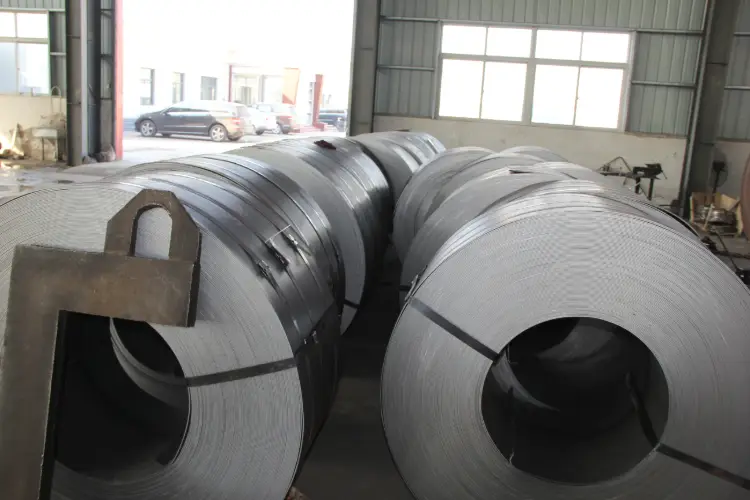
DNV Grade A Shipbuilding Steel Coil
DNV Grade A Shipbuilding Steel Coil: Comprehensive Material Data, Chemical Composition & Mechanical Properties
DNV Grade A is a normal-strength hull structural steel widely used in shipbuilding, complying with Det Norske Veritas (now DNV) rules. It offers excellent weldability, good toughness, and moderate strength for general ship structures.
Hot rolling, cold forming, cutting, welding, machining
- Phone : +8618037372205
- Email : [email protected]
- WhatsApp: Contact via Whtsapp
- WeChat: +8618037372205
DNV Grade A Shipbuilding Steel Coil Introduction
DNV Grade A is a hot-rolled, normal-strength carbon-manganese steel primarily used for ship hull structures and marine applications. Certified by DNV (Det Norske Veritas) classification society, it meets rigorous standards for weldability, notch toughness, and strength. The steel is available in coil and plate form, and its balanced chemical composition ensures consistent forming and fabrication performance. Typical applications include main hull plating, superstructures, and internal stiffeners. It provides reliable service in mild to moderate operating temperatures, with guaranteed impact toughness at 0°C.
- Normal-strength hull steel (ReH ≥ 235 MPa)
- Good toughness at 0°C (KV₂ ≥ 27 J longitudinal)
- Excellent weldability without preheating in moderate thickness
- Compliant with IACS UR W11 and major classification societies
DNV Grade A Shipbuilding Steel Coil Chemical Composition
The chemical composition of DNV Grade A is defined by the DNV rules to ensure good weldability and toughness. Carbon is limited to a maximum of 0.21%; manganese content is linked to carbon to guarantee adequate strength. Residual elements like chromium, nickel, and copper are restricted to maintain fabrication properties.
| Element | Standard Value (max, %) | Remarks |
|---|---|---|
| C | ≤ 0.21 | Product analysis tolerance +0.02 |
| Mn | ≥ 2.5 × C | Often in range 0.60 – 1.40 |
| Si | ≤ 0.50 | |
| P | ≤ 0.035 | |
| S | ≤ 0.035 | |
| Al (total) | ≥ 0.020 (if killed) | Required for fine grain practice |
| Cr | ≤ 0.20 | Residual element |
| Ni | ≤ 0.40 | Residual element |
| Cu | ≤ 0.35 | Residual element |
| Mo | ≤ 0.08 | Residual element |
| Nb | ≤ 0.05 | Optional microalloying (not typical for Grade A) |
| V | ≤ 0.10 | Optional microalloying |
| Ti | ≤ 0.05 | Optional microalloying |
DNV Grade A Shipbuilding Steel Coil Physical Properties
Physical properties are not mandatory requirements in DNV rules; they are given as typical values for Grade A steel at room temperature unless otherwise stated. These data assist in design calculations for thermal expansion, heat transfer, and weight estimation.
| Property | Typical Value | Unit | Test Condition / Reference |
|---|---|---|---|
| Density (ρ) | 7.85 | g/cm³ | 20°C |
| Young's Modulus (E) | 205 | GPa | 20°C |
| Shear Modulus (G) | 80 | GPa | Calculated from E and ν |
| Poisson's ratio (ν) | 0.29 – 0.30 | – | Elastic range |
| Thermal expansion coefficient (α) | 12.0 × 10⁻⁶ | K⁻¹ | 20 – 100°C |
| Thermal expansion coefficient (α) | 13.2 × 10⁻⁶ | K⁻¹ | 20 – 200°C |
| Thermal conductivity (λ) | 51.9 | W/(m·K) | 20°C |
| Specific heat capacity (cₚ) | 486 | J/(kg·K) | 20 – 100°C |
| Electrical resistivity (ρₑ) | 0.143 | µΩ·m | 20°C |
DNV Grade A Shipbuilding Steel Coil Mechanical Properties
Mechanical properties are determined in accordance with DNV testing requirements. Tensile test specimens are taken in the longitudinal direction for coils. Impact tests are carried out on Charpy V-notch specimens at 0°C. Bend test mandrel diameter depends on plate thickness.
| Property | Standard Requirement | Unit | Test Condition / Thickness |
|---|---|---|---|
| Yield Strength (ReH) | ≥ 235 | MPa | t ≤ 50 mm |
| Tensile Strength (Rm) | 400 – 520 | MPa | t ≤ 100 mm |
| Elongation (A, 5.65√S₀) | ≥ 22 | % | t ≤ 50 mm, longitudinal |
| Elongation (A, 5.65√S₀) | ≥ 21 | % | 50 < t ≤ 70 mm |
| Elongation (A, 5.65√S₀) | ≥ 20 | % | 70 < t ≤ 100 mm |
| Charpy-V impact (KV₂) | ≥ 27 (average), ≥ 20 (single) | J | 0°C, longitudinal, t ≤ 50 mm |
| Charpy-V impact (KV₂) | ≥ 27 (average), ≥ 20 (single) | J | 0°C, transverse, t ≤ 50 mm (optional) |
| Bend test (180°) | d = 3a | – | t ≤ 25 mm, a = specimen thickness |
DNV Grade A Shipbuilding Steel Coil Full Equivalent Grades – Classification Society Materials
| Country / Society | Standard / Rule | Equivalent Grade | Remarks |
|---|---|---|---|
| American Bureau of Shipping (ABS) | ABS Rules | ABS Grade A | Identical requirements, IACS member |
| Lloyd's Register (LR) | LR Rules | LR Grade A | Identical, often used interchangeably |
| Bureau Veritas (BV) | BV Rules | BV Grade A | Same strength and chemistry range |
| China Classification Society (CCS) | CCS Rules | CCS Grade A | Follows IACS UR W11 |
| ClassNK (NK) | NK Rules | NK Grade A | Japanese ship steel equivalent |
| Korean Register (KR) | KR Rules | KR Grade A | Korean equivalent, fully matching |
| RINA | RINA Rules | RINA Grade A | Italian classification society |
| Indian Register of Shipping (IRS) | IRS Rules | IRS Grade A | IACS member, same specification |
DNV Grade A Shipbuilding Steel Coil Application Introduction
DNV Grade A steel coil is designed for primary and secondary structures in shipbuilding and marine environments. Its reliable strength and excellent weldability make it ideal for large panel construction. Components can be produced by plasma cutting, shearing, cold forming, and welding, followed by protective coating.
- Marine & Shipbuilding Industry: main hull plates, decks, bulkheads, superstructures, stiffeners, and frames.
- Offshore Engineering: jacket legs, barge decks, floating production storage and offloading (FPSO) units, and accommodation modules.
- Port & Coastal Structures: lock gates, quay wall plates, fender panels, and floating docks.
Product Applications: Cargo ship hulls, Tanker and container vessel structures, Bulk carrier holds, Passenger ferry superstructures, Naval auxiliary vessels, Floating docks and pontoons
Processed into products: Shell plating (bottom, side, and deck), Longitudinal and transverse stiffeners, Web frames and stringers, Bulkhead plates, Keel and stem plates, Rudder horn and rudder blade parts, Hatch coamings and covers, Deckhouse / accommodation block panels
Application industries: Shipbuilding and ship repair, Offshore oil & gas platforms, Marine engineering and coastal infrastructure, Barge and floating terminal construction, Pressure vessels for non-cryogenic service (with additional classification)
DNV Grade A Shipbuilding Steel Coil Similar Materials
| Country / Region | Standard | Grade | Remarks |
|---|---|---|---|
| USA | ASTM A131 / A131M | Grade A | Direct equivalent to DNV Grade A; specifically for shipbuilding |
| EU | EN 10025-2 | S235JR | Similar yield strength (235 MPa) and chemistry, but not certified for marine classification; impact properties and certification differ |
| International | ISO 630-2 | S235A | Structural steel, similar strength but not full marine grade |
| China | GB/T 712 | A | Chinese shipbuilding steel, equivalent to CCS Grade A, matches DNV Grade A |
| Japan | JIS G3106 | SM400A | Welding structural steel, comparable strength but impact test not specified; only as alternative with engineering judgment |
Notes:
This data is based on DNV Rules for Classification of Ships, Pt.2 Ch.1 and IACS UR W11. Product thickness range typically covers 3 mm to 100 mm. Additional tests (e.g., Z-direction properties, ultrasonic examination) may be required for critical structural members. For specific projects, always refer to the latest DNV rule edition and the approved material manufacturer's certificate.
- Share



