
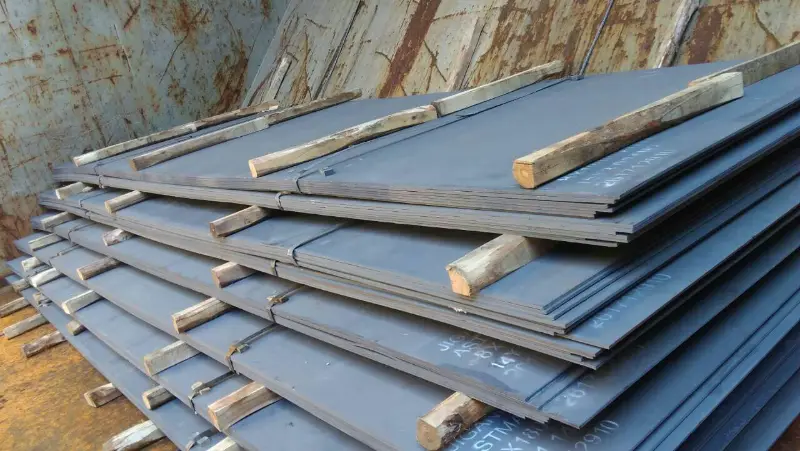
316H (S31609) Stainless Steel Plate/Coil
316H (S31609) Stainless Steel Plate/Coil: High-Temperature Austenitic Material Data
Comprehensive technical data for 316H (UNS S31609) stainless steel plate and coil, including chemistry, mechanical and physical properties, equivalents, and application guidelines per ASTM A240.
Hot rolling, cold rolling, solution annealing, forming, welding, machining
- Phone : +8618037372205
- Email : [email protected]
- WhatsApp: Contact via Whtsapp
- WeChat: +8618037372205
316H Stainless Steel Plate/Coil Introduction
Austenitic 316H (S31609) is a high-carbon modification of the classic 316 stainless steel, designed for enhanced creep resistance and strength at elevated temperatures. Its carbon content of 0.04–0.10% promotes a coarse grain structure (typically ASTM No. 7 or coarser) that improves high-temperature performance while maintaining excellent corrosion resistance in many aggressive environments, including chloride-containing media. This grade is widely used for pressure vessels, boiler components, and high-temperature piping systems. The plate and coil form is supplied in solution-annealed condition, offering good formability and weldability, making it a reliable choice for demanding industrial applications above 500°C (932°F) where standard austenitic grades may lose strength.
316H Stainless Steel Plate/Coil Chemical Composition per ASTM A240
The chemical requirements for UNS S31609 plate and coil are listed below. The controlled, relatively high carbon range ensures adequate high-temperature strength, while chromium, nickel, and molybdenum provide the characteristic corrosion resistance of the alloy. Elements like phosphorus and sulfur are kept low to preserve hot workability and weld quality. The analysis is representative of the heat and product analysis limits specified in the standard.
| Element | Standard Value (wt %) | Remarks |
|---|---|---|
| Carbon (C) | 0.04 – 0.10 | Key for high-temperature strength |
| Manganese (Mn) | ≤ 2.00 | – |
| Silicon (Si) | ≤ 0.75 | – |
| Phosphorus (P) | ≤ 0.045 | – |
| Sulfur (S) | ≤ 0.030 | – |
| Chromium (Cr) | 16.0 – 18.0 | – |
| Nickel (Ni) | 10.0 – 14.0 | – |
| Molybdenum (Mo) | 2.00 – 3.00 | Enhances pitting resistance |
| Iron (Fe) | Balance | – |
316H Stainless Steel Plate/Coil Thermal and Electrical Physical Properties
Physical property data for 316H are essentially identical to those of standard 316 stainless steel. Values are for the annealed condition and may vary slightly with temperature and processing. These data are useful for design calculations involving thermal expansion, heat transfer, and electrical considerations. Properties such as density, modulus, and thermal expansion are averaged values from recognized materials handbooks (e.g., ASM, ASTM datasheets).
| Property | Typical Value | Unit | Condition / Temperature |
|---|---|---|---|
| Density (ρ) | 8.0 | g/cm³ | 20°C |
| Modulus of Elasticity (E) | 193 | GPa | 20°C, tension |
| Shear Modulus (G) | 78 | GPa | 20°C, calculated |
| Poisson's Ratio (ν) | 0.30 | — | 20°C |
| Thermal Expansion (α) | 15.9 | μm/m·K | 20 – 100°C |
| Thermal Expansion (α) | 16.5 | μm/m·K | 20 – 300°C |
| Thermal Conductivity (λ) | 16.3 | W/m·K | 100°C |
| Thermal Conductivity (λ) | 21.5 | W/m·K | 500°C |
| Specific Heat Capacity | 500 | J/kg·K | 20°C |
| Electrical Resistivity (ρ_e) | 0.74 | μΩ·m | 20°C |
316H Stainless Steel Plate/Coil Mechanical Properties
The following mechanical properties are the standard requirements for solution-annealed 316H plate/coil tested at room temperature in accordance with ASTM A240. Elongation values vary depending on specimen gauge length and thickness. The specified grain size requirement (ASTM No. 7 or coarser) is a distinctive feature for the H-grade and is typically verified by microstructural examination. Hardness values are maxima and may not be specified in all purchase specifications but are commonly used as supplementary data.
| Property | Standard Requirement | Unit | Test Condition |
|---|---|---|---|
| Tensile Strength, Rm | ≥ 515 | MPa | Room temperature, transverse specimen, A240 |
| Yield Strength, Rp0.2 | ≥ 205 | MPa | Room temperature, transverse specimen, A240 |
| Elongation (50 mm gage length) | ≥ 40 | % | Thickness ≤ 4.57 mm (0.180 in) |
| Elongation (50 mm gage length) | ≥ 35 | % | Thickness > 4.57 to ≤ 19.05 mm (0.180 to 0.750 in) |
| Brinell Hardness, HBW | ≤ 217 | — | Typical maximum for annealed plate |
| Rockwell Hardness, HRB | ≤ 95 | — | Typical maximum for annealed plate |
316H Stainless Steel Plate/Coil Fully Equivalent Material Standards and Alternative Designations
| Country/Region | Standard | Designation | Remarks |
|---|---|---|---|
| USA | ASTM A240/A240M | 316H (UNS S31609) | Base specification for plate/sheet/coil |
| Japan | JIS G4304 | SUS316H | Hot-rolled stainless steel plate, sheet and strip |
| China | GB/T 4238 | 06Cr17Ni12Mo2 | Heat-resisting steel plate, equivalent carbon range |
| Europe | EN 10028-7 | X6CrNiMo17-13-2 (1.4919) | High temperature pressure purposes, similar chemistry (C 0.04–0.08, Mo 2.0–2.5) |
316H Stainless Steel Plate/Coil Application Introduction
316H stainless steel is engineered for long-term service at elevated temperatures (typically 500°C to 815°C) where creep and stress rupture properties are critical. Its combination of high-temperature strength and corrosion resistance makes it a primary material for pressure-containing equipment in the chemical, petrochemical, and power generation sectors. Components made from 316H plate and coil are often used in welded fabrications that require post-weld heat treatment capabilities and reliable through-thickness properties. Typical applications are described below.
Product Applications: Welded pressure vessels and tanks, Shell-and-tube heat exchangers, Boiler drums and waterwalls, High-temperature ducting and stacks, Furnace parts and radiant tubes, Flanges, fittings, and expansion joints
Processed into products: Tube sheets and baffle plates, Spiral heat exchanger plates, Reactor internal support rings and grids, Manhole covers and nozzles, Structural stiffeners for hot equipment, Transition joints between dissimilar metals
Application industries: Oil and gas refining (fired heaters, hydroprocessing units), Chemical processing (reactors, columns, high-temperature piping), Power generation (boilers, superheaters, steam separators), Nuclear engineering (structural components, heat exchangers), Petrochemical (ethylene crackers, reformers), Pulp and paper (digesters, liquor heaters)
316H Stainless Steel Plate/Coil Similar or Alternative Materials for High-Temperature Service
| Country/Region | Standard | Designation | Remarks |
|---|---|---|---|
| USA | ASTM A240 | 316L (S31603) | Low carbon; lower high-temperature strength but better sensitization resistance; suitable for lower service temperatures or corrosion-only applications. |
| USA | ASTM A240 | 304H (S30409) | High carbon 18-8 grade; lower alloy content, less corrosion resistance than 316H but similar creep strength; used where chloride pitting is not a concern. |
| USA | ASTM A240 | 321H (S32109) | Titanium-stabilized austenitic; excellent creep strength and resistance to intergranular corrosion in the 425–815°C range; often interchangeable with 316H in many high-temperature uses. |
| USA | ASTM A240 | 347H (S34709) | Niobium-stabilized; high creep strength similar to 321H; preferred for welded structures under high-temperature oxidizing environments. |
Notes:
316H must be supplied with a grain size of ASTM No. 7 or coarser to meet the H-grade requirements. Solution annealing at 1120–1170°C is essential to dissolve carbides and achieve the target microstructure. For service above 540°C, stress rupture strength is a key design parameter; consult ASME Boiler and Pressure Vessel Code for allowable design stresses. The material can be welded by all common processes (SMAW, GTAW, SAW) using matching or slightly overalloyed filler metals such as ER316H or E316H. Post-weld heat treatment is generally not required but may be applied to relieve stresses. In environments where sensitization is a concern, stabilization heat treatment or selection of stabilized grades (321H, 347H) should be considered.
- Share



