
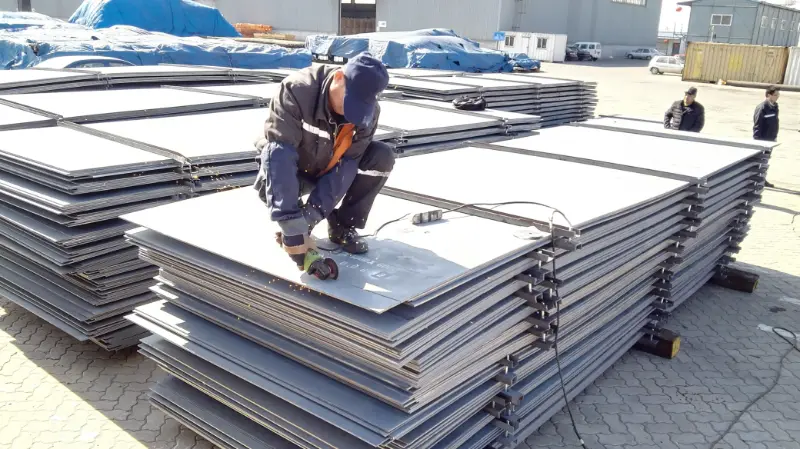
Austenitic 316Ti (S31635) Stainless Steel Plate/Coil
Austenitic 316Ti (S31635) Stainless Steel Plate/Coil: Titanium-Stabilized Excellence for Elevated Temperatures
Explore the comprehensive technical profile of 316Ti (UNS S31635) stainless steel plate and coil, a titanium-stabilized austenitic grade with superior intergranular corrosion resistance and strength at both cryogenic and high temperatures.
Hot rolling, cold rolling, annealing, pickling, welding, forming, machining
- Phone : +8618037372205
- Email : [email protected]
- WhatsApp: Contact via Whtsapp
- WeChat: +8618037372205
Austenitic 316Ti Stainless Steel Plate/Coil Introduction
316Ti (S31635) is a titanium-stabilized austenitic stainless steel, an enhanced version of standard 316, designed to prevent carbide precipitation during welding or elevated temperature service. The addition of titanium (typically 5×(C+N) min) stabilizes the structure against sensitization, enabling it to maintain corrosion resistance in the as-welded condition without post-weld annealing. It offers excellent general corrosion resistance, pitting resistance, and creep strength up to approximately 900°C (1650°F). The alloy retains non-magnetic properties in the annealed condition and can be slightly magnetic after cold working. Widely used in chemical processing, pressure vessels, heat exchangers, and nuclear reactor components, 316Ti plate/coil delivers reliable performance in aggressive environments containing chlorides, acids, and high-temperature oxidizing atmospheres.
Austenitic 316Ti Stainless Steel Plate/Coil Chemical Composition
The nominal chemical composition per ASTM A240/A240M and EN 10028-7. Titanium content is at least five times the sum of carbon and nitrogen to ensure full stabilization.
- Carbon limited to 0.08% maximum for good weldability.
- Molybdenum (2.00-3.00%) enhances pitting corrosion resistance.
- Chromium (16.0-18.0%) maintains basic corrosion protection.
| Element | Standard Value | Remarks |
|---|---|---|
| Carbon (C) | ≤0.08% | Reduced to maintain weldability |
| Silicon (Si) | ≤1.00% | Deoxidizer and strength contributor |
| Manganese (Mn) | ≤2.00% | Improves hot working properties |
| Phosphorus (P) | ≤0.045% | Typically lower in practice |
| Sulfur (S) | ≤0.030% | For machinability, but may be ≤0.015% for certain applications |
| Chromium (Cr) | 16.00-18.00% | Essential for corrosion resistance |
| Nickel (Ni) | 10.00-14.00% | Promotes austenitic structure |
| Molybdenum (Mo) | 2.00-3.00% | Pitting and crevice corrosion resistance |
| Titanium (Ti) | 5×(C+N) ≤ Ti ≤ 0.70% | Stabilization element to tie up carbon and nitrogen |
| Nitrogen (N) | ≤0.10% | Austenitic stabilizer, balances Ti addition |
| Iron (Fe) | Balance | Remainder |
Austenitic 316Ti Stainless Steel Plate/Coil Thermal, Electrical, and Physical Properties
Physical properties representative of solution-annealed 316Ti. Slight variations occur based on product form and temperature.
- Density: 8.0 g/cm³
- Elastic Modulus (E): Approx. 193 GPa at 20°C
- Coefficient of Thermal Expansion: 16.0 × 10⁻⁶/K (20-100°C) to 18.0 × 10⁻⁶/K (20-600°C)
- Thermal Conductivity: ~15 W/m·K at 20°C
| Property | Typical Value | Unit | Test Condition / Temperature |
|---|---|---|---|
| Density (ρ) | 8.0 | g/cm³ | 20°C |
| Elastic Modulus (E) | 193 | GPa | 20°C |
| Shear Modulus (G) | 77 | GPa | 20°C (calculated from E and ν) |
| Poisson's Ratio (ν) | 0.30 | – | At room temperature |
| Coefficient of Thermal Expansion (α) | 16.0 | 10⁻⁶/K | 20-100°C |
| Coefficient of Thermal Expansion (α) | 16.3 | 10⁻⁶/K | 20-200°C |
| Coefficient of Thermal Expansion (α) | 17.0 | 10⁻⁶/K | 20-400°C |
| Coefficient of Thermal Expansion (α) | 18.0 | 10⁻⁶/K | 20-600°C |
| Thermal Conductivity (λ) | 15.0 | W/(m·K) | 20°C |
| Thermal Conductivity (λ) | 18.0 | W/(m·K) | 200°C |
| Thermal Conductivity (λ) | 22.0 | W/(m·K) | 600°C |
| Specific Heat Capacity (c) | 500 | J/(kg·K) | 20°C |
| Electrical Resistivity (ρ_e) | 0.73 × 10⁻⁶ | Ω·m | 20°C |
Austenitic 316Ti Stainless Steel Plate/Coil Mechanical Properties
Minimum mechanical properties as per ASTM A240/A240M for plate and coil, thickness up to specified limits. Actual properties depend on product form and thickness.
- Tensile Strength (Rm): ≥515 MPa (74.7 ksi)
- Yield Strength (ReH: 0.2% offset): ≥205 MPa (29.7 ksi)
- Elongation (A): ≥40% in 50mm for thickness ≤19 mm (0.75 in)
- Hardness: ≤95 HRB or ≤217 HB
| Property | Standard Requirement | Unit | Test Condition |
|---|---|---|---|
| Yield Strength (ReH, 0.2% offset) | ≥205 (205-345 typical) | MPa | Room temperature, transverse, thickness ≤ specified |
| Yield Strength (ReH, 0.2% offset) | ≥205 | MPa | At 100°C (212°F) typical ~190-220 |
| Tensile Strength (Rm) | ≥515 (515-690 typical) | MPa | Room temperature |
| Elongation (A) | ≥40 (50mm gauge) | % | Thickness ≤ 19.05 mm (0.75 inch) |
| Elongation (A) | ≥30 (200mm gauge) | % | Thickness ≤ 19.05 mm, strip/coil |
| Hardness, Brinell | ≤217 HB | HB | As per ASTM E10 |
| Hardness, Rockwell B | ≤95 HRB | HRB | As per ASTM E18 |
| Bending Test (Mandrel Diameter) | No cracks, 180° bend | – | Diameter = 1 × thickness for plates up to 12.7 mm; welded specimens if applicable |
| Impact Energy (KV, Charpy) | ≥60 (typical at 20°C) | J | Longitudinal, 10×10 mm specimen (not mandatory in base spec) |
Austenitic 316Ti Stainless Steel Plate/Coil Fully Equivalent Material Standards and Substitute Grades
| Country/Region | Standard | Grade / Designation | Remarks |
|---|---|---|---|
| USA | ASTM A240/A240M | 316Ti (UNS S31635) | Plate, sheet, and strip; equivalent to 316 stabilized with Ti |
| Germany/EU | EN 10028-7, EN 10088-2 | X6CrNiMoTi17-12-2 (1.4571) | Plate and strip; fully equivalent |
| China | GB/T 3280, GB/T 4237 | 06Cr17Ni12Mo2Ti (old name: 0Cr18Ni12Mo2Ti) | Cold/hot rolled plate and strip; Ti-stabilized 316 |
| Japan | JIS G4304, JIS G4305 | SUS316Ti | Hot/cold rolled stainless steel plate, sheet and strip |
| International | ISO 15510 | X6CrNiMoTi17-12-2 | Stainless steel grades for pressure purposes |
| UK | BS EN 10028-7 / BS EN 10088-2 | 316S31 (1.4571) | Same as European grade |
| France | NF EN 10028-7 | Z6CNDT17-12 | Equivalent to 1.4571 |
Austenitic 316Ti Stainless Steel Plate/Coil Application Introduction
316Ti plate and coil are selected for environments requiring resistance to intergranular corrosion after welding, combined with service temperatures from cryogenic to about 900°C. The material's titanium stabilization eliminates the need for post-weld heat treatment in many applications, saving cost and time. It is particularly suited for thick-section welded components that cannot be solution annealed after fabrication. Typical uses include chemical process equipment, heat exchangers, pressure vessels operating at elevated temperatures, exhaust systems, and boiler internals.
Product Applications: Welded chemical reactors and storage tanks, Distillation columns and fractionators, Shell-and-tube heat exchangers, Boiler tubes and superheater tubes, Spiral-wound heat exchanger gaskets, Flanges, fittings, and piping, Process instrumentation housings, Elevated-temperature ductwork and expansion joints
Processed into products: Pressure vessels and columns (fabricated from plate), Heat exchanger tube sheets and baffles, Reactor internal cladding and linings, Welded pipe coils for heating/cooling, Pump casings and impellers (when castings not applicable), Fasteners for high-temperature service (nuts and bolts from plate/bar), Cryogenic vessel parts (plate material for LNG storage), Automotive exhaust system components (muffler internals, catalytic converter shells)
Application industries: Chemical and Petrochemical Processing, Oil and Gas (offshore/onshore), Power Generation (fossil and nuclear), Pharmaceutical and Food Processing, Pulp and Paper, Marine Engineering, Environmental and Water Treatment, Architectural and Construction (when high corrosion resistance is needed)
Austenitic 316Ti Stainless Steel Plate/Coil Similar / Alternative Material Recommendations
| Country/Region | Standard | Grade / Designation | Remarks |
|---|---|---|---|
| USA | ASTM A240 | 316L (UNS S31603) | Ultra-low carbon variant (C≤0.03). Provides similar corrosion resistance without Ti stabilization, suitable for medium temperature applications. |
| USA | ASTM A240 | 316 (UNS S31600) | Standard Mo-bearing grade without Ti; susceptible to sensitization in weld HAZ. Not recommended for high-temperature corrosion service without post-weld anneal. |
| USA/EU | ASTM A240 / EN 1.4541 | 321 (UNS S32100), X6CrNiTi18-10 | Ti-stabilized, but without Mo. Lower pitting resistance than 316Ti. Used in similar applications where Mo is not required. |
| EU | EN 10028-7 | X6CrNiMoTi17-12-3 (1.4435) | Higher Mo variant (2.5-3.5% Mo), fully stabilized, for enhanced corrosion resistance over 316Ti. |
| Global | – | Duplex 2205 (UNS S31803/S32205) | Provides higher strength and better stress corrosion cracking resistance, but different weldability and temperature limits. Not direct substitute but usable in some chemical environments. |
Notes:
Welding considerations: 316Ti can be welded with matching filler metals like ER316Ti or equivalent. Shielding gas typically argon or helium-argon mixtures. Proper post-weld cleaning to remove heat tint is essential to maintain full corrosion resistance. The alloy exhibits good resistance to sigma phase formation up to 870°C but prolonged exposure in the 540-870°C range should be avoided if high toughness is required. Machining: Work hardening rate is similar to 316; use sharp tools, rigid setups, and positive feeds. Annealed condition offers best machinability. Standards variations: Plate and coil may be supplied to ASTM A240 with supplementary requirements like increased mechanical testing, ultrasonic examination (ASTM A480), or specific surface finishes (e.g., No. 1, 2B, 2D). EN 10088-2 provides similar finish designations.
- Share



