
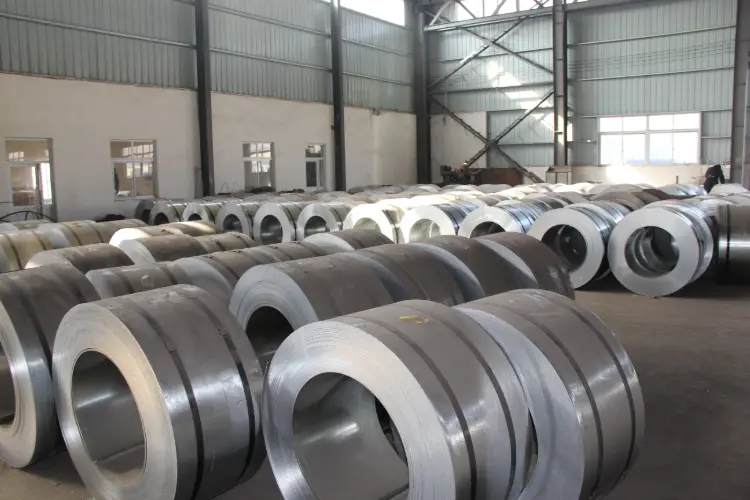
DNV A32 Shipbuilding Steel Coil
DNV A32 Shipbuilding Steel Coil – High-Strength Hull Structural Steel for Marine Applications
Comprehensive technical data for DNV A32 shipbuilding steel coil according to DNV rules: chemical composition, mechanical properties, thermal and electrical physical properties, equivalent grades, and application guidance.
Cutting, welding, bending, forming, machining
- Phone : +8618037372205
- Email : [email protected]
- WhatsApp: Contact via Whtsapp
- WeChat: +8618037372205
DNV A32 Shipbuilding Steel Coil Introduction
DNV A32 is a high-strength hull structural steel grade certified by Det Norske Veritas (DNV), designed for marine and offshore applications. It offers a minimum yield strength of 315 MPa and excellent weldability, making it suitable for critical ship structures subjected to high stress and low-temperature environments. Typically supplied as thermomechanically rolled or normalized, A32 provides good toughness at 0°C and complies with international classification society standards. Its balanced chemistry ensures reliable performance in plate and coil form for ship hulls, decks, and bulkheads.
DNV A32 Shipbuilding Steel Coil Chemical Composition
The chemical composition of DNV A32 steel is controlled to ensure adequate strength, toughness, and weldability. The table below shows the ladle analysis limits according to DNV Rules Pt.2 Ch.2. Fine grain practice is mandatory, typically achieved by sufficient aluminium or other grain-refining elements. Residual elements like Cr, Ni, Cu, and Mo may be present but are not intentionally added beyond the specified limits unless agreed.
| Element | Standard Value (max, unless range) | Remarks |
|---|---|---|
| C (Carbon) | ≤ 0.18% | Strengthening element |
| Si (Silicon) | ≤ 0.50% | Deoxidizer |
| Mn (Manganese) | 0.90 – 1.60% | Strength and toughness |
| P (Phosphorus) | ≤ 0.035% | Impurity, limited for toughness |
| S (Sulfur) | ≤ 0.035% | Impurity, limited for ductility |
| Al (Acid-soluble) | ≥ 0.015% | Grain refinement; total Al ≥ 0.020% if not acid-soluble |
| Nb (Niobium) | ≤ 0.05% | Microalloy (optional, may be used for grain refinement) |
| V (Vanadium) | ≤ 0.10% | Microalloy (optional) |
| Ti (Titanium) | ≤ 0.02% | Microalloy (optional) |
| Cr (Chromium) | ≤ 0.20% | Residual element |
| Ni (Nickel) | ≤ 0.40% | Residual element |
| Cu (Copper) | ≤ 0.35% | Residual element |
| Mo (Molybdenum) | ≤ 0.08% | Residual element |
| N (Nitrogen) | ≤ 0.009% | Unless sufficient Al or Ti present |
| CEV (Carbon equivalent) | ≤ 0.38% (formula: C+Mn/6+(Cr+Mo+V)/5+(Ni+Cu)/15) | For weldability control |
DNV A32 Shipbuilding Steel Coil Thermal and Electrical Physical Properties
Listed physical properties are typical for DNV A32 steel and are based on industry-accepted values for low-carbon structural steels. These properties are not subject to mandatory certification under DNV rules but are essential for design calculations and fabrication processes. Values are valid at room temperature unless otherwise noted.
| Property | Typical Value | Unit | Test Condition / Temperature |
|---|---|---|---|
| Density (ρ) | 7.85 | g/cm³ | 20 °C |
| Modulus of Elasticity (E) | 205 – 210 | GPa | 20 °C |
| Shear Modulus (G) | approx. 80 | GPa | 20 °C |
| Poisson's Ratio (ν) | 0.3 | – | 20 °C (elastic range) |
| Thermal Expansion Coefficient (α) | 11.9 – 12.5 | 10⁻⁶ /K | 20 °C to 100 °C |
| Thermal Conductivity (λ) | 50 – 52 | W/(m·K) | 20 °C |
| Specific Heat Capacity (cp) | 460 | J/(kg·K) | 20 °C |
| Electrical Resistivity (ρ_e) | 0.18 – 0.25 | μΩ·m | 20 °C |
DNV A32 Shipbuilding Steel Coil Mechanical Properties
The mechanical properties of DNV A32 are determined from tensile and impact tests on specimens sampled from the coil/plate according to DNV Rules. Values depend on product thickness and test direction. The table presents mandatory requirements for thickness ≤ 50 mm. Impact test temperature is 0°C and longitudinal specimens are standard; transverse values may be specified. Bending test mandrel diameter is expressed as multiples of specimen thickness (a).
| Property | Required Value | Unit | Test Condition |
|---|---|---|---|
| Yield Strength (ReH) | ≥ 315 | MPa | Transverse; thickness ≤ 50 mm |
| Yield Strength (ReH) | ≥ 315 | MPa | Longitudinal; thickness ≤ 50 mm (min 10 MPa less if specified) |
| Tensile Strength (Rm) | 440 – 570 | MPa | Transverse; thickness ≤ 50 mm |
| Elongation (A5) | ≥ 22 | % | Longitudinal; gauge length 5.65√So; thickness ≤ 50 mm |
| Impact Energy (KV) at 0°C | ≥ 31 (average of 3, min single 22) | J | Longitudinal; V-notch; thickness ≤ 50 mm |
| Bend Test (180°) | No cracks or defects | – | Mandrel diameter = 3a (a = specimen thickness); test piece width ≥ 30 mm |
DNV A32 Shipbuilding Steel Coil Complete Equivalents – Equivalent Standards and Replacement Grades
The following classification society grades are considered fully equivalent to DNV A32 in terms of composition, mechanical properties, and intended use. They can be mutually substituted subject to agreement between the parties and compliance with the respective society's rules.
| Country / Region | Standard | Grade | Remarks |
|---|---|---|---|
| Norway / International | DNV Rules | A32 | Original grade |
| USA / International | ABS Rules | A32 | American Bureau of Shipping – identical requirements |
| UK / International | LR Rules | A32 | Lloyd's Register – identical requirements |
| France / International | BV Rules | A32 | Bureau Veritas – identical requirements |
| China | CCS Rules | A32 | China Classification Society – identical requirements |
| Japan | NK Rules | KA32 | Nippon Kaiji Kyokai (ClassNK) – notation KA32 |
| South Korea | KR Rules | RA32 | Korean Register – notation RA32 |
| Italy | RINA Rules | A32 | Registro Italiano Navale – identical requirements |
| Germany / International | DNV GL (now DNV) Rules | A32 | Historic GL A32; now merged into DNV |
DNV A32 Shipbuilding Steel Coil Application Introduction
DNV A32 steel coil is widely used in marine construction because it combines high strength (315 MPa yield) with good toughness at 0°C, ensuring structural integrity in harsh sea environments. It is suitable for fabricating large panels, stiffened structures, and parts that require forming and welding. The coil form allows efficient cutting and processing for standardized parts. The steel can be cold bent to moderate radii and is compatible with all common welding methods, provided preheating and interpass temperatures are observed when thickness or carbon equivalent demands. Delivery with class certificates ensures traceability and compliance with statutory requirements.
Product Applications: Hull plates and shell plating, Decks, tank tops, and bulkheads, Longitudinal stiffeners and girders, Hatch coamings and covers, Superstructure and deckhouse frames, Barge and floating crane structures, Offshore module substructures
Processed into products: Cut and formed hull sections from coil, Flanged stiffeners and brackets, Web frames and stringers, Pipe supports and equipment foundations, Corrugated bulkhead panels, Accommodation ladders and platforms, Local reinforcements and doubling plates
Application industries: Shipbuilding and ship repair, Offshore oil & gas platforms, Marine engineering and heavy fabrication, Port and harbor construction, Offshore wind energy structures
DNV A32 Shipbuilding Steel Coil Similar and Nearby Substitute Materials
The following grades are often regarded as similar to DNV A32 but differ slightly in impact test temperature, strength level, or delivery condition. They are often used in adjacent applications and may serve as alternatives with careful assessment of requirements.
| Country / Region | Standard | Grade | Remarks |
|---|---|---|---|
| Norway / International | DNV Rules | A27 | Normal strength hull steel (min yield 235 MPa), not direct substitute; lower strength |
| Norway / International | DNV Rules | D32 | Same strength as A32, but impact tested at -20°C; better low-temperature toughness |
| Norway / International | DNV Rules | E32 | Same strength as A32, impact tested at -40°C; for cryogenic conditions |
| Norway / International | DNV Rules | AH32 | High strength hull steel with additional through-thickness property requirements (Z-test) for critical joints |
| International | EN 10025-4 | S355M / S355ML | Thermomechanically rolled structural steel with min yield 355 MPa, similar but not ship-certified without additional testing |
| USA | ASTM A131 | A131 Grade A32 | ASTM shipbuilding grade A32, equivalent but may have slight differences in CEV limits |
Notes:
Additional notes:
- DNV A32 is typically delivered in the thermomechanically rolled (TMCP) or normalized condition. TMCP steels should not be hot formed or heat treated above 600°C without re-qualification of properties.
- For thicknesses above 50 mm, mechanical properties and chemical limits may be subject to agreement; typical maximum thickness for A32 coil is around 20 mm.
- Impact test temperature of 0°C refers to standard DNV requirements for grade A. If lower temperatures are needed, grades D32 (-20°C) or E32 (-40°C) shall be specified.
- Carbon Equivalent Value (CEV) is normally ≤ 0.38% for thickness ≤ 50 mm; for greater thickness, a lower CEV may be recommended to avoid cold cracking.
- Material certificates to EN 10204 Type 3.1 or 3.2 are standard for shipbuilding grades.
- Share



