
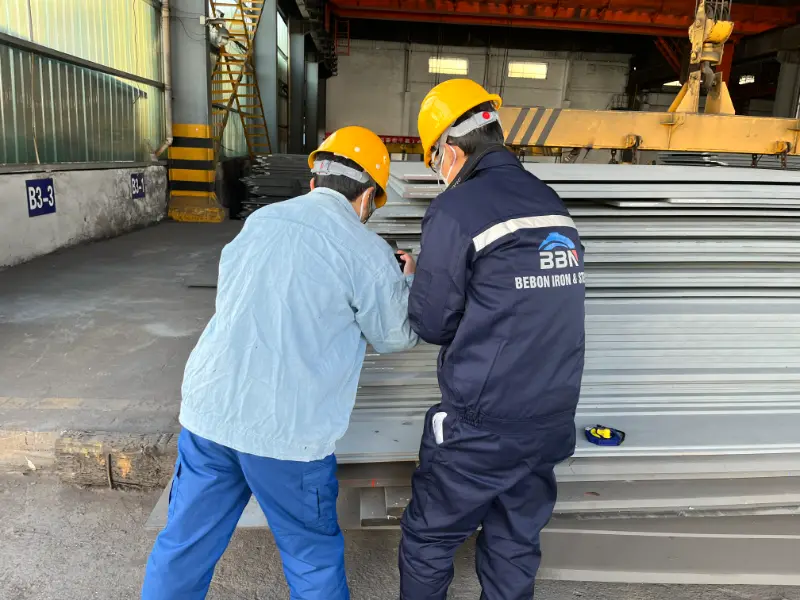
DNV F620 High-Strength Shipbuilding Steel
DNV F620 High-Strength Shipbuilding Steel - Premium Quenched & Tempered Grade for Offshore and Marine Structures
DNV F620 is an ultra-high-strength, quenched and tempered shipbuilding steel with a minimum yield strength of 620 MPa. Certified by DNV, it offers excellent weldability, toughness, and resistance to harsh marine environments, ideal for critical structural components in shipbuilding, offshore platforms, and heavy engineering.
Welding, cold forming, bending, gas cutting, machining, and blasting/painting
- Phone : +8618037372205
- Email : [email protected]
- WhatsApp: Contact via Whtsapp
- WeChat: +8618037372205
DNV F620 High-Strength Shipbuilding Steel Introduction
DNV F620 is an ultra-high-strength structural steel grade governed by DNV (Det Norske Veritas) rules for shipbuilding and offshore applications. It belongs to the extra-high-strength hull structural steel category and is typically supplied in a quenched and tempered (Q&T) condition. The steel exhibits a minimum yield strength of 620 MPa and excellent low-temperature toughness, making it suitable for critical, highly stressed parts of ships, offshore platforms, and marine structures.
Key features include:
- High strength-to-weight ratio enabling lighter, more efficient designs
- Good weldability with appropriate preheating and consumables
- Excellent resistance to brittle fracture even at low temperatures
- Stringent quality control to meet DNV certification requirements
- Available in plates and coils suitable for forming, cutting, and welding
DNV F620 High-Strength Shipbuilding Steel Chemical composition
The typical chemical composition for DNV F620 is defined by DNV rules. Elements are controlled to ensure high strength, good weldability, and low-temperature toughness. The table below shows maximum allowable values unless a range is specified. Carbon equivalent (CEV) is generally limited to ≤0.56% (or as per thickness) to guarantee weldability.
| Element | Standard value (%) | Remarks |
|---|---|---|
| Carbon (C) | ≤ 0.20 | Typical max. for ladle analysis; lower C improves weldability |
| Silicon (Si) | ≤ 0.55 | Deoxidizer and strength contributor |
| Manganese (Mn) | 0.90 – 1.60 | Key strengthening element; upper range for thickness >50 mm may be adjusted |
| Phosphorus (P) | ≤ 0.025 | Low P to avoid temper embrittlement and improve toughness |
| Sulfur (S) | ≤ 0.025 | Low S for ductility and through-thickness properties |
| Aluminum (Al, acid soluble) | ≥ 0.015 | Grain refining element |
| Niobium (Nb) | ≤ 0.05 | Micro-alloying for grain refinement and strengthening |
| Vanadium (V) | ≤ 0.10 | Precipitation strengthening |
| Titanium (Ti) | ≤ 0.02 | Grain refinement and inclusion control |
| Chromium (Cr) | ≤ 0.25 | Optional; may be present as residual or for strength |
| Nickel (Ni) | ≤ 0.40 | Improves toughness; may be higher for thicker sections |
| Molybdenum (Mo) | ≤ 0.08 | Enhances hardenability and high-temperature strength |
| Copper (Cu) | ≤ 0.30 | Residual; may be higher if corrosion resistance is required |
| Nitrogen (N) | ≤ 0.012 | Controlled to avoid strain aging |
| Boron (B) | ≤ 0.0005 | Only if added for hardenability (seldom used in F620) |
DNV F620 High-Strength Shipbuilding Steel Thermal and electrical physical properties
The following physical properties are typical for quenched and tempered high-strength low-alloy steel of this strength class. Actual values may vary slightly depending on exact chemical composition and heat treatment. These data are useful for design, welding procedure qualification, and thermal analysis.
- Density, elastic modulus, and thermal expansion are consistent with standard structural steels.
- Thermal conductivity and specific heat capacity influence preheating and interpass temperatures during welding.
| Property | Typical value | Unit | Test conditions / Remarks |
|---|---|---|---|
| Density (ρ) | 7850 | kg/m³ | At 20 °C |
| Elastic modulus (E) | 205 | GPa | In tension, room temperature |
| Shear modulus (G) | 80 | GPa | Calculated; E/[2(1+ν)] |
| Poisson's ratio (ν) | 0.3 | — | In elastic range |
| Thermal expansion coefficient (α) | 11.5 × 10⁻⁶ | K⁻¹ | Average between 20 °C and 100 °C; increases at higher temperatures |
| Thermal conductivity (λ) | 42 | W/(m·K) | At 20 °C; decreases with increasing temperature |
| Specific heat capacity (Cp) | 460 | J/(kg·K) | At 20 °C; typical for low-alloy steels |
| Electrical resistivity (ρ_e) | 0.25 × 10⁻⁶ | Ω·m | At 20 °C |
DNV F620 High-Strength Shipbuilding Steel Mechanical properties
Mechanical properties are based on DNV class rules for thickness ≤100 mm. Values may vary slightly depending on thickness and product form. Testing is usually performed at room temperature for tensile tests and at specified low temperatures for impact toughness.
- Yield strength (ReH) and tensile strength (Rm) are mandatory.
- Elongation (A) measured on gauge length 5.65√S0 (A5) or proportional.
- Charpy V-notch impact energy (KV) tested at -20 °C (or -40 °C for F grade designation in some rules).
- Bend test: 180° over former diameter = 3 × thickness (t) for plates up to 50 mm.
| Property | Minimum required value | Unit | Test conditions |
|---|---|---|---|
| Yield strength (ReH) | 620 | MPa | Ambient temperature, transverse direction; for thickness ≤100 mm |
| Tensile strength (Rm) | 720 – 890 | MPa | Ambient temperature, transverse direction |
| Elongation after fracture (A) | 14 | % | Gauge length 5.65√S0, transverse, for thickness ≤100 mm |
| Yield-to-tensile ratio (ReH/Rm) | ≤ 0.90 for thickness ≤50 mm ≤ 0.92 for 50< t ≤100 mm | — | Required to ensure sufficient deformability (may not be mandated in all editions) |
| Charpy impact energy (KV) | 27 (average of 3 tests, minimum single value 19) | J | Test temperature: -20 °C, longitudinal direction; for plate thickness ≤50 mm; for thicker plates see DNV rules |
| Bend test (180°) | No cracks or defects | — | Bending over a mandrel diameter = 3t (t = plate thickness) for plates up to 50 mm thickness |
DNV F620 High-Strength Shipbuilding Steel Completely equivalent material grades under different classification societies
| Country/Region | Standard | Grade | Remarks |
|---|---|---|---|
| Norway (DNV) | DNV-OS-B101 / Ship Rules | F620 | Original class; also covered as NV F620 in older certifications |
| USA (ABS) | ABS Rules for Materials and Welding | EQ620 | Extra-high-strength quenched and tempered steel; equivalent minimum yield 620 MPa |
| UK (LR) | Lloyd's Register Rules | FH620 | FH denotes high-strength Q&T steel; same mechanical requirements |
| France (BV) | Bureau Veritas Rules | AH620 / DH620 / EH620 / FH620 | Prefix A, D, E, F denote impact test temperatures (0, -20, -40, -60 °C). FH620 is fully equivalent to F620. |
| China (CCS) | CCS Rules for Materials and Welding | F620 | Direct equivalent with identical mechanical and chemical requirements |
| Japan (NK) | ClassNK Rules | K620 | High-strength steel grade K620 corresponds to 620 MPa yield |
| Italy (RINA) | RINA Rules | F620 | Equivalent high-strength hull structural steel |
| Korea (KR) | Korean Register Rules | F620 | Same as other IACS member societies |
| Poland (PRS)/Croatia (CRS)/India (IRS) | Respective rules | F620 or similar | Most IACS class societies adopt equivalent designations |
DNV F620 High-Strength Shipbuilding Steel Application Introduction
DNV F620 steel is engineered for demanding structural applications where high strength, good weldability, and reliable low-temperature toughness are essential. Proper handling, including preheating before welding and post-weld heat treatment if required, is critical to maintain mechanical properties. Typical applications span the marine, offshore, and heavy-lifting industries.
Product Applications: Hull plates and stiffeners in the main deck, bottom, and side shells, Legs and rack chords of self-elevating offshore platforms (jack-ups), Boom and jib sections of heavy-duty offshore cranes, Transition pieces for offshore wind monopiles, Heavy machinery support structures on vessels
Processed into products: Ship hull plates (longitudinal and transverse frames), Strengthened stringers and girders, Crane pedestals and slewing rings, Leg components for jack-up rigs, Fatigue-critical welded nodes in offshore tubular structures, Reinforcement pads and inserts in high-stress zones
Application industries: Shipbuilding (military and commercial vessels, icebreakers), Offshore oil & gas platforms (jackets, decks, topsides, modules), Offshore wind turbine foundations (monopiles, transition pieces), Crane and heavy-lifting equipment manufacturing, Pressure vessels and boilers for marine service, Bridges and infrastructure in corrosive marine environments
DNV F620 High-Strength Shipbuilding Steel Similar / alternative materials with comparable strength level
| Country/Region | Standard | Grade | Remarks |
|---|---|---|---|
| Europe | EN 10025-6 | S690QL / S690QL1 | Quenched and tempered structural steel with minimum yield 690 MPa; slightly higher strength, but often used in analogous marine/offshore applications if certified by classification society |
| USA | ASTM A514 / A517 | Grade F, Q, S, etc. | Quenched and tempered alloy steel plates for structural and pressure vessel use; yield ~690 MPa; can be considered but requires project-specific approval for shipbuilding |
| International | ISO 4885 | ISO 630-6: S690Q | Harmonized standard for high-strength Q&T steel; similar to EN S690QL |
| Norway | DNV | F690 | DNV grade with 690 MPa yield; higher strength alternative if weight savings are critical |
| European offshore | EN 10225 | S620G2+M / S620G2+QT | Weldable structural steels for fixed offshore structures; specifically designed for offshore use, similar strength |
Notes:
Welding recommendations: Preheating to 100–150 °C is typically required depending on plate thickness and combined plate thickness. Use low-hydrogen welding consumables (E11018-M or equivalent) and control interpass temperature. Post-weld heat treatment (PWHT) is generally not required but may be specified for stress relief in highly restrained joints.
Corrosion protection: The steel is not inherently corrosion-resistant; suitable coatings (e.g., epoxy-based) or cathodic protection must be applied in offshore environments.
Certification: All plates must be stamped with the manufacturer's mark, grade, heat number, and DNV surveyor's stamp. Mechanical testing must be witnessed by a DNV surveyor.
Thickness limits: Maximum thickness for guaranteed properties is usually 100 mm; thicker plates may require special agreement and additional testing.
- Share



