
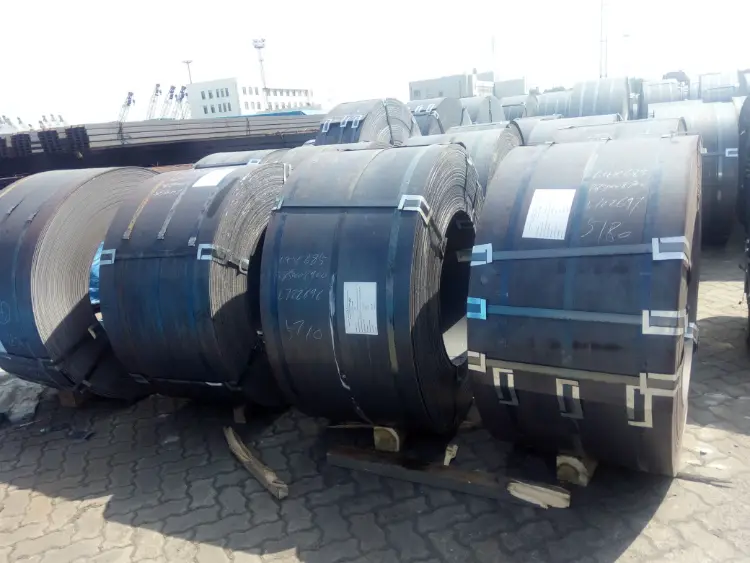
DNV E620 Shipbuilding Steel Coil
DNV E620 Shipbuilding Steel Coil: High-Strength Marine Grade Properties & Global Equivalents
Explore complete material data for DNV E620 shipbuilding steel coil: chemical composition, mechanical and thermal properties, international equivalents, and typical applications in shipbuilding and offshore structures.
Welding (SMAW, SAW, GMAW), plasma/laser cutting, cold forming, bending, machining
- Phone : +8618037372205
- Email : [email protected]
- WhatsApp: Contact via Whtsapp
- WeChat: +8618037372205
DNV E620 Shipbuilding Steel Coil Introduction
DNV E620 is a high-strength low-alloy structural steel specified by Det Norske Veritas (DNV) for marine and offshore applications. With a minimum yield strength of 620 MPa, it is designed for weight-critical welded structures such as ship hulls, naval vessels, and offshore platforms. The steel is typically supplied in quenched and tempered (Q&T) or thermo-mechanically controlled processed (TMCP) condition, ensuring a fine-grained microstructure that delivers excellent toughness at low temperatures (down to -40°C) and good weldability. Key features:
- High yield strength of 620+ MPa enables thinner sections and weight reduction
- Exceptional impact toughness at -40°C meets the strictest notch ductility requirements for polar and cold-water service
- Controlled chemistry and low carbon equivalent (CEV) facilitate welding without excessive preheat
- Available in coil and plate form for efficient fabrication
- Approved by major classification societies under the unified IACS UR W11 requirements
DNV E620 is ideal for critical structural members subjected to high static and dynamic loads in harsh environments.
DNV E620 Shipbuilding Steel Coil Chemical Composition
Typical ladle analysis limits for DNV E620 steel according to IACS UR W11 and common mill practice. Values are maximum unless a range is indicated. The steel is fine-grain treated and contains microalloying elements (Nb, V, Ti) to achieve high strength and toughness. Key points:
- Low carbon content ensures good weldability and low CEV
- Manganese and silicon contribute to strength and deoxidation
- Microalloying with niobium, vanadium, and titanium for grain refinement
- Strict control of phosphorus and sulfur to avoid brittleness and improve through-thickness properties
| Element | Standard Value (wt%) | Remarks |
|---|---|---|
| Carbon (C) | ≤ 0.20 | Maximum, based on ladle analysis |
| Silicon (Si) | 0.10 – 0.55 | Typical range |
| Manganese (Mn) | 0.80 – 1.60 | Typical range, adjusted for strength and CEV |
| Phosphorus (P) | ≤ 0.025 | Maximum |
| Sulfur (S) | ≤ 0.015 | Maximum (lower for Z-grade) |
| Chromium (Cr) | ≤ 0.80 | Maximum |
| Nickel (Ni) | ≤ 0.80 | Maximum (may be higher for thicker products) |
| Molybdenum (Mo) | ≤ 0.30 | Maximum |
| Copper (Cu) | ≤ 0.35 | Maximum |
| Vanadium (V) | ≤ 0.10 | Maximum |
| Titanium (Ti) | ≤ 0.05 | Maximum, grain refiner |
| Niobium (Nb) | ≤ 0.05 | Maximum, grain refiner |
| Aluminum (Al) total | 0.015 – 0.050 | Grain refining, acid soluble minimum |
| Nitrogen (N) | ≤ 0.012 | Maximum |
| Boron (B) | ≤ 0.0005 | Maximum, if added for hardenability |
| Carbon Equivalent (CEV) | ≤ 0.57 (t ≤ 50 mm) | CEV = C + Mn/6 + (Cr+Mo+V)/5 + (Ni+Cu)/15, typically controlled per DNV |
DNV E620 Shipbuilding Steel Coil Thermal and Electrical Physical Properties
The following physical properties are typical for quenched and tempered high-strength structural steels of this alloy class (density, elastic modulus, thermal conductivity are not part of DNV specification but are representative for grades similar to S620Q/Weldox 700). Values serve as engineering estimates and may vary with exact chemical composition and heat treatment.
| Property | Typical Value | Unit | Test Condition |
|---|---|---|---|
| Density (ρ) | 7.85 | g/cm³ | At 20°C |
| Elastic modulus (E) | 210 | GPa | At 20°C, tensile |
| Shear modulus (G) | ~80 | GPa | Calculated from E and ν |
| Poisson's ratio (ν) | 0.3 | – | Elastic range |
| Thermal expansion coefficient (α) | 11.5 × 10⁻⁶ | K⁻¹ | 20 – 100°C |
| Thermal expansion coefficient (α) | 12.5 × 10⁻⁶ | K⁻¹ | 20 – 300°C |
| Thermal conductivity (λ) | ~35 | W/(m·K) | At 20°C |
| Specific heat capacity (cp) | ~460 | J/(kg·K) | At 20°C |
| Electrical resistivity (ρe) | ~0.23 × 10⁻⁶ | Ω·m | At 20°C |
DNV E620 Shipbuilding Steel Coil Mechanical Properties
Mechanical properties according to DNV-OS-B101 and IACS UR W11 for E620 grade, tested in the transverse direction at room temperature unless specified otherwise. Charpy V-notch impact tests are performed at -40°C. Note: Minimum values vary with product thickness; multi-row entries indicate requirements for different thickness ranges.
| Property | Required Value | Unit | Test Condition |
|---|---|---|---|
| Yield strength (ReH) | ≥ 620 | MPa | Thickness ≤ 50 mm |
| Yield strength (ReH) | ≥ 580 | MPa | Thickness > 50 mm up to 100 mm |
| Yield strength (ReH) | ≥ 540 | MPa | Thickness > 100 mm up to 150 mm |
| Tensile strength (Rm) | 720 – 890 | MPa | Thickness ≤ 50 mm |
| Tensile strength (Rm) | 700 – 890 | MPa | Thickness > 50 mm up to 100 mm |
| Elongation (A, L0 = 5.65√So) | ≥ 14 | % | Thickness ≤ 50 mm; longitudinal specimen |
| Elongation (A, L0 = 5.65√So) | ≥ 13 | % | Thickness > 50 mm ≤ 100 mm |
| Impact energy (KV2) | ≥ 27 | J | Longitudinal, -40°C; average of 3 tests |
| Impact energy (KV2) single value | ≥ 20 | J | Individual minimum value at -40°C |
| Bending test | No cracks, bend angle 180° | – | Mandrel diameter = 4t (t = specimen thickness); room temperature |
DNV E620 Shipbuilding Steel Coil Exactly Equivalent Standard Grades
| Country/Region | Standard | Grade | Remarks |
|---|---|---|---|
| International | IACS UR W11 | EH620 | Unified requirement for high-strength hull structural steel; basis for all major classification societies |
| USA | ABS Rules | ABS EH620 | American Bureau of Shipping; identical mechanical properties and chemistry to DNV E620 |
| United Kingdom | Lloyd's Register Rules | LR EH620 | Lloyd's Register approval, fully interchangeable |
| France | Bureau Veritas Rules | BV EH620 | Bureau Veritas equivalent grade |
| China | CCS Rules | CCS EH620 | China Classification Society; often used in domestically built ships |
| Japan | ClassNK Rules | NK KEH620 | Nippon Kaiji Kyokai; designation may include 'KE' for high tensile |
| Italy | RINA Rules | RINA EH620 | Registro Italiano Navale, fully equivalent |
| Russia | RMRS Rules | RMRS EH620 | Russian Maritime Register of Shipping |
| South Korea | Korean Register Rules | KR EH620 | Korean Register equivalent |
| Croatia (EU) | CRS Rules | CRS EH620 | Croatian Register of Shipping |
DNV E620 Shipbuilding Steel Coil Application Introduction
DNV E620 steel is engineered for structural applications where high strength, low temperature toughness, and weldability are critical. It is especially suited for the marine and offshore industries due to its compliance with strict classification society rules. Typical fabrication methods include thermal cutting, cold forming (with appropriate minimum bending radii), and all standard arc welding processes. Preheating and interpass temperature control are essential depending on thickness and CEV. Post-weld heat treatment (stress relieving) may be applied when required, but care must be taken to avoid loss of temper.
Product Applications: Merchant ships (container ships, bulk carriers, tankers), Naval vessels (frigates, destroyers, landing craft), Icebreakers and ice-class ships, Floating production, storage and offloading (FPSO) units, Offshore platform topsides and jackets, Jack-up rig legs and spudcans, Crane booms and heavy-lift equipment, LPG/LNG tanker structures (subject to special requirements), Bridge girders and orthotropic decks
Processed into products: Hull shell plates, Deck plates and stringer plates, Longitudinal and transverse bulkheads, Web frames and deep girders, Brackets and stiffeners, Keel and bilge strakes, Hatch coamings, Superstructure structural members, Offshore module main beams, Tubular joint cans, Jack-up leg chords, Heavy lifting lugs and padeyes
Application industries: Shipbuilding (commercial and naval), Offshore oil & gas (fixed and floating platforms), Marine engineering (port equipment, dredgers), Heavy construction (cranes, bridges, heavy transport), Renewable energy (offshore wind turbine substructures), Pressure vessels (cryogenic or low temperature service)
DNV E620 Shipbuilding Steel Coil Similar Alternative Grades
| Country/Region | Standard | Grade | Remarks |
|---|---|---|---|
| Europe | EN 10025-6 | S620Q (1.8914), S620QL (1.8927), S620QL1 (1.8987) | Quenched and tempered structural steels with yield 620 MPa; good toughness, but may require additional certification for marine use |
| Europe | EN 10025-6 | S690Q (1.8931), S690QL, S690QL1 | Higher 690 MPa minimum yield; often used in offshore cranes and heavy equipment |
| USA | ASTM A514/A514M | Grade Q (Type 1) | Quenched and tempered plate with minimum yield 690 MPa; weldable high-strength steel |
| International | ISO 4950-3 | S620Q | High yield strength flat products – similar to EN 10025-6 |
| Sweden | SSAB proprietary | Strenx 700 (formerly Weldox 700) | Yield 700 MPa, excellent toughness and weldability; used in demanding lifting and structural applications |
| Japan | JIS G 3128 | SHY 685 | High yield strength steel plates for welded structures; yield ≥685 MPa, similar to 700 class but can be considered for 620 MPa applications with extra safety margin |
Notes:
- For welding, low-hydrogen consumables (e.g., ISO 2560-A: E 69 4 Mn2Ni1Mo B 4 2) are strongly recommended. Preheat temperature typically 100–150°C depending on thickness, and maximum interpass 250°C.
- Through-thickness (Z-grade) properties (Z25 or Z35) can be ordered for joints subject to high restraint in thickness direction, to avoid lamellar tearing.
- Bending: a minimum inside radius of 4t (for thickness ≤16 mm) and up to 6t for thicker plates is advised in cold forming; hot forming should be followed by re-tempering.
- DNV certification requires material to be produced by an approved manufacturer and tested under survey. Each plate or coil carries a DNV stamp and 3.2 certificate.
- Surface condition shall be free from detrimental defects; ultrasonic testing (UT) to class A or higher is often specified for critical applications.
- Equivalent grades from other IACS societies are interchangeable, but minor differences in chemistry may exist; always verify through mil certificate.
- Share



