
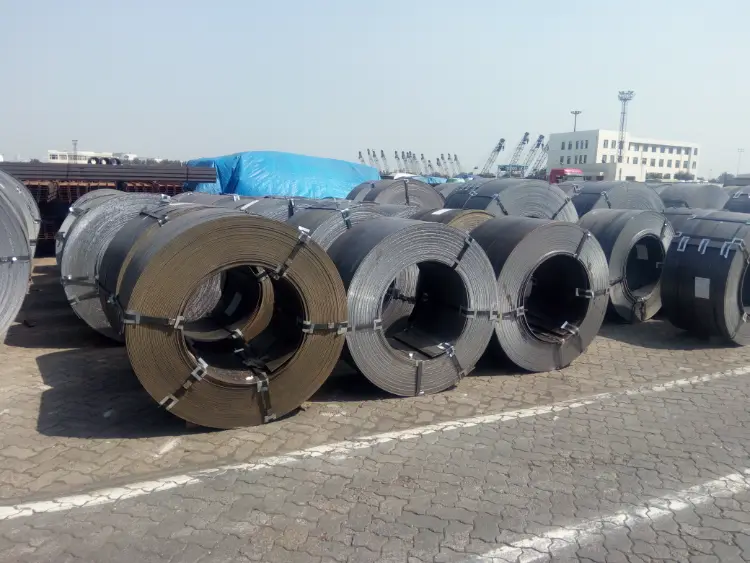
DNV D620 Shipbuilding Steel Coil
DNV D620 Shipbuilding Steel Coil – High-Strength Quenched & Tempered Marine Structural Steel
Authoritative data sheet for DNV D620 shipbuilding steel coil: chemical composition limits, mechanical properties, thermal & electrical physical properties, international cross-reference equivalents, similar substitute grades, and application guidelines for ship and offshore structures.
Welding (SMAW, SAW, GMAW with preheat/interpass control), thermal cutting, cold forming, machining, bending
- Phone : +8618037372205
- Email : [email protected]
- WhatsApp: Contact via Whtsapp
- WeChat: +8618037372205
DNV D620 Shipbuilding Steel Coil Introduction
DNV D620 is a high-strength shipbuilding structural steel grade specified by the Det Norske Veritas (DNV) classification rules. The designation normally corresponds to DH620 – a quenched and tempered steel with a minimum yield strength of 620 MPa and guaranteed impact toughness at -20 °C (Class D). It is supplied in coil or plate form and is intended for critical load-bearing components in large vessels and offshore platforms. The steel exhibits a good combination of high strength, excellent weldability when proper procedures are followed, and reliable low-temperature toughness. It meets the stringent requirements of DNV-OS-B101 and comparable IACS unified requirements, making it a preferred choice for weight-optimised marine constructions where both strength and safety are paramount.
DNV D620 Shipbuilding Steel Coil Chemical Composition
The following table provides the maximum and minimum limits as required by DNV rules for DH620 grade. All values are in weight percent. Residual elements are kept low to ensure good toughness and weldability. Carbon equivalent (Ceq) is controlled to guarantee crack-free welding performance.
| Chemical Element | Standard Value | Remarks |
|---|---|---|
| C | ≤ 0.20 | Maximum |
| Si | ≤ 0.55 | Maximum |
| Mn | ≤ 1.70 | Maximum |
| P | ≤ 0.025 | Maximum |
| S | ≤ 0.025 | Maximum |
| Al (total) | ≥ 0.015 | Minimum, for grain refining |
| N | ≤ 0.012 | Maximum |
| Cu | ≤ 0.35 | Maximum |
| Cr | ≤ 0.20 | Maximum |
| Ni | ≤ 0.40 | Maximum |
| Mo | ≤ 0.08 | Maximum |
| Nb | ≤ 0.05 | Maximum, microalloying element |
| V | ≤ 0.10 | Maximum, microalloying element |
| Ti | ≤ 0.02 | Maximum, grain refining |
| B | ≤ 0.0005 | Maximum, if added |
| Ceq | ≤ 0.52 | Carbon equivalent: C + Mn/6 + (Cr+Mo+V)/5 + (Ni+Cu)/15 |
DNV D620 Shipbuilding Steel Coil Thermal & Electrical Physical Properties
The physical properties listed below are approximate values for quenched and tempered high-strength steel and are intended for engineering calculations. They are not specified as mandatory by the DNV material standard but are representative of DH620-type steel at room temperature unless otherwise noted.
| Property | Typical Value | Unit | Test Condition / Remarks |
|---|---|---|---|
| Density (ρ) | 7.85 | g/cm³ | At 20 °C |
| Modulus of Elasticity (E) | 210 | GPa | Tension, room temperature |
| Shear Modulus (G) | ~ 80 | GPa | Calculated from E and ν |
| Poisson's Ratio (ν) | 0.3 | – | Elastic range, room temperature |
| Thermal Expansion Coefficient (α) | 11.5 × 10⁻⁶ | K⁻¹ | Temperature range 20–100 °C |
| Thermal Conductivity (λ) | ~ 52 | W/(m·K) | At 20 °C |
| Specific Heat Capacity (cp) | ~ 460 | J/(kg·K) | At 20 °C |
| Electrical Resistivity (ρe) | ~ 0.22 | μΩ·m | At 20 °C |
DNV D620 Shipbuilding Steel Coil Mechanical Properties
Mechanical properties are determined on transverse or longitudinal test pieces as specified by DNV rules. The values below represent the guaranteed minimum or range for the DH620 grade in the as-delivered (quenched and tempered) condition. Impact test temperature refers to the Charpy V-notch test with a minimum average energy value, at a specified test temperature.
| Property | Required Value | Unit | Test Condition |
|---|---|---|---|
| Yield Strength (ReH) | ≥ 620 | MPa | Room temperature, thickness ≤ 50 mm |
| Yield Strength (ReH) | ≥ 580 | MPa | Room temperature, 50 mm < thickness ≤ 100 mm |
| Tensile Strength (Rm) | 720 – 890 | MPa | Thickness ≤ 50 mm |
| Tensile Strength (Rm) | 700 – 890 | MPa | 50 mm < thickness ≤ 100 mm |
| Elongation (A5) | ≥ 14 | % | Gauge length 5.65√S₀, thickness ≤ 50 mm |
| Elongation (A5) | ≥ 14 | % | 50 mm < thickness ≤ 100 mm |
| Charpy Impact Energy (KV₂) | ≥ 41 (longitudinal) / ≥ 27 (transverse) | J | Test temperature -20 °C, average of 3 specimens |
| Bend Test (180°) | d = 3a | – | Bend diameter, thickness ≤ 30 mm |
| Bend Test (180°) | d = 4a | – | Bend diameter, thickness > 30 mm |
DNV D620 Shipbuilding Steel Coil Fully Equivalent Standards & Grades – Exact Substitutes
| Country / Region | Standard / Classification Society | Grade | Remarks |
|---|---|---|---|
| International (IACS) | American Bureau of Shipping (ABS) | ABS DH620 | Same strength and toughness class (D, -20 °C) |
| International (IACS) | Lloyd's Register (LR) | LR DH620 | Equivalent grade for marine structures |
| International (IACS) | Bureau Veritas (BV) | BV DH620 | Fully interchangeable with DNV DH620 |
| China | China Classification Society (CCS) | CCS DH620 | Direct equivalent, same specifications |
| Japan | Nippon Kaiji Kyokai (NK) | NK KD620 | KD620 is the NK designation for DH620 |
| Italy | RINA | RINA DH620 | Meets the same DNV-based requirements |
| Russia | Russian Maritime Register of Shipping (RS) | RS DH620 | Recognised equivalent for Russian-flagged vessels |
DNV D620 Shipbuilding Steel Coil Application Introduction
DNV D620 (DH620) steel is engineered for heavy-duty marine and offshore applications where high strength and weight reduction are critical. It can be cut, formed, and welded by conventional methods, provided that the heat input, preheat, and interpass temperatures are carefully controlled to avoid softening or cracking. Post-weld heat treatment is generally not required for thicknesses up to 50 mm, but stress relieving may be applied if necessary. The material is supplied with a class society certificate, ensuring traceability and compliance with all prescribed tests.
Product Applications: Hull bottom and side shell plating for ultra-large container ships, Deck plates and longitudinal stiffeners in high-stress areas, Heavy-lift vessel crane pedestals and grillages, Jack-up rig legs and spudcans, Offshore mooring components and fairleads, Structural members in FPSO (Floating Production Storage and Offloading) modules
Processed into products: Single hull plates and coil-cut sheet piles, Ship transverse web frames and girders, Hatch coamings and corner pieces, Winch foundations and towing brackets, Boom and jib sections of marine cranes, Corrugated bulkhead panels, Structural nodes and stiffened panel assemblies
Application industries: Shipbuilding (commercial and naval), Offshore oil & gas platforms, Renewable offshore wind turbine foundations (transition pieces, monopiles), Heavy machinery and lifting equipment, Bridge construction, especially for large spans or movable bridges
DNV D620 Shipbuilding Steel Coil Similar / Substitute Materials with Comparable Performance
| Country / Region | Standard | Grade | Remarks |
|---|---|---|---|
| Europe | EN 10025-6 | S620Q / S620QL / S620QL1 | Quenched & tempered structural steel with min. yield 620 MPa, different toughness classes; S620QL provides lower temperature toughness (Q – -20 °C, QL – -40 °C, QL1 – -60 °C). Not a direct marine approval standard but mechanically comparable. |
| USA | ASTM A514 / A517 | Grade S (690 MPa yield typical, but thinner sections may be adjusted) | High yield strength Q&T steel (min. 690 MPa), used in pressure vessels and construction; higher strength requires design adjustments. Not IACS-recognised for shipbuilding. |
| USA | API 2W | Grade 60 (620 MPa) | Steel for offshore structures, produced by TMCP, minimum yield 415–620 MPa depending on thickness; closest grade to DH620 but not always identical in chemistry. |
| International | IACS UR W28 | EH620 (additional toughness) | EH620 is the same strength level but with impact test at -40 °C instead of -20 °C; can be used as a superior substitute for DH620 when lower temperature toughness is required. |
Notes:
Welding and fabrication advice: Use low-hydrogen consumables and strictly follow the recommended preheat and interpass temperatures (typically 100–200 °C, depending on thickness) to prevent cold cracking. Heat input should be controlled to 1.5–3.5 kJ/mm to avoid degradation of the heat-affected zone (HAZ). For critical applications, a welding procedure qualification test (WPQT) is mandatory and must be approved by the relevant classification society.
Certification: Any delivery of DNV D620 must be accompanied by a DNV inspection certificate (type 3.1 or 3.2) stating chemical composition, mechanical test results, and heat treatment condition. Retesting is possible under DNV surveyor supervision if required by the client.
Storage and handling: Coils and plates should be stored on flat, well-drained surfaces and protected from excessive moisture to avoid hydrogen-induced cracking. After cutting, edges should be ground smooth before welding.
- Share



