
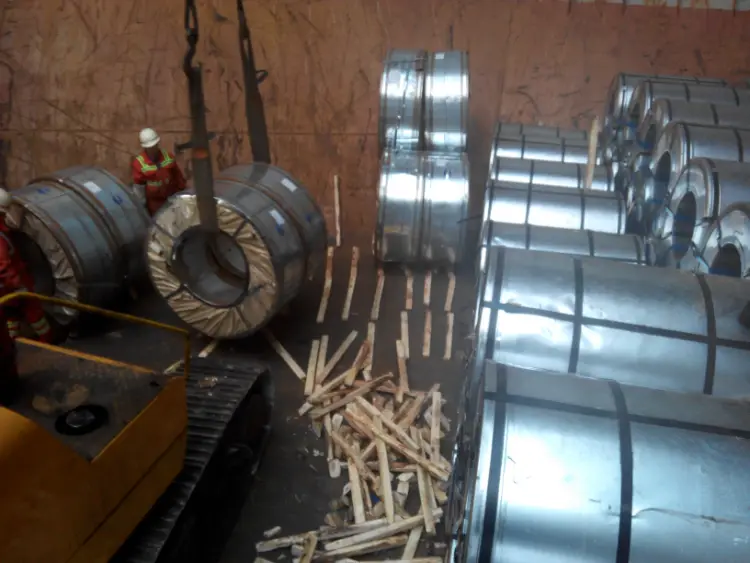
DNV A620 Shipbuilding Steel Coil
DNV A620 Shipbuilding Steel Coil: High-Strength Marine Structural Steel for Demanding Hull Applications
Explore DNV A620 shipbuilding steel coil, a high-strength quenched and tempered grade with minimum 620 MPa yield strength. Discover its chemical composition, mechanical properties, thermal and electrical data, international equivalents, and typical applications in marine and offshore structures.
Suitable for welding, cold forming, hot forming (with thermal treatment), machining, and cutting (plasma, laser, flame)
- Phone : +8618037372205
- Email : [email protected]
- WhatsApp: Contact via Whtsapp
- WeChat: +8618037372205
DNV A620 Shipbuilding Steel Coil Introduction
DNV A620 is a high-strength shipbuilding structural steel grade certified by DNV (Det Norske Veritas) under the standard DNV-OS-B101. It belongs to the NV 620 series, designed for critical marine and offshore applications where high yield strength (minimum 620 MPa) and good toughness at 0°C are required. The steel is typically supplied as coil in quenched and tempered (Q&T) or thermo-mechanically controlled processed and tempered (TMCP+T) condition.
- Excellent strength-to-weight ratio for lightweight ship designs
- Reliable low-temperature toughness with guaranteed impact energy at 0°C
- Good weldability with controlled carbon equivalent
- Compliant with IACS UR W31 for harmonized global acceptance
DNV A620 Shipbuilding Steel Coil Chemical Composition
The chemical composition of DNV A620 complies with DNV-OS-B101 requirements. Controlled additions of microalloying elements (Nb, V, Ti) and low sulfur/phosphorus ensure high strength, toughness, and weldability. The carbon equivalent (CEV) is limited to ≤0.55 (typical) to prevent cold cracking during welding. All values are maximum unless a range or minimum is stated.
| Element | Specified Value (wt.%) | Remarks |
|---|---|---|
| Carbon (C) | ≤ 0.20 | Typical aim 0.15–0.18 for strength-toughness balance |
| Silicon (Si) | ≤ 0.55 | Deoxidizer and solid-solution strengthener |
| Manganese (Mn) | ≤ 1.70 | Key hardenability element; may be adjusted for thick sections |
| Phosphorus (P) | ≤ 0.025 | Strict limit for toughness and cracking resistance |
| Sulfur (S) | ≤ 0.025 | Low sulfur ensures lamellar tearing resistance |
| Aluminium (Altotal) | ≥ 0.015 | Grain refining; ensures fine austenite grain size |
| Niobium (Nb) | ≤ 0.06 | Microalloying for grain refinement and precipitation strengthening |
| Vanadium (V) | ≤ 0.12 | Precipitation strengthener |
| Titanium (Ti) | ≤ 0.05 | Nitride former for grain size control |
| Copper (Cu) | ≤ 0.35 | May increase atmospheric corrosion resistance |
| Chromium (Cr) | ≤ 0.25 | Hardenability element; limited for weldability |
| Nickel (Ni) | ≤ 0.40 | Improves toughness; optional depending on thickness |
| Molybdenum (Mo) | ≤ 0.08 | Minor addition for strength |
| Nitrogen (N) | ≤ 0.012 | Controlled to avoid strain aging |
| Boron (B) | ≤ 0.0005 | Optional for hardenability, if added |
| Carbon Equivalent (CEV) | ≤ 0.55 (typical) | CEV = C + Mn/6 + (Cr+Mo+V)/5 + (Ni+Cu)/15 |
DNV A620 Shipbuilding Steel Coil Thermal and Electrical Physical Properties
These physical properties are representative of high-strength low-alloy structural steels at room temperature, unless otherwise stated. They are not part of the mandatory certification but are essential for engineering calculations. Note: Actual values can vary slightly depending on the exact heat treatment and chemical composition.
| Property | Typical Value | Unit | Test Conditions / Remarks |
|---|---|---|---|
| Density (ρ) | 7.85 | g/cm³ | Ambient temperature |
| Modulus of Elasticity (E) | 210 | GPa | Room temperature, tensile |
| Shear Modulus (G) | 80 | GPa | Calculated; room temperature |
| Poisson's Ratio (ν) | 0.30 | - | Elastic range |
| Thermal Expansion Coefficient (α) | 12.0 × 10⁻⁶ | 1/K | 20–100 °C range; increases to ~13.5 × 10⁻⁶ at 300 °C |
| Thermal Expansion Coefficient (α) | 13.2 × 10⁻⁶ | 1/K | 20–200 °C |
| Thermal Conductivity (λ) | 38 | W/(m·K) | At 20 °C; decreases to ~36 at 200 °C |
| Specific Heat Capacity (c) | 460 | J/(kg·K) | At 20 °C; ~550 at 400 °C |
| Electrical Resistivity (ρₑ) | 0.23 × 10⁻⁶ | Ω·m | At 20 °C |
DNV A620 Shipbuilding Steel Coil Mechanical Properties
Mechanical properties are determined on transverse or longitudinal test pieces from the final heat-treated product. The values below apply to thicknesses t ≤ 50 mm for quenched and tempered or TMCP+T material. For thicker products, slight reductions in minimum elongation and impact energy may apply. Impact testing is performed at 0 °C for the A-grade.
- Yield strength is the upper yield point (ReH) or 0.2% proof strength (Rp0.2) if no yield point.
- Bend test: specimen shall withstand 180° bending without cracking; mandrel diameter depends on thickness.
| Property | Specified Value | Unit | Test Conditions / Remarks |
|---|---|---|---|
| Yield Strength (ReH) | ≥ 620 | MPa | Transverse or longitudinal, t ≤ 50 mm; may be specified for thicker sections with slightly lower minimum |
| Tensile Strength (Rm) | 720 – 890 | MPa | Typical range for thin and thick sections; upper limit ensures ductility |
| Elongation (A) | ≥ 14 | % | Longitudinal, gauge length 5.65√S₀ (A5); for t ≤ 50 mm |
| Elongation (A) | ≥ 12 | % | Transverse, same gauge length; for t ≤ 50 mm (alternative requirement if specified) |
| Charpy Impact Energy (KV₂) | ≥ 46 | J | Longitudinal, at 0 °C, t ≤ 50 mm; average of 3 tests, single min 70% of average |
| Charpy Impact Energy (KV₂) | ≥ 31 | J | Transverse, at 0 °C, t ≤ 50 mm (if required by specification) |
| Bend Test | d = 3a | - | Mandrel diameter, a = specimen thickness; 180° bending for t ≤ 25 mm |
| Bend Test | d = 4a | - | Mandrel diameter for 25 < t ≤ 50 mm |
DNV A620 Shipbuilding Steel Coil Fully Equivalent Material Standards and Substitute Grades
Through the IACS Unified Requirement W31, classification societies harmonize their high-strength structural steel grades. The following grades are directly comparable to DNV A620 in terms of minimum yield strength, toughness class (0°C), and intended application. Small differences in chemistry or supplementary testing may exist; always verify with the specific society's rules.
| Country / Society | Standard / Rule | Grade | Remarks |
|---|---|---|---|
| American Bureau of Shipping | ABS Rules Part 2 | ABS AH620 | 0°C impact, min YS 620 MPa |
| Lloyd's Register | LR Rules | LR AH620 | Designation may include AH620 |
| Bureau Veritas | BV Rules | BV A620 | A-class (0°C) high-strength steel |
| RINA (Italy) | RINA Rules | RINA A620 | Same strength and toughness class |
| China Classification Society | CCS Rules | CCS A620 | Identical requirements per IACS |
| ClassNK (Japan) | NK Rules | NK KA620 | K indicates high-strength; KA for 0°C |
| Korean Register | KR Rules | KR AH620 | AH for 0°C toughness |
| Russian Maritime Register | RMRS Rules | A620 or A620W | Depending on delivery condition |
DNV A620 Shipbuilding Steel Coil Application Introduction
DNV A620 steel coil is engineered for the most demanding marine and offshore structural applications. Its high yield strength allows significant weight reduction without compromising safety. Below are typical industries, products, and specific components fabricated from this grade.
Product Applications: Hull side shells, strength decks, and longitudinal stiffeners, Weather-exposed structural members (e.g., hatch coamings, sheer strakes), Jack-up rig leg chords and spudcans, Offshore crane pedestals and boom segments, Underwater structural nodes (after through-thickness properties are validated), Pressure hulls for submersibles (with additional certification)
Processed into products: Cut-to-length plates for stiffened panel fabrication, Bent or rolled cylindrical sections (e.g., columns, bracings), Welded box girders and I-beams, Flame-cut brackets and complex structural details, Machined connecting parts (pin holes, flanges) where high edge ductility is maintained
Application industries: Shipbuilding (merchant, naval, and special-purpose vessels), Offshore oil & gas (fixed platforms, FPSO modules, jack-up rigs), Marine heavy lifting and engineering (cranes, davits, winching equipment), Renewable energy (offshore wind turbine foundations, transition pieces), Heavy machinery (excavator booms, mining equipment subjected to dynamic loads)
DNV A620 Shipbuilding Steel Coil Similar / Near-Equivalent Alternative Materials
These grades are close in performance to DNV A620 but differ primarily in yield strength level, toughness class, or delivery condition. They can be considered when 620 MPa is not mandatory or when improved toughness/weldability is required. Always check compatibility with the design specification.
| Country / Society | Standard / Grade | Material | Key Differences and Analysis |
|---|---|---|---|
| DNV | NV A550 | DNV A550 | Yield strength 550 MPa; slightly lower carbon equivalent and often better weldability. Suitable for weight-sensitive designs with lower stress demands. |
| DNV | NV A690 | DNV A690 | Yield strength 690 MPa; provides higher strength but requires more careful welding heat input control. Used in ultra-high-strength applications like crane booms. |
| DNV | NV E620 | DNV E620 | Same 620 MPa strength but with -40°C impact toughness (E-grade). Used for extremely cold environments or critical fracture-critical members. |
| ASTM / EN | S690Q/S690QL | EN 10025-6 S690Q | Quenched and tempered structural steel with YS ≥690 MPa, 0°C impact (S690Q). A potential substitute for non-marine applications, but requires separate classification approval. |
| ASTM | A514 Grade B | ASTM A514 Gr. B | High-strength Q&T steel, min YS 690 MPa. Limited use in shipbuilding; must be evaluated for weldability and classification compliance. |
Notes:
- Welding: Preheat and interpass temperature control is critical due to the high strength level. Typically, a preheat of 75–125°C is applied for thicknesses above 20 mm. Low-hydrogen consumables and processes (SAW, GMAW, FCAW) are recommended. Post-weld heat treatment (PWHT) is generally not required for thicknesses below 50 mm but may be specified for stress relief in complex assemblies.
- Certification: All coils shall be supplied with DNV material certificate (type 3.1 or 3.2 as per EN 10204) verifying ladle analysis, mechanical tests, and non-destructive examination if required.
- Thickness limits: The standard typically covers thicknesses up to 100 mm. For sections thicker than 50 mm, reduced mechanical property values and stricter impact testing may apply as per DNV rules.
- Availability: Coils are normally available in thickness range 6–25 mm; wider dimensions can be produced by reversing mills. Custom rolling with specific TMCP parameters is available to optimize weldability and toughness.
- Share



