
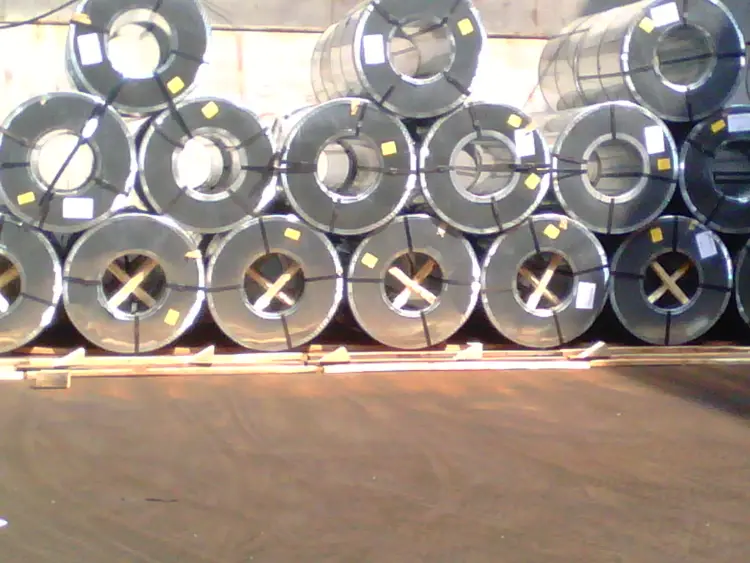
DNV F550 Shipbuilding Steel Coil
DNV F550 Shipbuilding Steel Coil: High-Strength Marine Grade for Extreme Conditions
Comprehensive material data for DNV F550 shipbuilding steel coil: chemical composition, mechanical properties, thermal and electrical performance, international equivalents, and application guide.
Hot rolling, TMCP, quenching and tempering, cutting, forming, welding
- Phone : +8618037372205
- Email : [email protected]
- WhatsApp: Contact via Whtsapp
- WeChat: +8618037372205
DNV F550 Shipbuilding Steel Coil Introduction
DNV F550 is a high-strength structural steel grade for shipbuilding, certified by DNV (Det Norske Veritas) rules. It belongs to the F-class with a minimum yield strength of 550 MPa and excellent low-temperature impact toughness down to -60°C. Produced mainly as steel coil and plate, it is designed for critical hull structures and offshore applications. Key features include:
- High strength-to-weight ratio, enabling lighter ship designs
- Excellent weldability through controlled chemistry and low carbon equivalent
- Superior notch toughness at cryogenic temperatures (F-grade: ≥60 J at -60°C)
- Good formability and crack resistance under dynamic loading
- Delivery in TMCP (thermo-mechanical controlled process) or quenched and tempered conditions
DNV F550 Shipbuilding Steel Coil Chemical Composition
Chemical composition requirements for DNV F550 as specified in DNV-OS-C101. All figures are maximum unless a range is given. Additional microalloying elements may be present to achieve strength and toughness. Note: The sum of Nb+V+Ti shall not exceed 0.12%.
| Chemical Element | Standard Value (wt%) | Remarks |
|---|---|---|
| Carbon (C) | ≤ 0.18 | Ladle analysis |
| Silicon (Si) | 0.10 - 0.50 | |
| Manganese (Mn) | 0.90 - 1.60 | |
| Phosphorus (P) | ≤ 0.025 | |
| Sulfur (S) | ≤ 0.025 | |
| Chromium (Cr) | ≤ 0.25 | |
| Nickel (Ni) | ≤ 0.40 | |
| Molybdenum (Mo) | ≤ 0.08 | |
| Copper (Cu) | ≤ 0.35 | |
| Vanadium (V) | ≤ 0.10 | |
| Niobium (Nb) | ≤ 0.05 | |
| Titanium (Ti) | ≤ 0.02 | |
| Aluminium (Al, total) | ≥ 0.015 | Minimum acid-soluble aluminium |
| Nitrogen (N) | ≤ 0.012 | May be adjusted for strengthening |
DNV F550 Shipbuilding Steel Coil Thermal and Electrical Physical Properties
Physical properties are nominal values for low-alloy structural steel at room temperature unless a temperature range is given. The properties are not specified by DNV but are useful for design calculations. Caution: Actual values may vary with heat treatment and composition.
| Property | Nominal Value | Unit | Test Condition |
|---|---|---|---|
| Density (ρ) | 7850 | kg/m³ | at 20°C |
| Elastic Modulus (E) | 205 | GPa | at 20°C |
| Shear Modulus (G) | 80 | GPa | at 20°C |
| Poisson's Ratio (ν) | 0.3 | - | at 20°C |
| Thermal Expansion Coefficient (α) | 11.5 × 10⁻⁶ | /°C | 20-100°C range |
| Thermal Conductivity (λ) | 50 | W/(m·K) | at 20°C |
| Specific Heat Capacity (c) | 460 | J/(kg·K) | at 20°C |
| Electrical Resistivity (ρ_e) | 0.20 | Ω·mm²/m | at 20°C |
DNV F550 Shipbuilding Steel Coil Mechanical Properties
Mechanical properties as required by DNV rules for thickness ≤ 50 mm. Test specimens are taken in the transverse direction unless otherwise stated. Charpy V-notch values are for longitudinal specimens at -60°C. Note: For thicker sections, the specified values may be reduced; refer to the material certificate.
| Property | Specified Value | Unit | Test Condition |
|---|---|---|---|
| Yield Strength (ReH) | ≥ 550 | MPa | t ≤ 50 mm, transverse |
| Tensile Strength (Rm) | 620 - 770 | MPa | t ≤ 50 mm, transverse |
| Elongation (A) | ≥ 16 | % | Gauge length 5.65√So, t ≤ 50 mm, transverse |
| Charpy V-notch Impact Energy (KV) | ≥ 60 | J | Longitudinal, -60°C, t ≤ 50 mm |
| Bend Test | No cracks | - | 180°, D=3a (a=thickness), transverse |
DNV F550 Shipbuilding Steel Coil Fully Equivalent Material Standards and Substitutable Grades
| Country/Region | Standard / Classification Society | Grade | Remarks |
|---|---|---|---|
| International (original) | DNV Rules | F550 | F-grade shipbuilding steel, YS ≥550 MPa, impact -60°C |
| USA | ABS Rules | FH550 | Same strength and F-grade impact toughness |
| UK | LR Rules | FH550 | Lloyd's Register F-grade high-strength steel |
| France | BV Rules | FH550 | Bureau Veritas equivalent |
| China | CCS Rules | FH550 | China Classification Society high-strength marine steel |
| Japan | NK Rules | FH550 | ClassNK F-grade structural steel |
| Italy | RINA Rules | FH550 | RINA F550 equivalent |
| Korea | KR Rules | FH550 | Korean Register high-tensile shipbuilding steel |
DNV F550 Shipbuilding Steel Coil Application Introduction
DNV F550 steel coil is primarily used in the construction of large, high-stress marine structures. Its combination of high strength, excellent weldability, and low-temperature toughness makes it ideal for critical applications in shipbuilding and offshore engineering. Delivery forms: hot-rolled coil (typically 2–20 mm thick), cut-to-length plates, and sections. Processing includes plasma/laser cutting, cold or hot forming, and welding using low-hydrogen procedures. Certification: material supplied with DNV 3.1 or 3.2 certificates.
Product Applications: Container ships and bulk carriers (high-strength hull envelopes), Oil tankers and chemical tankers, Icebreakers and Arctic LNG carriers, Offshore platform modules and jack-up rig legs, Hatch covers, deck structures, and crane pedestals
Processed into products: Hull plates and shell plating, Stringers, stiffeners, and frames, Bulkheads (transverse and longitudinal), Deck plates and bottom plates, Primary structural members (girders, webs), Welded brackets and supports
Application industries: Shipbuilding (commercial and naval vessels), Offshore oil & gas (platforms, FPSO modules), Renewable energy (offshore wind turbine foundations), Polar vessels and icebreakers, Heavy marine structural engineering
DNV F550 Shipbuilding Steel Coil Similar / Alternative Material Recommendations
| Country/Region | Standard / Classification Society | Grade | Remarks |
|---|---|---|---|
| International | DNV Rules | EH550 | E-grade: minimum impact temperature -40°C; use where -60°C is not required |
| International | DNV Rules | FH530 | Slightly lower yield strength (≥530 MPa), same F-class toughness |
| International | EN 10025-6 | S690Q | Quenched and tempered high-strength structural steel; not certified for marine service but may be considered for non-class components |
| USA | ASTM A514 / A517 | Grade Q | High yield strength (≥690 MPa) quenched and tempered steel; suitable for heavy construction, not for marine classification |
Notes:
Welding considerations: A suitable preheat and interpass temperature must be applied depending on plate thickness and carbon equivalent. Low-hydrogen consumables (e.g., E7018, E11018) are recommended. Hot forming: If hot forming is performed, a subsequent normalizing or re-tempering treatment may be required to restore mechanical properties; consult DNV guidelines. Corrosion protection: Standard marine coating systems should be applied, and cathodic protection considered for submerged components. Traceability: Each coil must be marked with DNV stamp, grade, heat number, and producer identification.
- Share



