
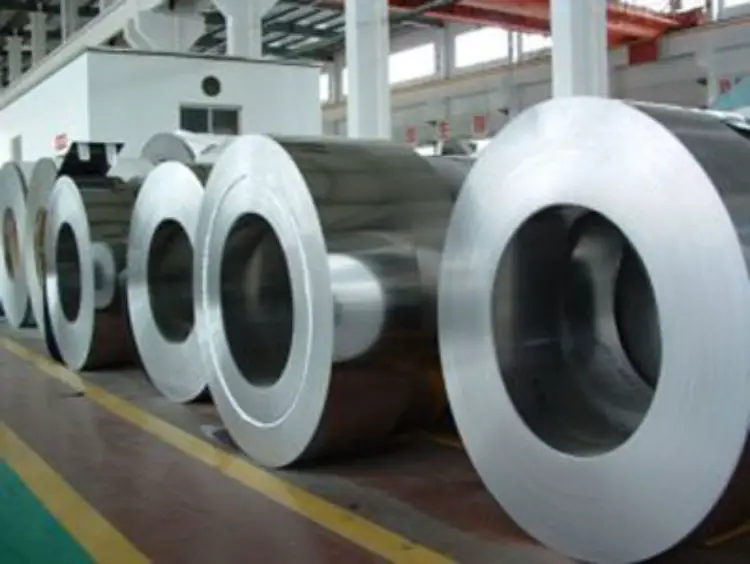
DNV E550 Shipbuilding Steel Coil
DNV E550 Shipbuilding Steel Coil - Extra High Strength Hull Structural Steel
Detailed material data for DNV E550 extra high-strength shipbuilding steel coil, covering chemical composition, mechanical and physical properties, international equivalents and application guidance.
Cutting, welding, cold forming, hot forming (with suitable heat treatment), machining, shot blasting
- Phone : +8618037372205
- Email : [email protected]
- WhatsApp: Contact via Whtsapp
- WeChat: +8618037372205
DNV E550 Shipbuilding Steel Coil Introduction
DNV E550 is an extra high-strength structural steel for shipbuilding, classified under DNV GL rules for metallic materials. With a minimum yield strength of 550 MPa and guaranteed impact toughness at -40 °C (grade 'E'), this quenched and tempered steel offers excellent weldability and high resistance to brittle fracture. It is primarily supplied in coil and plate form for hull structures, decks, and stiffeners in large vessels and offshore platforms. The steel combines high strength with good formability and is tailored for demanding marine environments.
DNV E550 Shipbuilding Steel Coil Chemical Composition
Chemical composition limits as per DNV GL rules for extra high strength steel E550. The values are typical maxima for all product thicknesses; actual certified values may be lower depending on mill practice.
- CEV (Carbon Equivalent Value) typically ≤ 0.53 for weldability control.
- Fine grain practice with sufficient Al, Nb, V, or Ti additions ensures desired mechanical properties.
| Element | Value (mass %) | Remarks |
|---|---|---|
| C | ≤ 0.20 | Max, for strength and weldability |
| Mn | 0.90–1.70 | Range, deoxidiser and strength enhancer |
| Si | 0.10–0.55 | Deoxidiser |
| P | ≤ 0.025 | Max, for toughness |
| S | ≤ 0.025 | Max, for toughness |
| Cr | ≤ 1.50 | Max, optional alloying element |
| Ni | ≤ 2.00 | Max, improves low-temperature toughness |
| Mo | ≤ 0.70 | Max, optional strengthening |
| Cu | ≤ 0.50 | Max, optional for corrosion resistance |
| V | ≤ 0.12 | Max, microalloy for grain refinement |
| Nb | ≤ 0.06 | Max, microalloy |
| Ti | ≤ 0.05 | Max, grain refinement |
| Al (total) | ≥ 0.015 | Min, for fine grain practice |
| N | ≤ 0.020 | Max, free nitrogen control |
| CEV | ≤ 0.53 | Carbon equivalent for weldability |
DNV E550 Shipbuilding Steel Coil Thermal and Electrical Physical Properties
Approximate physical properties for a high-strength low-alloy shipbuilding steel similar to E550. The values are representative for design calculations; actual properties may vary slightly depending on exact composition and heat treatment.
- Density and elastic moduli are nearly invariant across low-alloy grades.
- Thermal expansion and conductivity are given for a typical temperature range.
| Property | Typical Value | Unit | Test Conditions |
|---|---|---|---|
| Density (ρ) | 7.85 | g/cm³ | At 20 °C |
| Elastic modulus (E) | 200–210 | GPa | At 20 °C |
| Shear modulus (G) | 80 | GPa | Calculated from E and ν |
| Poisson's ratio (ν) | 0.3 | – | Ambient temperature |
| Thermal expansion coefficient (α) | 12 × 10⁻⁶ | /K | 20–200 °C range |
| Thermal conductivity (λ) | 35–45 | W/(m·K) | At 20 °C |
| Specific heat capacity | 460–480 | J/(kg·K) | At 20 °C |
| Electrical resistivity (ρₑ) | 0.20–0.25 × 10⁻⁶ | Ω·m | At 20 °C |
DNV E550 Shipbuilding Steel Coil Mechanical Properties
Minimum specified mechanical properties for DNV E550 steel. Tensile testing transverse to rolling direction unless otherwise agreed. Impact properties are based on longitudinal Charpy V-notch specimens at -40 °C.
- Thickness-dependent yield and tensile values apply.
- Bend test ensures good formability without cracking.
| Property | Required Value | Unit | Test Conditions / Remarks |
|---|---|---|---|
| Yield strength (ReH) | ≥ 550 | MPa | For thickness ≤ 50 mm |
| Yield strength (ReH) | ≥ 530 | MPa | For thickness > 50 mm but ≤ 100 mm |
| Yield strength (ReH) | ≥ 490 | MPa | For thickness > 100 mm but ≤ 150 mm |
| Tensile strength (Rm) | 670–830 | MPa | For all thicknesses |
| Elongation A5 | ≥ 16 | % | Longitudinal; gauge length 5.65√So |
| Elongation A5 | ≥ 14 | % | Transverse |
| Impact energy KV, -40 °C | ≥ 27 | J | Longitudinal, for ≤ 50 mm thickness |
| Impact energy KV, -40 °C | ≥ 24 | J | Longitudinal, for > 50 mm ≤ 100 mm |
| Impact energy KV, -40 °C | ≥ 20 | J | Longitudinal, for > 100 mm ≤ 150 mm |
| Bend test (180°) | No cracks | - | Bend diameter = 3×thickness for t ≤ 25 mm, 4×thickness for t > 25 mm |
DNV E550 Shipbuilding Steel Coil Directly Equivalent International Shipbuilding Steel Grades
| Country / Region | Standard / Classification Society | Equivalent Grade | Remarks |
|---|---|---|---|
| Global | DNV (Det Norske Veritas) | E550 | Base grade analysed |
| USA | ABS (American Bureau of Shipping) | EH550 | Toughness test at -40 °C |
| France | BV (Bureau Veritas) | EH550 | Identical mechanical and chemical limits |
| China | CCS (China Classification Society) | E550 | Same requirements |
| South Korea | KR (Korean Register) | EH550 | Equivalent grade |
| Japan | NK (ClassNK) | EH550 | Equivalent grade |
| Italy | RINA (Registro Italiano Navale) | EH550 | Equivalent grade |
| United Kingdom | LR (Lloyd's Register) | EH550 | Equivalent grade, formerly LR EH550 |
DNV E550 Shipbuilding Steel Coil Application Introduction
DNV E550 plate and coil are used in critical structural components of ships and offshore units where high strength and excellent low-temperature toughness are essential. The quenched and tempered condition ensures a fine bainitic/martensitic microstructure, providing resistance to fatigue and crack propagation. Typical application fields and fabricated products are outlined below.
Product Applications: Hull plating (side, bottom, deck), Stiffeners and longitudinal girders, Transverse bulkheads and web frames, Deck girders and hatch coamings, Offshore platform deck beams
Processed into products: Welded I-beams and T-sections from cut coil strips, Bent and rolled profiles for hull framing, Machined connection plates for high-load areas, Cold-formed angles and channels, Ship lift decks and ramp components
Application industries: Shipbuilding (container ships, bulk carriers, tankers, LNG carriers), Offshore engineering (jack-up rigs, semisubmersibles, FPSO hulls), Heavy machinery and crane construction, Polar class vessels (with additional testing)
DNV E550 Shipbuilding Steel Coil Similar High-Strength Structural Steels
| Country / Region | Standard | Grade | Remarks |
|---|---|---|---|
| Europe | EN 10025-6 | S550Q | Quenched and tempered steel, min. yield 550 MPa, similar toughness depending on quality (QL, QL1) |
| Germany | DIN EN 10028-6 | P550Q | Pressure vessel steel, comparable strength |
| USA | ASTM A514 / A517 | Grade S | Yield 690 MPa, higher strength but often used in similar marine applications |
| Europe | EN 10025-4 | S460M/ML | Thermomechanical rolled, lower strength (460 MPa) but good toughness |
| Japan | JIS G 3106 | SM570TMC | High strength weldable structural steel, 570 MPa tensile class |
Notes:
Important preheating and welding consumables selection note: DNV E550 is typically welded with low-hydrogen processes and matching strength electrodes (yield ≥ 550 MPa). Preheating and interpass temperatures must be controlled according to thickness and CEV.
- Post-weld heat treatment is generally not required for thicknesses up to 50 mm if qualified welding procedures are used.
- Surface treatment: primer coats (shop primer) are normally applied to coil before forming.
- Certification: Material must be marked and supplied with DNV inspection certificate (3.1 or 3.2 according to EN 10204).
- Share



