
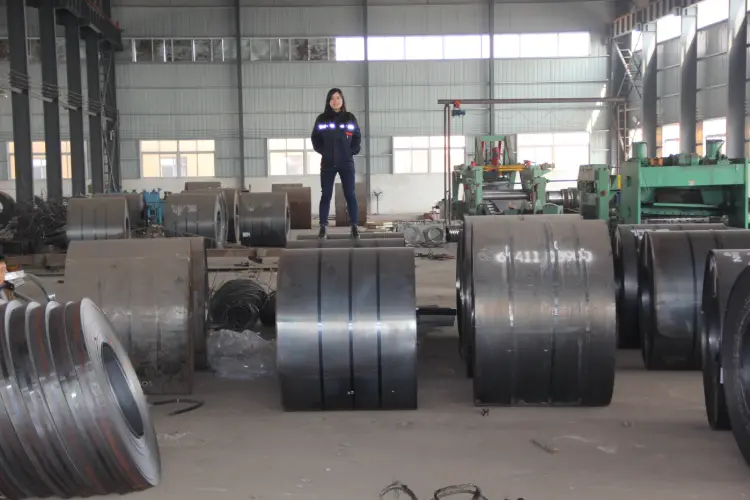
DNV D550 Shipbuilding Steel Coil
DNV D550 Shipbuilding Steel Coil - Ultra-High Strength Marine Grade
Explore DNV D550, a high-strength shipbuilding steel coil with 550 MPa minimum yield, certified by DNV GL (now DNV) for demanding marine and offshore structural applications.
Hot rolling, thermo-mechanical controlled processing (TMCP), quenching and tempering (QT), bending, cutting, welding
- Phone : +8618037372205
- Email : [email protected]
- WhatsApp: Contact via Whtsapp
- WeChat: +8618037372205
DNV D550 Shipbuilding Steel Coil Introduction
DNV D550 is an ultra-high-strength quenched and tempered steel grade specified by the Det Norske Veritas (DNV) classification society, now part of DNV GL, for shipbuilding and offshore structures. With a specified minimum yield strength of 550 MPa, it belongs to the extra-high strength structural steel category (group EH). D550 offers an excellent combination of strength, toughness, and weldability, making it suitable for critical load-bearing components in large vessels, jack-up rigs, and offshore platforms. It is typically supplied in the form of coils and plates under the delivery condition of thermo-mechanically rolled (TM) or quenched and tempered (QT), ensuring consistent properties in harsh marine environments. The steel meets strict requirements for low-temperature impact toughness, with Charpy V-notch values guaranteed at -20°C or below depending on the specific classification (e.g., D, E grades with additional low-temperature certifications).
DNV D550 Shipbuilding Steel Coil Chemical Composition
The chemical composition of DNV D550 is controlled to achieve high strength and excellent weldability. Typical limits according to DNV rules are presented. Micro-alloying elements such as niobium, vanadium, and titanium are often added for grain refinement, while the maximum carbon equivalent (CEV) ensures good weldability without pre-heating in moderate thicknesses.
| Element | Specification Requirement | Remarks |
|---|---|---|
| C (Carbon) | ≤ 0.20 | Typical max; may be lower for better toughness |
| Mn (Manganese) | ≤ 1.70 | High Mn for strength and hardenability |
| Si (Silicon) | ≤ 0.55 | Deoxidizer and strength enhancer |
| P (Phosphorus) | ≤ 0.025 | Maximum to avoid embrittlement |
| S (Sulfur) | ≤ 0.025 | Maximum to ensure cleanliness |
| Al (Aluminum) | ≥ 0.015 (acid soluble) | Min if used as grain refiner |
| Nb (Niobium) | ≤ 0.06 | Micro-alloying for grain refinement |
| V (Vanadium) | ≤ 0.10 | Micro-alloying for precipitation strengthening |
| Ti (Titanium) | ≤ 0.03 | Optional micro-alloying; often limited |
| Cr (Chromium) | ≤ 0.25 | Optional; may be added for strength |
| Ni (Nickel) | ≤ 0.80 | Optional; improves toughness at low temperatures |
| Mo (Molybdenum) | ≤ 0.30 | Optional; increases hardenability |
| Cu (Copper) | ≤ 0.35 | Optional; may be added for corrosion resistance |
| N (Nitrogen) | ≤ 0.012 | Maximum unless accompanied by Al to form AlN |
| CEV (Carbon Equivalent) | Typically ≤ 0.45 | Based on formula: C + Mn/6 + (Cr+Mo+V)/5 + (Ni+Cu)/15 |
DNV D550 Shipbuilding Steel Coil Thermal and Electrical Physical Properties
Physical properties are typical for quenched and tempered extra-high strength structural steels. They vary slightly with heat treatment condition and temperature. Values here are given at room temperature unless specified otherwise.
| Property | Typical Value | Unit | Test Condition |
|---|---|---|---|
| Density (ρ) | 7.80 – 7.85 | g/cm³ | At 20°C |
| Elastic Modulus (E) | 205 – 210 | GPa | At 20°C |
| Shear Modulus (G) | ≈ 79 | GPa | Calculated from E and Poisson ratio |
| Poisson's Ratio (ν) | 0.28 – 0.30 | – | At 20°C |
| Thermal Expansion Coefficient (α) | 11.5 – 12.5 | ×10⁻⁶/K | 20°C to 100°C; increases with temperature |
| Thermal Conductivity (λ) | 35 – 45 | W/(m·K) | At 20°C, decreases with increasing temperature |
| Specific Heat Capacity | 460 – 500 | J/(kg·K) | At 20°C, increases with temperature |
| Electrical Resistivity (ρ_e) | 0.20 – 0.25 | µΩ·m | At 20°C |
DNV D550 Shipbuilding Steel Coil Mechanical Properties
The mechanical properties are guaranteed by DNV rules for thicknesses typically up to 100 mm. Yield strength is specified as a minimum, and tensile strength and elongation ensure ductility. Impact energy values are measured at -20°C for grade D (or lower for E). The values below reflect typical minimum requirements for plate ≤50 mm thickness.
| Property | Specification Requirement | Unit | Test Condition |
|---|---|---|---|
| Yield Strength (ReH) | ≥ 550 | MPa | Transverse, at ambient temperature |
| Tensile Strength (Rm) | 670 – 830 | MPa | Transverse, at ambient temperature |
| Elongation (A) | ≥ 14 | % | Gauge length 5.65√S0 (L0=5.65√A), transverse |
| Bend Test (Bend Diameter) | No cracks after 180° bend: 4 × thickness (for t≤12 mm) | – | Ambient temperature, bend diameter as per standard |
| Impact Energy (KV) – D grade | ≥ 31 (average of 3 tests, min single 22) | J | At -20°C, Charpy V-notch, transverse |
| Impact Energy (KV) – E grade | ≥ 31 (average of 3 tests, min single 22) | J | At -40°C, Charpy V-notch, transverse |
DNV D550 Shipbuilding Steel Coil Full Equivalent Material Standards and Replaceable Grade Recommendations
| Country/Region | Standard | Grade | Remarks |
|---|---|---|---|
| International | ABS (American Bureau of Shipping) | EH550 | Equivalent extra-high strength grade; identical mechanicals |
| International | LR (Lloyd's Register) | AH550 / DH550 / EH550 | Grade suffix indicates temperature (A=0°C, D=-20°C, E=-40°C); D550 maps to DH550 or EH550 |
| International | BV (Bureau Veritas) | EH550 | Similar requirements; chemical composition may have slight variations |
| International | CCS (China Classification Society) | EH550 | Full equivalence with DNV D550 when charpy at -40°C (E grade) |
| International | NK (Nippon Kaiji Kyokai) | EH550 | Equivalent in strength and impact classes |
| International | RINA (Registro Italiano Navale) | EH550 | Corresponds to extra-high strength structural steel |
| International | GL (Germanischer Lloyd, now DNV GL) | EH550 | Historically identical to DNV rules; fully interchangeable |
DNV D550 Shipbuilding Steel Coil Application Introduction
DNV D550 steel coil is engineered for heavy-load marine structures where minimizing weight without sacrificing strength is critical. Its high yield strength reduces required plate thickness, leading to lighter vessel designs and increased payload. Typical applications include:
Product Applications: Hull and deck plating, Deck girders and longitudinal stiffeners, Leg structures for jack-up rigs, Crane pedestals and booms, Ice-strengthened hull inserts, Blast walls and protective structures
Processed into products: High-strength structural profiles and built-up beams, Heavy-duty brackets and flanges, Transition pieces and node connections, Reinforcement plates for mooring attachments, Pressure hull sections for submersibles
Application industries: Shipbuilding (large container ships, bulk carriers, tankers, LNG carriers), Offshore oil & gas (jack-up rig legs, platforms, FPSOs), Marine heavy-lift and crane construction, Arctic and ice-class vessel construction (with low-temperature toughness), Renewable marine energy (offshore wind turbine foundations)
DNV D550 Shipbuilding Steel Coil Similar or Close Alternative Material Recommendations
| Country/Region | Standard | Grade | Remarks |
|---|---|---|---|
| Europe | EN 10025-6 | S690QL / S690QL1 | Quenched & tempered structural steel with 690 MPa yield; higher strength alternative to D550 but requires higher CEV and preheat |
| USA | ASTM A514 / A517 | Grade B / H | High strength quenched & tempered steel plates with yield up to 690 MPa; used in structural applications; ship classification society approval often required |
| Japan | JIS G 3128 | SHY685 / SHY685N | High yield strength steel for welded structures, approx. 685–785 MPa UTS; similar to EH690 but can be reduced to match D550 with proper design |
| International | API Spec 2Y / 2W | Grades 50, 60 | Offshore structural steel with yield up to 414–483 MPa; lower strength but may substitute in less demanding areas |
| China | GB/T 712 | EH550 | Chinese national standard for shipbuilding steel; directly mirrors CCS EH550 requirements |
Notes:
Welding considerations: Pre-heat may be required for thicker sections. Low-hydrogen welding consumables are recommended. Formability: Cold forming may require intermediate stress relieving for high deformation ratios. Certification: All deliveries must be accompanied by DNV GL material certificates (3.2) according to the rules. For service temperature lower than -20°C, specify grade E (impact at -40°C).
- Share



