
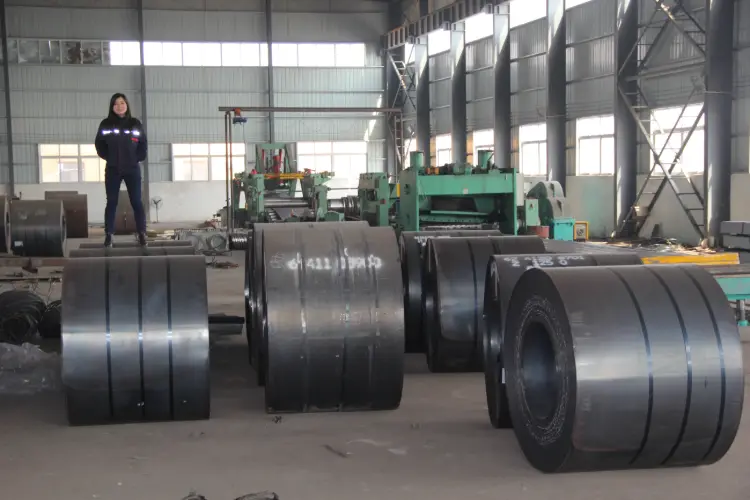
DNV A550 (AH550) Shipbuilding Steel Coil
DNV A550 (AH550) Shipbuilding Steel Coil: High Strength, Excellent Weldability
Comprehensive material data for DNV A550 (AH550) shipbuilding steel coil including chemical composition, mechanical and thermal properties, international equivalents, and application guidance.
Hot rolling, cold forming, plasma/laser cutting, shielded metal arc welding (SMAW), gas metal arc welding (GMAW), submerged arc welding (SAW)
- Phone : +8618037372205
- Email : [email protected]
- WhatsApp: Contact via Whtsapp
- WeChat: +8618037372205
DNV A550 Shipbuilding Steel Coil Introduction
DNV A550, designated as AH550 in the DNV classification rules, is a high-strength, low-alloy structural steel primarily used in shipbuilding and offshore engineering. With a minimum yield strength of 550 MPa, it belongs to the extra-high-strength category of hull structural steels. Manufactured through quenching and tempering (Q&T) or thermo-mechanical controlled processing (TMCP), this grade offers an excellent combination of strength, toughness, and weldability. It meets the strict requirements of the DNV Rules for Classification of Ships, Part 2 Chapter 2, and is suitable for critical structural components subjected to high static and dynamic loads. The steel is available in coil, plate, and section forms, and is widely applied in demanding marine environments where weight saving and durability are essential.
DNV A550 Shipbuilding Steel Coil Chemical Composition
The chemical composition of AH550 is tightly controlled to ensure high strength, good toughness, and excellent weldability. All values are maximum unless a range is specified. Aluminium is added as a grain refiner, and micro-alloying elements (Nb, V, Ti) are used for precipitation strengthening and grain size control. Low carbon content and low carbon equivalent (CE) values are maintained for superior weldability.
| Chemical Element | Standard Value | Remarks |
|---|---|---|
| Carbon (C) | ≤ 0.20 | Max |
| Silicon (Si) | ≤ 0.55 | Max |
| Manganese (Mn) | ≤ 1.70 | Max |
| Phosphorus (P) | ≤ 0.025 | Max |
| Sulfur (S) | ≤ 0.015 | Max |
| Chromium (Cr) | ≤ 0.80 | Max |
| Nickel (Ni) | ≤ 1.00 | Max |
| Molybdenum (Mo) | ≤ 0.70 | Max |
| Copper (Cu) | ≤ 0.50 | Max |
| Aluminium (Al) – acid soluble | ≥ 0.015 | Min |
| Niobium (Nb) | ≤ 0.06 | Max |
| Vanadium (V) | ≤ 0.12 | Max |
| Titanium (Ti) | ≤ 0.05 | Max |
| Niobium + Vanadium + Titanium | ≤ 0.12 | Sum of Nb, V, Ti |
| Nitrogen (N) | ≤ 0.015 | Max |
| Boron (B) | ≤ 0.005 | Max (if added) |
DNV A550 Shipbuilding Steel Coil Thermal and Electrical Physical Properties
The following physical properties are typical reference values for quenched and tempered high-strength low-alloy steels similar to AH550. They are not specified by the DNV standard but are provided for design and engineering calculations. Actual values may vary slightly depending on the exact chemical composition and heat treatment.
| Property | Standard Value | Unit | Test Condition / Remarks |
|---|---|---|---|
| Density (ρ) | 7.85 | g/cm³ | At room temperature |
| Modulus of Elasticity (E) | 205 | GPa | At room temperature |
| Shear Modulus (G) | 80 | GPa | Calculated from E and ν |
| Poisson's Ratio (ν) | 0.3 | — | Typical for steel |
| Thermal Expansion Coefficient (α) | 12 × 10⁻⁶ | K⁻¹ | 20–100 °C |
| Thermal Expansion Coefficient (α) | 13 × 10⁻⁶ | K⁻¹ | 20–200 °C |
| Thermal Expansion Coefficient (α) | 14 × 10⁻⁶ | K⁻¹ | 20–400 °C |
| Thermal Conductivity (λ) | 35 | W/(m·K) | At 100 °C |
| Thermal Conductivity (λ) | 32 | W/(m·K) | At 300 °C |
| Specific Heat Capacity (cp) | 460 | J/(kg·K) | At room temperature |
| Electrical Resistivity (ρe) | 0.25 | μΩ·m | At room temperature |
DNV A550 Shipbuilding Steel Coil Mechanical Properties
The mechanical properties are determined according to DNV specifications. Tensile testing is performed on transverse specimens (unless otherwise agreed) at ambient temperature. The minimum yield strength of 550 MPa applies to all thicknesses ≤100 mm. Impact properties are verified at 0 °C for the A (AH550) grade using standard Charpy V-notch specimens (usually 10×10 mm). Values below are the minimum requirements from DNV Rules Part 2 Chapter 2.
| Property | Standard Required Value | Unit | Test Condition |
|---|---|---|---|
| Yield Strength (ReH) | ≥ 550 | MPa | t ≤ 100 mm, transverse |
| Tensile Strength (Rm) | 670 – 830 | MPa | t ≤ 100 mm, transverse |
| Elongation (A) | ≥ 16 | % | Gauge length L₀ = 5.65√S₀, transverse |
| Impact Energy (KV) | ≥ 50 (longitudinal) | J | 0 °C, Charpy V‑notch, standard specimen |
| Impact Energy (KV) | ≥ 33 (transverse) | J | 0 °C, Charpy V‑notch, standard specimen |
DNV A550 Shipbuilding Steel Coil Fully Equivalent Material Standards and Replacement Grades
| Country / Region | Standard / Classification Society | Grade | Remarks |
|---|---|---|---|
| Norway | DNV Rules Pt.2 Ch.2 | AH550 (A550) | Original grade |
| USA | ABS Rules | AH550 | Analogue to DNV AH550 |
| UK | Lloyd's Register (LR) Rules | AH550 | Analogue to DNV AH550 |
| France | Bureau Veritas (BV) Rules | AH550 | Analogue to DNV AH550 |
| China | CCS Rules | AH550 | Analogue to DNV AH550 |
| Japan | ClassNK (NK) Rules | AH550 | Analogue to DNV AH550 |
| Italy | RINA Rules | AH550 | Analogue to DNV AH550 |
| Russia | RS Rules | AH550 | Analogue to DNV AH550 |
| South Korea | KR Rules | AH550 | Analogue to DNV AH550 |
DNV A550 Shipbuilding Steel Coil Application Introduction
AH550 steel finds its primary use in heavy-loaded welded structures, especially in the shipbuilding and offshore sectors. Its high strength-to-weight ratio enables lighter constructions without compromising safety. The steel is suitable for large-scale fabrication processes including cutting, cold forming, and all common welding methods. Preheating and post-weld heat treatment shall be applied in accordance with DNV guidelines to avoid hydrogen cracking and to maintain toughness in the heat-affected zone (HAZ).
Product Applications: Hull structural members (decks, bottoms, side shells), Longitudinal and transverse stiffeners, Offshore jacket platforms, Helicopter decks, Crane pedestals and booms, Legs of jack-up rigs, Mining and earthmoving equipment
Processed into products: Plated bulkheads and shell plates, Reinforced frames and web frames, Brackets and gusset plates, Support stools for heavy equipment, Flanges and stiffeners of box girders, Transition pieces for offshore wind turbines, Load-bearing pads and bearing plates
Application industries: Shipbuilding, Offshore engineering, Marine engineering, Heavy machinery, Pressure vessel fabrication, Bridge construction (special applications)
DNV A550 Shipbuilding Steel Coil Similar / Near Equivalent Materials for Consideration
| Country / Region | Standard | Grade | Remarks |
|---|---|---|---|
| Europe | EN 10025-6 | S690Q | Higher min. yield strength (690 MPa); excellent toughness; similar Q&T process. Suitable for heavier sections but may require more careful welding. |
| USA | ASTM A514 / A514M | Grade Q | Yield strength ~690 MPa; Q&T alloy steel; used in structural and pressure vessel applications. Higher strength alternative. |
| Japan | JIS G 3128 | SHY685 | High strength steel with 685 MPa yield; used for welded structures; similar application areas but different certification. |
| Germany | DIN EN 10025-6 | S550Q | Yield strength 550 MPa; Q&T; very close in mechanical properties; often accepted as direct substitute with additional approval. |
Notes:
Special requirements: For thicknesses above 100 mm or for critical applications, through-thickness properties (Z-quality) or additional ultrasonic testing may be specified. Weldability: The carbon equivalent (CET or CEV) is commonly agreed upon at the time of order to guarantee weldability. Carefully follow the recommendations for preheat and interpass temperatures. Delivery conditions: Coils are usually supplied in the as-rolled + tempered condition; plates may be delivered in the quenched and tempered condition. The marking shall include the grade (AH550), heat number, and the DNV surveyor's stamp.
- Share



