
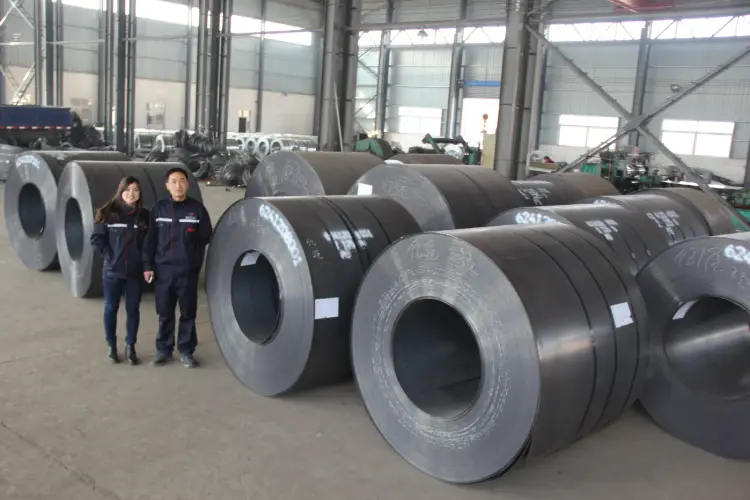
DNV A500 Shipbuilding Steel Coil
DNV A500 Shipbuilding Steel Coil: High Strength Hull Structural Steel with 500 MPa Minimum Yield
Comprehensive material data of DNV A500 shipbuilding steel coil including chemical composition, mechanical properties, thermal properties, equivalent grades and typical applications.
Hot rolling, normalizing rolling, thermo-mechanical controlled processing (TMCP), quenching and tempering (Q&T)
- Phone : +8618037372205
- Email : [email protected]
- WhatsApp: Contact via Whtsapp
- WeChat: +8618037372205
DNV A500 Shipbuilding Steel Coil Introduction
DNV A500 (AH500) is a high-strength hull structural steel grade specified by DNV (Det Norske Veritas) rules for ship classification. It belongs to the normal and high-strength structural steel series for shipbuilding and offshore structures, with a minimum yield strength of 500 MPa. The 'A' designation indicates an impact test temperature of 0°C. This steel is produced as hot-rolled coils and plates, typically delivered in thermo-mechanically controlled processed (TMCP) or quenched and tempered (Q&T) condition. It offers an excellent combination of high strength, good weldability, and adequate toughness for demanding marine environments. DNV A500 is commonly used in hull girders, decks, bottom structures, and offshore platforms where weight savings and structural integrity are critical. Equivalent grades can be found under other classification societies and international standards such as EN 10025-6 S500Q.
DNV A500 Shipbuilding Steel Coil Chemical Composition – Typical Requirements per DNV Rules
The chemical composition of DNV A500 is controlled to achieve high strength and good weldability. Maximum limits are specified for impurity elements, and microalloying elements such as niobium, vanadium, and titanium are added for grain refinement and precipitation strengthening. The carbon equivalent value (CEV) is restricted to ensure satisfactory weldability. The values below are based on typical ladle analysis for thickness up to 50 mm. Note: Actual composition may vary within the standard limits depending on the manufacturing process and thickness.
| Element | Specified Value (max % unless range given) | Remarks |
|---|---|---|
| Carbon (C) | ≤ 0.18 | Typical 0.08–0.16 |
| Silicon (Si) | ≤ 0.55 | Typical 0.15–0.50 |
| Manganese (Mn) | 0.90–1.60 | Higher Mn for strength |
| Phosphorus (P) | ≤ 0.025 | Maximum for cleanliness |
| Sulfur (S) | ≤ 0.025 | Maximum for cleanliness |
| Chromium (Cr) | ≤ 0.20 | Residual content |
| Nickel (Ni) | ≤ 0.40 | Residual content |
| Molybdenum (Mo) | ≤ 0.08 | Residual content |
| Copper (Cu) | ≤ 0.35 | Residual content |
| Niobium (Nb) | ≤ 0.05 | Microalloying element |
| Vanadium (V) | ≤ 0.10 | Microalloying element |
| Titanium (Ti) | ≤ 0.05 | Microalloying element |
| Aluminium (Al) | ≥ 0.015 | Minimum for grain refinement |
| Nitrogen (N) | ≤ 0.012 | Maximum |
| Carbon Equivalent (CEV) | ≤ 0.43 | CEV = C + Mn/6 + (Cr+Mo+V)/5 + (Ni+Cu)/15 |
DNV A500 Shipbuilding Steel Coil Thermal and Electrical Physical Properties
The physical properties of DNV A500 are similar to those of other high-strength low-alloy steels. The values below are typical for engineering calculations and may vary slightly with actual chemical composition and heat treatment condition. They are provided for general design reference and are not part of the mandatory certification tests.
| Property | Typical Value | Unit | Test Condition / Remarks |
|---|---|---|---|
| Density (ρ) | 7850 | kg/m³ | At 20°C |
| Modulus of Elasticity (E) | 205 | GPa | At 20°C |
| Shear Modulus (G) | 80 | GPa | At 20°C |
| Poisson's Ratio (ν) | 0.3 | — | At 20°C |
| Thermal Expansion Coefficient (α) | 12.0 | 10⁻⁶/K | 20°C to 100°C |
| Thermal Expansion Coefficient (α) | 12.5 | 10⁻⁶/K | 20°C to 200°C |
| Thermal Expansion Coefficient (α) | 13.0 | 10⁻⁶/K | 20°C to 300°C |
| Thermal Conductivity (λ) | 50 | W/(m·K) | At 20°C |
| Thermal Conductivity (λ) | 47 | W/(m·K) | At 200°C |
| Thermal Conductivity (λ) | 44 | W/(m·K) | At 300°C |
| Specific Heat Capacity (cₚ) | 460 | J/(kg·K) | At 20°C |
| Electrical Resistivity (ρₑ) | 0.20 | μΩ·m | At 20°C |
DNV A500 Shipbuilding Steel Coil Mechanical Properties – Typical Requirements at Room Temperature
The mechanical properties of DNV A500 steel are verified by tensile and impact tests in the specified delivery condition. Minimum values for yield strength, tensile strength, elongation, and impact energy are defined for different thickness ranges. Bending tests ensure formability. Note: For thicknesses above 50 mm, a slight reduction in yield strength may apply as per the standard. The impact test energy is measured on Charpy V-notch specimens in the longitudinal direction.
| Property | Required Value | Unit | Test Condition / Remarks |
|---|---|---|---|
| Yield Strength (ReH) | ≥ 500 | MPa | t ≤ 50 mm; for 50 < t ≤ 100 mm: ≥ 470 MPa |
| Tensile Strength (Rm) | 610 – 770 | MPa | t ≤ 100 mm |
| Elongation (A) | ≥ 16 | % | Gauge length 5.65√S₀ (proportional), longitudinal |
| Elongation (A) | ≥ 14 | % | Transverse (if specified) |
| Bend Test (bend diameter) | 3t (180°) | — | t = specimen thickness; no cracks |
| Impact Energy (KV₂) | ≥ 27 | J | At 0°C, longitudinal, average of 3 specimens (single value ≥ 19 J) |
| Impact Energy (KV₂) | ≥ 27 | J | At 0°C, transverse (if required), average of 3 specimens (single value ≥ 19 J) |
DNV A500 Shipbuilding Steel Coil Fully Equivalent Material Standards and Replaceable Grades
| Country / Region | Standard | Grade | Remarks |
|---|---|---|---|
| International | DNV (Det Norske Veritas) | A500 / AH500 | Base specification |
| USA | ABS (American Bureau of Shipping) | AH500 | Identical mechanical and toughness requirements |
| UK | LR (Lloyd's Register) | AH500 | Same as DNV AH500 |
| France | BV (Bureau Veritas) | AH500 | Equivalent grade |
| China | CCS (China Classification Society) | AH500 | Equivalent grade |
| Japan | NK (Nippon Kaiji Kyokai) | AH500 | Equivalent grade |
| Europe | EN 10025-6 | S500Q / S500QL | Quenched and tempered structural steel with similar strength |
| International | ISO 4950-2 | S500Q | High yield strength flat steel products |
| Germany | DIN EN 10025-6 | S500Q | Same as EN 10025-6 |
| Italy | UNI EN 10025-6 | S500Q | Same as EN 10025-6 |
DNV A500 Shipbuilding Steel Coil Application Introduction
DNV A500 steel is primarily designed for high-strength structural applications in shipbuilding and offshore engineering. It is widely used where a combination of high load-bearing capacity, weldability, and moderate toughness at sub-zero temperatures is required. The typical products manufactured from this grade include plates and coils that are further processed into structural components. Key industries and specific applications are listed below.
Product Applications: Ship hull plates and stiffeners, Deck and bottom longitudinals, Transverse webs and frames, Bulkheads and strength decks, Offshore platform tubular joints and nodes, Heavy-duty structural profiles, Wind turbine foundation transition pieces
Processed into products: Main deck stringer plates, Bottom shell plating in high-stress areas, Shear strake of side shells, Hatch coaming stiffeners, Crane pedestals and booms, Legs of jack-up rigs, Reinforcing rings and brackets, Welded beam and column sections
Application industries: Shipbuilding (commercial vessels, naval ships), Offshore oil & gas (platforms, FPSO units), Marine engineering (hulls, deckhouses), Heavy machinery (crane booms, structural frames), Bridges and civil construction (specialty structural elements), Pressure vessels and storage tanks (when certified)
DNV A500 Shipbuilding Steel Coil Near Equivalent Similar Material Replacements
| Country / Region | Standard | Grade | Remarks |
|---|---|---|---|
| Europe | EN 10149-2 | S500MC | Thermomechanically rolled steel with min ReH 500 MPa, thinner gauges, used in automotive and construction |
| Europe | EN 10025-6 | S550Q | Higher strength Q&T steel, min ReH 550 MPa, may replace A500 if design allows |
| International | DNV | AH550 / A550 | Next strength class (550 MPa) in DNV rules, for improved weight savings |
| International | DNV | DH500 | Same strength but lower impact temperature (-20°C), suitable for colder environments |
| International | DNV | EH500 | Same strength, impact temperature -40°C, for arctic conditions |
| USA | ASTM A514 / A517 | Grade Q | Quenched and tempered alloy steel, min yield 690 MPa, higher strength alternative |
| UK | BS 7191 | 450EM | Similar strength offshore structural steel, but often used in thicker sections |
| China | GB/T 16270 | Q500D | High strength structural steel, impact at -20°C, close mechanical properties |
Notes:
Important delivery and testing conditions: DNV A500 steel must be manufactured at an approved works and tested in the presence of a DNV surveyor. Mechanical testing is performed on material in the delivery condition. If the material is subject to cold forming or welding during fabrication, supplementary testing may be required to verify properties after aging or working. The steel can be supplied with additional certifications such as Z-quality (through-thickness properties) as per DNV rules. Weldability is generally good with appropriate preheat and heat input control. For specific thicknesses and design temperatures, consult the relevant class rules.
- Share



