
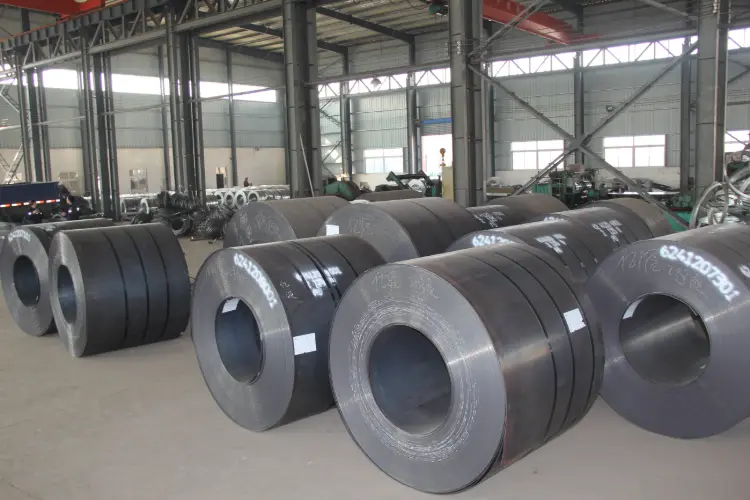
DNV D500 Shipbuilding Steel Coil
DNV D500 Shipbuilding Steel Coil: High-Strength Marine Grade for Extreme Conditions
DNV D500 is a high-strength shipbuilding steel coil designed for structural hull components, offering minimum 500 MPa yield strength and excellent low-temperature toughness at -20°C. Ideal for demanding marine environments.
Thermomechanically rolled (TMCP), normalizing rolling, or quenched and tempered (Q&T). Suitable for welding, bending, and cold forming.
- Phone : +8618037372205
- Email : [email protected]
- WhatsApp: Contact via Whtsapp
- WeChat: +8618037372205
DNV D500 Shipbuilding Steel Coil Introduction
DNV D500 is a high-strength structural steel grade certified under the DNV classification society rules for ships and mobile offshore units. It belongs to the D-quality level, meaning it guarantees specified impact toughness at -20°C. The '500' designation refers to the minimum specified yield strength of 500 MPa, making it suitable for weight-critical and high-load applications such as container ships, naval vessels, and offshore platforms. The steel is typically supplied in a thermomechanically rolled (TMCP) or quenched and tempered (Q&T) condition, ensuring a fine-grained microstructure that provides an excellent combination of strength, weldability, and resistance to brittle fracture. As a coil product, it can be efficiently processed into various plate dimensions via cut-to-length lines, optimizing material usage in shipyard operations. DNV D500 fully satisfies the requirements of DNV rules Pt.2 Ch.2, ensuring global acceptance in marine construction.
DNV D500 Shipbuilding Steel Coil Chemical Composition
The chemical composition of DNV D500 is controlled to ensure high strength, excellent weldability, and good low-temperature toughness. Microalloying elements like niobium, vanadium, and titanium are used to achieve grain refinement. The carbon equivalent (CEV) is typically limited to guarantee good weldability without preheating.
- Ladle analysis values according to DNV rules.
- CEV = C + Mn/6 + (Cr+Mo+V)/5 + (Ni+Cu)/15 (max 0.43% for typical delivery condition).
| Element | Specified Value (max) | Remarks |
|---|---|---|
| Carbon (C) | 0.18% | Ladle analysis |
| Silicon (Si) | 0.10 – 0.50% | - |
| Manganese (Mn) | 0.90 – 1.60% | - |
| Phosphorus (P) | 0.025% | - |
| Sulfur (S) | 0.025% | - |
| Aluminum (Al, total) | 0.015% min | Soluble or total |
| Niobium (Nb) | 0.02 – 0.05% | Typical range, may be replaced by V or Ti |
| Vanadium (V) | 0.05 – 0.10% | As alternative to Nb |
| Titanium (Ti) | 0.007 – 0.05% | For grain refinement |
| Nitrogen (N) | 0.009% | If not using nitrogen-binding elements |
| Copper (Cu) | ≤ 0.35% | - |
| Chromium (Cr) | ≤ 0.25% | - |
| Nickel (Ni) | ≤ 0.40% | - |
| Molybdenum (Mo) | ≤ 0.08% | - |
| Carbon Equivalent (CEV) | 0.43% (typical) | Depends on thickness and delivery condition |
DNV D500 Shipbuilding Steel Coil Thermal and Electrical Physical Properties
Typical physical properties for DNV D500 steel at room temperature (unless noted). These values are derived from common high-strength low-alloy steels and are not specified by DNV but provide design guidance.
- Properties may slightly change with heat treatment and composition.
- Density and modulus assumed constant for structural analysis.
| Property | Typical Value | Unit | Condition / Temperature |
|---|---|---|---|
| Density (ρ) | 7850 | kg/m³ | 20°C |
| Modulus of Elasticity (E) | 205 – 210 | GPa | 20°C |
| Shear Modulus (G) | ≈ 80 | GPa | 20°C |
| Poisson's Ratio (ν) | 0.30 | – | 20°C |
| Thermal Expansion Coefficient (α) | 11.7 – 12.5 | 10⁻⁶/K | 20–100°C |
| Thermal Expansion Coefficient (α) | 12.5 – 13.5 | 10⁻⁶/K | 20–200°C |
| Thermal Conductivity (λ) | 40 – 45 | W/(m·K) | 20°C |
| Specific Heat Capacity | 430 – 480 | J/(kg·K) | 20°C |
| Electrical Resistivity (ρ_e) | 0.22 – 0.28 | µΩ·m | 20°C |
DNV D500 Shipbuilding Steel Coil Mechanical Properties
The mechanical properties of DNV D500 are determined by tensile and impact testing under DNV rules. Tests are performed on transverse specimens. Yield strength, tensile strength, and elongation vary with thickness. The impact test temperature for D-grade is -20°C.
- Thickness range: ≤ 100 mm typically covered.
- Charpy V-notch energy values for longitudinal specimens may be higher.
| Property | Required Value | Unit | Test Condition / Thickness |
|---|---|---|---|
| Yield Strength (ReH) | ≥ 500 | MPa | t ≤ 50 mm |
| Yield Strength (ReH) | ≥ 480 | MPa | 50 < t ≤ 100 mm |
| Tensile Strength (Rm) | 610 – 770 | MPa | t ≤ 50 mm |
| Tensile Strength (Rm) | 580 – 770 | MPa | 50 < t ≤ 100 mm |
| Elongation (A, 5.65√So) | ≥ 16 | % | t ≤ 50 mm |
| Elongation (A, 5.65√So) | ≥ 15 | % | 50 < t ≤ 100 mm |
| Impact Energy (KV, transverse) | ≥ 27 (average) | J | -20°C, t ≤ 50 mm |
| Impact Energy (KV, transverse) | ≥ 27 (average) | J | -20°C, 50 < t ≤ 100 mm |
| Impact Energy (KV, longitudinal) | ≥ 41 (average) | J | -20°C, all thicknesses (typical) |
| Bend Test (180°) | No cracks | – | d = 3a (t ≤ 50 mm); d = 4a (t > 50 mm), a = specimen thickness |
DNV D500 Shipbuilding Steel Coil Full Equivalent Grade Standards and Replaceable Designations
| Country/Region | Standard | Designation | Remarks |
|---|---|---|---|
| International | DNV | DNV D500 | Base grade |
| International | ABS | ABS D500 | Same strength and toughness (-20°C) |
| International | Bureau Veritas | BV D500 | Identical requirements |
| International | Lloyd's Register | LR D500 | Identical requirements |
| International | ClassNK | NK D500 | Identical requirements |
| International | CCS | CCS D500 | Identical requirements |
| International | RINA | RINA D500 | Identical requirements |
| International | Russian Maritime Register | RMRS D500 | Identical requirements |
| Europe/EN | EN 10025-6 | S500G1+M / S500G2+M | Similar strength, need D-grade toughness certified by class society |
| Europe/EN | EN 10025-6 | S500QL / S500Q | Quenched and tempered option, also requires -20°C impact certification |
DNV D500 Shipbuilding Steel Coil Application Introduction
DNV D500 steel coil is engineered for structures where high strength-to-weight ratio and reliable low-temperature toughness are critical. It is widely used in shipbuilding and offshore engineering. The coil form offers flexibility for fabricators to produce plates of varying lengths, reducing waste. The material is approved for welding with conventional procedures without high preheat due to controlled carbon equivalent. Typical applications include:
Product Applications: Rolled plates cut from coil (for hull main deck, bottom shell, side shells), Fabricated stiffeners, girders, and web frames, Prefabricated blocks and modular ship sections, Jack-up rig leg chords and spud cans, Subsea structural components and templates
Processed into products: Longitudinal and transverse hull stiffeners, Deck plating, sheer strakes, and bilge keels, Bulkhead stools and stringers, Offshore crane pedestals and helideck support structures, Reinforcement pads and doubler plates
Application industries: Commercial shipbuilding (container ships, bulk carriers, tankers, cruise ships), Naval and defense shipbuilding (frigates, destroyers, auxiliary vessels), Offshore oil and gas (jack-up rig legs, topside modules, flare booms), Marine renewable energy (offshore wind turbine foundations, substations), Heavy lift and transport barges
DNV D500 Shipbuilding Steel Coil Similar / Alternative Material Recommendations
| Country/Region | Standard | Designation | Remarks |
|---|---|---|---|
| International | DNV | DNV E500 | Lower impact temperature (-40°C), higher toughness, otherwise equivalent strength |
| International | API | API 2Y-50 / 2W-50 | Offshore structural steel with similar yield strength (500 MPa), requires supplementary D-grade charpy agreement |
| Europe/EN | EN 10025-4 | S500MLO | Thermomechanical rolled offshore steel, may satisfy D500 if -20°C impact is certified |
| Japan | JIS G 3106 | SM570 | 580-720 MPa tensile, similar strength, not a full shipbuilding substitute without class approval |
| USA | ASTM | A709 Grade HPS 70W | High-performance steel, yield 485 MPa min, needs additional testing for marine use |
Notes:
DNV D500 steel must be ordered with thickness, rolling direction, and surface condition specified. The coil is typically pickled and oiled or shot-blasted and primer-coated to prevent corrosion during fabrication. Ultrasonic testing per EN 10160 or equivalent is often required. The material can be certified with through-thickness properties (e.g., Z25/Z35) if specified. Welding consumables should be matched to achieve minimum yield strength and -20°C impact toughness in the weld metal. For thick sections, post-weld heat treatment parameters must be reviewed to maintain properties.
- Share



