
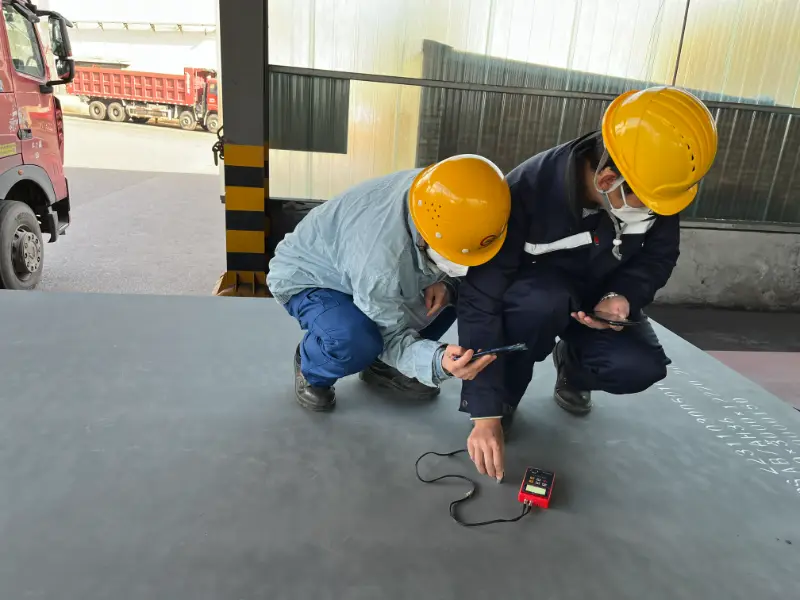
DNV E500 Shipbuilding Steel
DNV E500 Shipbuilding Steel - High Strength Hull Plate for Arctic and Offshore Environments
Detailed material data for DNV E500 shipbuilding steel coil including chemical composition, mechanical and physical properties, international equivalents, and application guidance. Conforms to DNV classification rules for hull structures with minimum 500 MPa yield strength and -40°C impact toughness.
Thermomechanical Controlled Rolling (TMCP), Normalizing Rolling, or Quenching and Tempering (as agreed); suitable for cold forming, bending, welding (preheating may be required for heavy sections), and cutting
- Phone : +8618037372205
- Email : [email protected]
- WhatsApp: Contact via Whtsapp
- WeChat: +8618037372205
DNV E500 Shipbuilding Steel Introduction
DNV E500 is a high-strength shipbuilding structural steel grade governed by the DNV Rules for Classification of Ships (Part 2, Chapter 2). The designation 'E' indicates guaranteed Charpy V-notch impact toughness at -40°C, and '500' denotes a minimum yield strength of 500 MPa. This thermomechanically controlled processed (TMCP) or normalized rolled steel is designed for critical hull and offshore structures exposed to low-temperature and high-stress conditions. Key characteristics include:
- Excellent weldability with controlled carbon equivalent (Ceq ≤0.40)
- Good formability and through-thickness properties
- Stable mechanical properties across a wide thickness range (up to 50 mm for the referenced values)
- Compliance with DNV's stringent requirements for notch toughness and freedom from internal defects
Typical delivery condition is TMCP or normalized rolling. The material is widely applied in ship hulls, decks, hatch coamings, offshore platforms, and polar-going vessels where low-temperature toughness and high strength are essential.
DNV E500 Shipbuilding Steel Chemical Composition
Ladle analysis according to DNV Pt.2 Ch.2 for grade E500. Trace elements may be present but are not specified. Carbon equivalent Ceq = C + Mn/6 + (Cr+Mo+V)/5 + (Ni+Cu)/15 ≤ 0.40%. All values are maximum unless a range is given. The composition ensures good weldability while achieving the required strength level.
| Chemical Element | Standard Value (max or range) | Remarks |
|---|---|---|
| C (Carbon) | 0.18 | Max; higher carbon may increase strength but reduce weldability |
| Si (Silicon) | 0.55 | Max; typical range 0.10–0.55 |
| Mn (Manganese) | 0.90–1.60 | Provides solid solution strengthening |
| P (Phosphorus) | 0.025 | Max; controlled for toughness |
| S (Sulfur) | 0.025 | Max; low sulfur for cleanliness |
| Alt (Total Aluminium) | 0.015 min | Minimum; for grain refinement |
| Nb (Niobium) | 0.02–0.05 | Micro-alloying for grain refinement and precipitation strengthening |
| V (Vanadium) | 0.05–0.10 | Micro-alloying; contributes to strength |
| Ti (Titanium) | 0.02 | Max; can be added for grain refinement |
| Cu (Copper) | 0.35 | Max; may be present from scrap |
| Cr (Chromium) | 0.20 | Max |
| Ni (Nickel) | 0.40 | Max |
| Mo (Molybdenum) | 0.08 | Max |
| N (Nitrogen) | 0.012 | Max; controlled to avoid strain aging |
| Ceq (Carbon Equivalent) | ≤0.40 | Calculated using DNV formula |
DNV E500 Shipbuilding Steel Typical Thermal and Electrical Physical Properties
The following values are typical reference data for low-alloy high-strength structural steels similar to DNV E500. They are not part of the mandatory delivery specification but are widely accepted in engineering design. Variations may occur depending on actual composition and heat treatment condition. Electrical resistivity and thermal expansion are measured from ambient to the indicated temperature.
| Property | Typical Value | Unit | Test Conditions / Remarks |
|---|---|---|---|
| Density (ρ) | 7.85 | g/cm³ | At 20°C |
| Modulus of Elasticity (E) | 205 | GPa | At 20°C, longitudinal |
| Shear Modulus (G) | 79 | GPa | Calculated from E = 2G(1+ν) |
| Poisson's Ratio (ν) | 0.3 | – | Typical for steel |
| Thermal Expansion Coefficient (α) | 12.0 | 10⁻⁶/K | Between 20°C and 100°C |
| Thermal Conductivity (λ) | 50 | W/(m·K) | At 100°C |
| Specific Heat Capacity (cp) | 460 | J/(kg·K) | At 20°C |
| Electrical Resistivity (ρe) | 0.20 | μΩ·m | At 20°C |
DNV E500 Shipbuilding Steel Mechanical Properties
Tensile testing at room temperature and Charpy V-notch impact testing at -40°C in the longitudinal direction. Properties are valid for thicknesses ≤50 mm. For larger thicknesses, the values may need to be agreed upon. Bend test is carried out with d=3a (d = mandrel diameter, a = specimen thickness) and an angle of 180°. Impact energy values are minimum average of 3 specimens.
| Property | Standard Required Value | Unit | Test Conditions / Remarks |
|---|---|---|---|
| Yield Strength (ReH) | ≥500 | MPa | Upper yield or 0.2% proof; thickness ≤50 mm, transverse |
| Tensile Strength (Rm) | 610–770 | MPa | Room temperature, transverse |
| Elongation (A5) | ≥16 | % | Gauge length 5.65√So; thickness ≤50 mm, transverse |
| Bend Test (180°) | d = 3a | – | Mandrel diameter 3 times specimen thickness; no cracks |
| Charpy Impact Energy (KV2) | ≥34 | J | At -40°C; longitudinal; average of 3 tests; single min. 24 J |
DNV E500 Shipbuilding Steel Fully Equivalent Material Standards and Substitutable Grades
| Country / Classification Society | Standard / Rule | Grade Designation | Remarks |
|---|---|---|---|
| American Bureau of Shipping (ABS) | ABS Rules for Materials and Welding (Part 2) | EH500 | Same yield strength and -40°C impact requirement; suitable substitute |
| Lloyd's Register (LR) | LR Rules for the Manufacture, Testing and Certification of Materials | E500 | Direct equivalent; same chemistry and mechanical limits |
| Bureau Veritas (BV) | BV Rules for the Classification of Steel Ships | E500 | Fully interchangeable with DNV E500 |
| China Classification Society (CCS) | CCS Rules for Materials and Welding | E500 | Adopted directly from DNV requirements; match exactly |
| Nippon Kaiji Kyokai (ClassNK) | NK Rules for the Survey and Construction of Steel Ships | E500 | Same designation; covers the same technical delivery conditions |
| RINA (Registro Italiano Navale) | RINA Rules for the Classification of Ships | E500 | Equivalent high-strength hull steel for -40°C service |
DNV E500 Shipbuilding Steel Application Introduction
DNV E500 steel coil is engineered for demanding marine and offshore environments. Its combination of high yield strength (≥500 MPa) and excellent low-temperature notch toughness (34 J at -40°C) makes it suitable for weight-saving designs without compromising safety. The TMCP delivery condition ensures fine grain structure and good weldability. Typical processing includes plasma or laser cutting, cold forming, and submerged arc or flux-cored arc welding with low-hydrogen consumables. Preheating may be required for thicker sections (>50 mm). Applications range from primary hull members to components of mobile offshore units.
Product Applications: Ship hull plates and coils for shell plating, deck plating, and bottom plating, Longitudinals, stiffeners, and web frames, Hatch coamings and covers, Offshore platform legs and bracings, Ice belt reinforcement plates, Structural components for polar research vessels
Processed into products: Main deck panels and stringer plates, Bottom shell plates and bilge keels, Transverse bulkheads and watertight doors, Crane pedestal flanges and slewing rings, Helideck support structures, Mooring foundations and winch beds, Heavy-duty padeye plates and lifting lugs
Application industries: Commercial Shipbuilding (container ships, bulk carriers, tankers), Naval and Coast Guard Vessels, Offshore Oil & Gas (jack-up rigs, semi-submersibles, FPSO hulls), Offshore Wind Energy (transition pieces, monopile reinforcement), Heavy Lift and Crane Structures (shipboard cranes, offshore crane pedestals), Arctic and Ice-Class Vessel Construction
DNV E500 Shipbuilding Steel Similar / Closely Related Alternative Materials
| Country / Classification Society | Standard / Rule | Grade Designation | Remarks |
|---|---|---|---|
| DNV | DNV Pt.2 Ch.2 | DH500 | High-strength hull steel with yield ≥500 MPa but impact test at -20°C; suitable where higher temperature toughness is acceptable |
| DNV | DNV Pt.2 Ch.2 | FH500 | Higher toughness grade with impact test at -60°C; for extreme low-temperature applications |
| DNV | DNV Pt.2 Ch.2 | E460 | Lower minimum yield strength (460 MPa); may serve as an undermatched alternative with better weldability |
| ABS | ABS Rules | DH500 | Equivalent to DNV DH500; -20°C impact, otherwise similar strength |
| EN 10025-6 | European Standard | S500Q / S500QL | Quenched and tempered structural steel with ≥500 MPa yield; not specifically shipbuilding but can be considered for some offshore structures |
Notes:
Delivery documentation: Products are supplied with a DNV inspection certificate type 3.1 or 3.2 as per EN 10204, stating the heat and mechanical test results. Ultrasonic testing to DNV Class 1 or higher may be specified for critical applications. Weldability: Welding consumables should be chosen to match the base material's strength and toughness; low-hydrogen procedures are mandatory. Corrosion protection: Standard marine coatings or cathodic protection schemes apply. For sour service or hydrogen-induced cracking (HIC) resistance, additional requirements must be agreed upon at the inquiry stage. Further processing: The steel can be cold formed up to a certain ratio; hot forming above 600°C followed by normalizing may require re-qualification of mechanical properties.
- Share



