
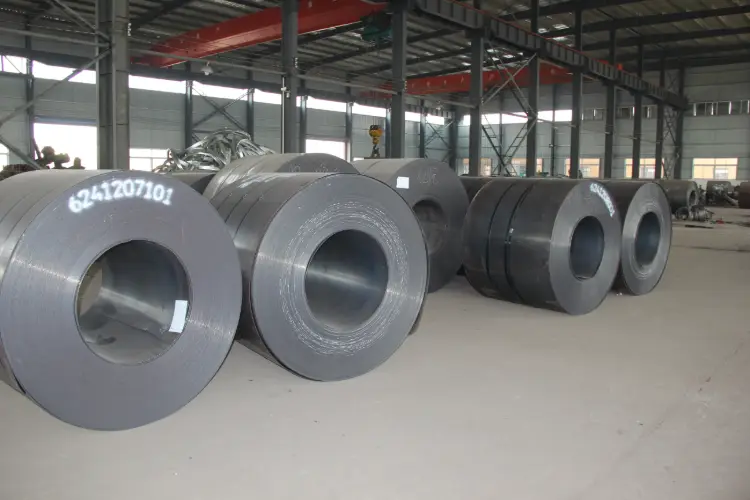
DNV F500 Shipbuilding Steel Coil
DNV F500 Shipbuilding Steel Coil: High-Strength Quenched & Tempered Steel for Extreme Marine Environments
Comprehensive material data for DNV F500 shipbuilding steel coil, a high-strength quenched and tempered steel with minimum 500 MPa yield strength, certified by DNV for ship and offshore structures. Includes chemical composition, mechanical and thermal properties, international equivalents, and application guidance.
Hot rolling, Quenching & Tempering (Q&T), Welding, Cold forming, Machining
- Phone : +8618037372205
- Email : [email protected]
- WhatsApp: Contact via Whtsapp
- WeChat: +8618037372205
DNV F500 Shipbuilding Steel Coil Introduction
DNV F500 is a high-strength quenched and tempered structural steel coil specifically manufactured and certified according to DNV (Det Norske Veritas) rules for the classification of ships and offshore units. It offers a minimum yield strength of 500 MPa, combined with excellent low-temperature toughness down to -60°C and good weldability. Designed for critical load-bearing components in harsh marine environments, F500 ensures high structural integrity and resistance to brittle fracture. Its mechanical properties are achieved through a precisely controlled heat treatment process, delivering a fine-grained microstructure with balanced strength and ductility. The steel is typically supplied in the normalized or quenched and tempered condition and is widely used in shipbuilding, offshore platforms, and heavy-duty marine equipment where weight reduction and high performance are essential.
DNV F500 Shipbuilding Steel Coil Chemical Composition
The chemical composition of DNV F500 is optimized for high strength and excellent weldability. Key alloying elements such as chromium, nickel, and molybdenum enhance hardenability and toughness, while micro-alloying with vanadium and niobium provides grain refinement. Low sulfur and phosphorus contents ensure high cleanliness and resistance to brittle fracture. Actual heat analysis is subject to DNV-approved manufacturing specifications.
| Chemical Element | Standard Value (max unless range) | Remarks |
|---|---|---|
| Carbon (C) | ≤ 0.20 | Tighter control may apply for CEV requirements |
| Silicon (Si) | ≤ 0.50 | Deoxidizer and strength contributor |
| Manganese (Mn) | ≤ 1.70 | Important for strength and toughness |
| Phosphorus (P) | ≤ 0.025 | Low P ensures ductility |
| Sulfur (S) | ≤ 0.015 | Low S for improved cleanliness |
| Chromium (Cr) | ≤ 1.50 | Increases hardenability |
| Nickel (Ni) | ≤ 2.0 | Enhances low-temperature toughness |
| Molybdenum (Mo) | ≤ 0.70 | Improves high-temperature strength and temper resistance |
| Vanadium (V) | ≤ 0.12 | Grain refinement and precipitation strengthening |
| Niobium (Nb) | ≤ 0.06 | Grain refinement |
| Titanium (Ti) | ≤ 0.05 | Optional micro-alloy for grain control |
| Nitrogen (N) | ≤ 0.015 | Controlled to avoid aging effects |
| Boron (B) | ≤ 0.005 | Used in extremely low levels for hardenability |
| Aluminium (Al) | ≥ 0.015 total | Grain refining and deoxidation |
| Carbon Equivalent (CEV) | ≤ 0.52 (typical) | For weldability assessment; CEV = C + Mn/6 + (Cr+Mo+V)/5 + (Ni+Cu)/15 |
DNV F500 Shipbuilding Steel Coil Thermal and Electrical Physical Properties
The physical properties listed are typical for quenched and tempered high-strength low-alloy steel of this grade. These values may vary slightly based on exact heat treatment and chemical composition. They are provided as guidance for engineering design, thermal deformation calculations, and electrical applications.
| Property | Typical Reference Value | Unit | Test Condition |
|---|---|---|---|
| Density (ρ) | 7850 | kg/m³ | At 20°C |
| Modulus of Elasticity (E) | 205,000 | MPa | Tensile modulus at 20°C |
| Shear Modulus (G) | ~ 80,000 | MPa | Calculated from E and ν |
| Poisson's Ratio (ν) | 0.28 | — | Elastic range, room temperature |
| Thermal Expansion Coefficient (α) | 11.5 × 10⁻⁶ | 1/K | 20–100°C |
| Thermal Expansion Coefficient (α) | 12.0 × 10⁻⁶ | 1/K | 20–200°C |
| Thermal Expansion Coefficient (α) | 13.0 × 10⁻⁶ | 1/K | 20–300°C |
| Thermal Conductivity (λ) | 42 | W/(m·K) | At 20°C |
| Thermal Conductivity (λ) | 39 | W/(m·K) | At 200°C |
| Thermal Conductivity (λ) | 36 | W/(m·K) | At 400°C |
| Specific Heat Capacity | 460 | J/(kg·K) | At 20°C |
| Electrical Resistivity (ρ_e) | 0.22 × 10⁻⁶ | Ω·m | At 20°C |
DNV F500 Shipbuilding Steel Coil Mechanical Properties
The mechanical properties are certified for quenched and tempered condition. Testing is carried out in accordance with DNV standards on specimens taken in the transverse direction. The steel exhibits high yield and tensile strength with excellent elongation, ensuring sufficient ductility for forming and resistance to sudden failure. Impact energy values at -60°C confirm suitability for Arctic and low-temperature service.
| Property | Standard Requirement | Unit | Test Condition |
|---|---|---|---|
| Yield Strength (ReH) | ≥ 500 | MPa | Ambient temperature, thickness ≤ 50 mm |
| Yield Strength (ReH) | ≥ 480 | MPa | Thickness > 50 mm to 100 mm |
| Tensile Strength (Rm) | 610 - 770 | MPa | Ambient temperature |
| Elongation (A5) | ≥ 17 | % | Gauge length 5.65√So |
| Elongation (A50) | ≥ 15 | % | 50 mm gauge length, typical for strip/coil |
| Bending Test | Not to crack at 180° bend | — | Mandrel diameter 3t (t = specimen thickness) typical |
| Impact Energy (KV2) at -60°C | ≥ 27 J (longitudinal) | J | Charpy V-notch, 10×10 mm specimen |
| Impact Energy (KV2) at -60°C | ≥ 20 J (transverse) | J | Charpy V-notch, 10×10 mm specimen |
| Hardness | ~ 220 - 280 | HBW | Typical range, for info |
DNV F500 Shipbuilding Steel Coil Fully Equivalent Material Standards and Substitutable Grades
| Country/Region | Standard | Grade | Remarks |
|---|---|---|---|
| International | EN 10025-6 | S500Q / S500QL / S500QL1 | Identical mechanical and chemical concept, with DNV witness certification |
| United Kingdom | BS 7191 | 500EM | Equivalent quenched and tempered offshore structural steel |
| France | NF A 36-231 | 500QL | Equivalent grade, similar delivery condition |
| United States | ASTM A514 / A517 | Grade S | Comparable yield and tensile strength, requires supplementary impact testing at -60°C to match F500 |
| Norway/International | DNV-OS-B101 | F500 | Original DNV designation, identical to S500Q with special toughness requirements |
DNV F500 Shipbuilding Steel Coil Application Introduction
DNV F500 steel coil is engineered for structural integrity in extreme marine environments. Its high strength-to-weight ratio and superior low-temperature toughness enable advanced design solutions for weight-sensitive structures. It is suitable for both new building and repair projects, and can be processed using standard industrial methods provided that heat treatment is controlled.
Product Applications: Ship hull plates and stiffeners, Deck and bottom longitudinals, Jack-up rig leg chords and racks, Crane pedestals and booms, Heavy-lift mast sections, Pressure shells for submersibles
Processed into products: Bulkhead and deck plates, Sheer strakes and bilge keels, Transition joints and doubler plates, Foundation plates for heavy equipment, Custom formed structural brackets, Cut and welded lifting lugs
Application industries: Shipbuilding and ship repair (military and commercial vessels), Offshore oil & gas (fixed platforms, FPSOs, subsea templates), Renewable offshore energy (wind turbine foundations, floating solar supports), Heavy machinery and crane manufacturing, Arctic engineering and ice-class vessels
DNV F500 Shipbuilding Steel Coil Similar or Alternative Steel Grades for Engineering Consideration
| Country/Region | Standard | Grade | Remarks |
|---|---|---|---|
| International | EN 10025-6 | S460Q/QL/QL1 | Lower yield strength (460 MPa) but similar weldability; often used where 500 MPa is over-specified |
| International | EN 10025-6 | S550Q/QL/QL1 | Higher strength (550 MPa) but reduced elongation; may require special forming and welding procedures |
| United States | ASTM A514/A517 | Grade F / H / Q | High strength but toughness values may not reach -60°C unless agreed; check impact test requirements |
| Russia | GOST R 52927 | 500W | Comparable strength class for shipbuilding, but inspection and certification may differ |
| China | GB 712 | FH500 | China Classification Society (CCS) equivalent for high-strength hull steel with -60°C impact |
Notes:
Welding: Pre-heating and interpass temperature control are recommended based on thickness and heat input. Low-hydrogen welding consumables must be used. Post-weld heat treatment is generally not required but may be applied after consultation.
Forming: Cold forming is acceptable within deformation limits; for severe forming, hot forming with subsequent re-heat treatment to the original Q&T condition may be necessary.
Inspection: DNV surveyor witness of mechanical testing and non-destructive examination (ultrasonic testing, magnetic particle) is typically specified for critical applications. All coils are marked in accordance with DNV certification rules.
- Share



