
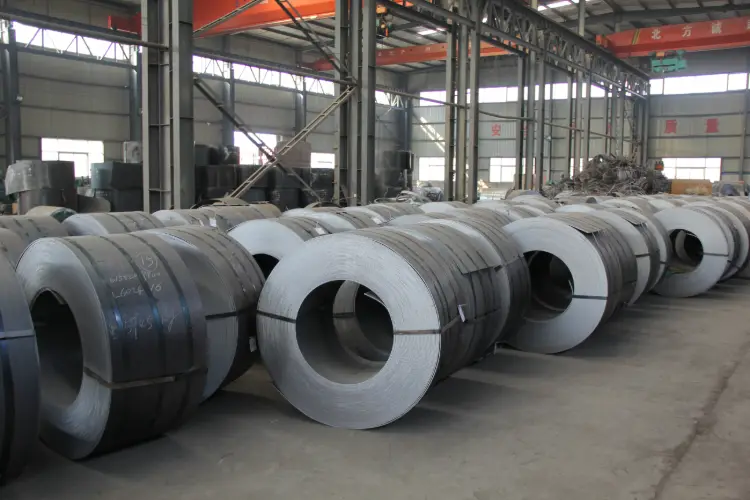
DNV F460 Shipbuilding Steel Coil
DNV F460 Shipbuilding Steel Coil - High-Strength Arctic-Grade Structural Plate
DNV F460 is a high-strength shipbuilding steel for Arctic and severe cold conditions, offering minimum 460 MPa yield, excellent toughness at -60°C, and superior weldability.
Normalizing (N), Thermo-Mechanical Controlled Processing (M/TMCP), Quenching & Tempering (Q+T, optional); Fabrication: welding, cutting, cold/hot forming
- Phone : +8618037372205
- Email : [email protected]
- WhatsApp: Contact via Whtsapp
- WeChat: +8618037372205
DNV F460 Shipbuilding Steel Coil Introduction
DNV F460 is a high-strength structural steel grade certified by DNV (Det Norske Veritas) for shipbuilding and offshore applications. It belongs to the normalized or TMCP (thermo-mechanical controlled process) rolled 460 MPa yield strength category with an 'F' designation, indicating guaranteed impact toughness at -60°C. This steel is specifically designed for critical structural components operating in extreme low-temperature environments, such as Arctic vessels, icebreakers, and offshore platforms.
- Excellent combination of high strength and superior low-temperature toughness
- Good weldability with low carbon equivalent (CEV ≤ 0.40 typical)
- Complies with DNV Rules for Classification of Ships / Offshore Standards
- Available in coil, plate, and wide flat formats in various thicknesses and Z-direction properties
DNV F460 Shipbuilding Steel Coil Chemical Composition of DNV F460 Shipbuilding Steel
Representative ladle analysis according to DNV rules. The steel is fully killed and fine-grained, with microalloying elements to achieve strength and toughness. Carbon equivalent (CEV) is controlled to ensure weldability.
- Niobium, vanadium, and titanium are added individually or combined for grain refinement and precipitation strengthening.
- Aluminum is added for deoxidation and grain size control.
- CEV typically ≤ 0.40% for thickness ≤ 50 mm; higher thickness may have slightly increased CEV.
| Chemical Element | Value (max % unless range) | Remarks |
|---|---|---|
| Carbon (C) | 0.18 | Ladle analysis, CEV controlling element |
| Silicon (Si) | 0.10 – 0.55 | Deoxidation and strength |
| Manganese (Mn) | 0.90 – 1.60 | Primary strength and toughness enhancer |
| Phosphorus (P) | 0.025 | Maximum for low-temperature toughness |
| Sulfur (S) | 0.025 | Maximum, controlled for low inclusion content |
| Nitrogen (N) | 0.012 | Maximum, or 0.009 if nitride-forming elements are present |
| Aluminum (Al) acid soluble | ≥ 0.015 | Grain size control |
| Niobium (Nb) | 0.02 – 0.05 | Typical microalloying, part of Nb+V+Ti ≤ 0.12% |
| Vanadium (V) | 0.05 – 0.10 | Typical microalloying, part of Nb+V+Ti ≤ 0.12% |
| Titanium (Ti) | 0.007 – 0.05 | Microalloying, part of Nb+V+Ti ≤ 0.12% |
| Copper (Cu) | ≤ 0.35 | May be present from scrap; CEV additive |
| Chromium (Cr) | ≤ 0.25 | May be present; CEV additive |
| Nickel (Ni) | ≤ 0.40 | Thicker plates may contain Ni for toughness; CEV additive |
| Molybdenum (Mo) | ≤ 0.08 | Thicker plates; CEV additive |
| Carbon Equivalent (CEV) | ≤ 0.40 (typical) | Based on CEV= C+Mn/6+(Cr+Mo+V)/5+(Ni+Cu)/15 |
DNV F460 Shipbuilding Steel Coil Thermal and Electrical Physical Properties of DNV F460
Physical property data are typical for low-carbon, high-strength structural steels and are valid for design calculations. Values may slightly vary depending on exact chemical composition and delivery condition.
- Density is used for weight estimation; elastic constants are for room temperature unless noted.
- Thermal conductivity and specific heat are average values over the indicated temperature range.
| Property | Typical Value | Unit | Condition / Temperature |
|---|---|---|---|
| Density (ρ) | 7850 | kg/m³ | Room temperature |
| Elastic modulus (E) | 210 | GPa | Room temperature, static |
| Shear modulus (G) | 81 | GPa | Room temperature, calculated from E and ν |
| Poisson's ratio (ν) | 0.3 | - | Room temperature, elastic range |
| Thermal expansion coefficient (α) | ≈ 12 × 10⁻⁶ | K⁻¹ | 20 – 100 °C average |
| Thermal conductivity (λ) | 50 | W/(m·K) | Room temperature |
| Specific heat capacity (c) | 460 | J/(kg·K) | Room temperature |
| Electrical resistivity (ρe) | ≈ 0.23 × 10⁻⁶ | Ω·m | Room temperature, typical |
DNV F460 Shipbuilding Steel Coil Mechanical Properties of DNV F460
The mechanical properties are determined from the transverse direction test specimens taken from the normalized or TMCP condition. Impact tests are performed at -60°C on longitudinal (L) and/or transverse (T) Charpy V-notch specimens. Properties comply with IACS UR W11.
- Thickness range typically 6 – 100 mm; for plates > 100 mm, slightly reduced yield may be agreed.
- Bend test: no cracks or ruptures appearing on the outer surface after 180° bending.
| Property | Standard Requirement | Unit | Test Condition |
|---|---|---|---|
| Yield Strength (ReH) | ≥ 460 | MPa | Transverse, room temperature, thickness ≤ 50 mm |
| Yield Strength (ReH) | ≥ 420 (thk. >50–100 mm) | MPa | Transverse, room temperature, as agreed |
| Tensile Strength (Rm) | 570 – 720 | MPa | Transverse, room temperature, all thicknesses |
| Elongation (A5) | ≥ 17 | % | Transverse, gauge length 5.65√S0, room temperature |
| Charpy V-notch impact energy (KV) | ≥ 41 (L) | J | Longitudinal, test temperature -60°C |
| Charpy V-notch impact energy (KV) | ≥ 27 (T) | J | Transverse, test temperature -60°C (typical min) |
| Bend test (d = bend diameter, a = specimen thickness) | d = 3a (thk. ≤ 25 mm) | - | 180° bending, no cracks |
| Bend test | d = 4a (thk. > 25 mm) | - | 180° bending, no cracks |
DNV F460 Shipbuilding Steel Coil Fully Equivalent Material Standards and Substitute Grades
The following classification society grades are considered fully equivalent to DNV F460 based on the IACS Unified Requirements for high-strength steel with yield point 460 MPa and F (-60°C) impact toughness designation.
| Country/Region | Standard | Grade | Remarks |
|---|---|---|---|
| International | IACS UR W11 | FH460 | Unified requirement for normal/high strength hull structural steel |
| USA | ABS Rules | FH46 | Equivalent F-grade (-60°C) 460 MPa yield ship steel |
| UK | Lloyd's Register Rules | FH46 | Equivalent grade for hull structures |
| France | Bureau Veritas Rules | F460 | Equivalent grade, same designation |
| China | CCS Rules | F460 | China Classification Society equivalent |
| Japan | ClassNK Rules | KF460 | Nippon Kaiji Kyokai equivalent |
| Italy | RINA Rules | F460 | Registro Italiano Navale equivalent |
| Russia | Russian Maritime Register | F460 | RS equivalent |
| South Korea | Korean Register Rules | FH46 | KR equivalent |
DNV F460 Shipbuilding Steel Coil Application Introduction
DNV F460 steel is engineered for demanding structural applications in shipbuilding, offshore engineering, and severe climate conditions. Its excellent combination of high strength, ductility, and -60°C impact toughness makes it suitable for critical primary structures subject to dynamic loading and extreme cold. The steel is supplied in coil or plate form and can be processed using conventional fabrication methods including welding, cold/hot bending, and machining.
- Typical welding with low-hydrogen procedures and preheat/interpass control.
- Consider Z-direction properties (e.g., Z35) for thicknesses over 40 mm where through-thickness stress is critical.
- Surface protection according to exposure (coatings, cathodic protection).
Product Applications: Hulls, side shells, longitudinal and transverse bulkheads, Deck plates, hatch coamings, frame structures, Icebreaker and ice-strengthened ship structures, Helidecks and stiffened panels on offshore platforms, Crane pedestals and lifting appliances, Wind turbine tower transition parts, Foundation structures and nodal joints
Processed into products: Shell plates, bilge keels, rudder horns, propeller brackets, Longitudinals, stringers, web frames, stiffeners, Bulkhead plating, tank corner plates, Mating structures for jack-up rigs, Truss nodes, transition rings, flanges, Lifting lugs, padeyes, and heavy-duty shackles
Application industries: Shipbuilding (commercial, naval, Arctic vessels, icebreakers), Offshore oil & gas (jacket legs, deck structures, modules), Offshore wind (monopile transition pieces, floating platform hulls), Heavy lifting and construction equipment for cold regions, Bridge and civil engineering in low-temperature environments, Mining and bulk material handling equipment in cold climates
DNV F460 Shipbuilding Steel Coil Similar or Alternative Material Recommendations
The grades listed below possess comparable strength and toughness characteristics, though they may belong to different application standards (offshore, structural, pressure vessels). They can be considered as engineering alternatives after evaluation of their specific delivery conditions and certifications.
| Country/Region | Standard | Grade | Remarks |
|---|---|---|---|
| EU | EN 10025-4 | S460ML / S460QL1 | TMCP or Q+T, impact down to -50°C; check -60°C availability |
| EU | EN 10025-6 | S500QL | Higher strength, quenched and tempered, option for low temp. with qualification |
| USA | ASTM A709 / AASHTO | Grade 70 (485) HPS 70W | High-performance steel for bridges, minimum yield 485 MPa, possible low-temp toughness |
| International | API 2Y / 2W | Grade 60 (415 MPa) | Offshore structural steel, some grades with high toughness; strength lower unless upgraded |
| Japan | JIS G 3128 | SHY685 | High-strength quenched steel for bridges, 685 MPa yield; low-temp toughness may match with modification |
Notes:
Additional Information:
- DNV F460 is available with improved through-thickness properties (Z15, Z25, Z35) in accordance with EN 10164 or DNV stamp, providing guaranteed minimum reduction of area in the Z-direction.
- The steel can be delivered with a manufacturer's certificate (cert. 3.1 per EN 10204) or DNV surveyor certified (cert. 3.2).
- Close tolerance (e.g., Class C) thickness and flatness can be ordered per IACS Recommendation No. 12.
- For coil products, the yield strength may be slightly higher due to accelerated cooling; caution should be exercised during subsequent hot forming re-heating to preserve temper condition.
- Professional welding consumable selection (e.g., matching or undermatching filler metals) and a proper WPS are essential to avoid cold cracking and maintain toughness in the heat-affected zone.
- Share



