
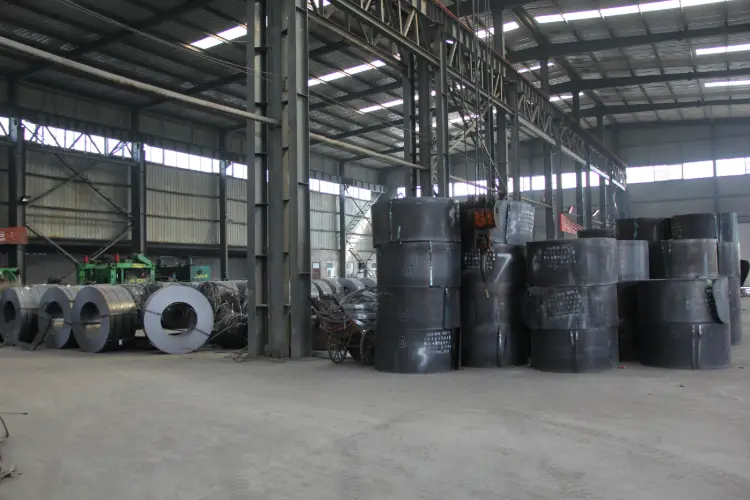
DNV E460 Shipbuilding Steel Coil
DNV E460 Shipbuilding Steel Coil: High-Strength Hull Structural Data & Global Equivalents
Full material profile of DNV E460 shipbuilding steel coil: chemical ranges, mechanical properties per thickness, thermal and electrical typical values, complete international equivalents, similar alternatives, and application guidelines for marine structures.
Welding, Oxy-fuel cutting, Plasma cutting, Bending, Forming, Straightening
- Phone : +8618037372205
- Email : [email protected]
- WhatsApp: Contact via Whtsapp
- WeChat: +8618037372205
DNV E460 Shipbuilding Steel Coil Introduction
DNV E460 is a high-strength hull structural steel classified under the DNV GL rules for ship classification. As an E-grade steel, it guarantees minimum Charpy V-notch impact toughness at -40°C, making it suitable for critical members operating in low-temperature marine environments. The designation follows the pattern NV E460, where NV denotes Det Norske Veritas, E indicates the toughness grade, and 460 represents the minimum yield strength in MPa. The material is typically supplied as normalized or thermo-mechanically controlled processed (TMCP) coils and plates, offering excellent weldability and consistent mechanical properties.
Key characteristics include:
- Minimum yield strength of 460 MPa in thicknesses up to 50 mm
- Tensile strength in the range of 570–720 MPa
- Guaranteed impact energy of 31 J longitudinal at -40 °C
- Low carbon equivalent (CEV≤0.42) for good weldability
- Compliance with IACS Unified Requirement W11 for high-strength ship steels
Widely adopted for hull plates, decks, and offshore structures, DNV E460 balances high strength with toughness and fabrication ease.
DNV E460 Shipbuilding Steel Coil Chemical Composition
The chemical composition of DNV E460 conforms to IACS UR W11 and DNV's additional requirements. Elements are controlled to ensure high strength and low-temperature toughness. The carbon equivalent CEV (C+Mn/6+(Cr+Mo+V)/5+(Ni+Cu)/15) is limited to ≤0.42 to guarantee good weldability. Grain refining elements (Nb, V, Ti) may be added singly or in combination, with their sum restricted to 0.12%. Nitrogen is kept low when aluminium is present to avoid strain ageing.
| Chemical Element | Standard Value (mass %) | Remarks |
|---|---|---|
| C (Carbon) | ≤ 0.18 | Ladle analysis |
| Mn (Manganese) | 0.90 u2013 1.60 | Higher for strength |
| Si (Silicon) | ≤ 0.50 | Deoxidation |
| P (Phosphorus) | ≤ 0.035 | Maximum |
| S (Sulphur) | ≤ 0.035 | Maximum |
| Al (acid soluble) | ≥ 0.015 | Grain refinement |
| Nb (Niobium) | ≤ 0.05 | Micro-alloy; part of Nb+V+Ti |
| V (Vanadium) | ≤ 0.10 | Micro-alloy; part of Nb+V+Ti |
| Ti (Titanium) | ≤ 0.05 | Micro-alloy; part of Nb+V+Ti |
| Nb+V+Ti | ≤ 0.12 | Combined limit |
| Ni (Nickel) | ≤ 0.40 | Optional residual |
| Cr (Chromium) | ≤ 0.20 | Optional residual |
| Cu (Copper) | ≤ 0.35 | Optional residual |
| Mo (Molybdenum) | ≤ 0.08 | Optional residual |
| N (Nitrogen) | ≤ 0.009 | If Al is present |
| CEV | ≤ 0.42 | Carbon Equivalent Value |
DNV E460 Shipbuilding Steel Coil Thermal and Electrical Physical Properties
The following physical properties are typical for as-rolled and normalized high-strength low-alloy structural steel similar to DNV E460. These values are not mandatory in the classification standard but are commonly used for engineering calculations. They apply in the ambient temperature range unless another condition is noted.
| Property | Typical Value | Unit | Test Condition / Notes |
|---|---|---|---|
| Density (u03c1) | 7850 | kg/mu00b3 | At 20 u00b0C |
| Elastic Modulus (E) | 205 | GPa | At 20 u00b0C; longitudinal |
| Shear Modulus (G) | 80 | GPa | At 20 u00b0C; estimated |
| Poissonu2019s Ratio (u03bd) | 0.3 | u2014 | At 20 u00b0C; typical for steel |
| Thermal Expansion (u03b1) | 11.5 u00d7 10u207bu2076 | /K | Between 20 u00b0C and 100 u00b0C |
| Thermal Conductivity (u03bb) | ~ 50 | W/(mu00b7K) | At 20 u00b0C |
| Specific Heat Capacity (c_p) | ~ 460 | J/(kgu00b7K) | At 20 u00b0C |
| Electrical Resistivity (u03c1_e) | ~ 0.15 u00d7 10u207bu2076 | u03a9u00b7m | At 20 u00b0C; typical low-alloy steel |
DNV E460 Shipbuilding Steel Coil Mechanical Properties
Mechanical properties are determined by tensile and impact tests on specimens taken in the rolling direction (longitudinal). Yield strength (ReH) and elongation (A) depend on plate thickness. Charpy V-notch impact energy (KV) is measured at -40°C for the E-grade; both longitudinal and transverse values are given. Bend tests are conducted on a ground flat coupon bent through 180 degrees without cracking. Values below represent the minimum specified limits unless a range is indicated.
| Property | Standard Requirement | Unit | Test Condition / Remarks |
|---|---|---|---|
| Yield Strength (ReH) | ≥ 460 | MPa | Thickness ≤ 50 mm |
| Yield Strength (ReH) | ≥ 440 | MPa | Thickness > 50 u2013 70 mm |
| Yield Strength (ReH) | ≥ 400 | MPa | Thickness > 70 u2013 100 mm |
| Tensile Strength (Rm) | 570 u2013 720 | MPa | All thicknesses up to 100 mm |
| Elongation (A) | ≥ 17 | % | Gauge length 5.65u221aSu2080; t≤50 mm |
| Elongation (A) | ≥ 17 | % | Gauge length 5.65u221aSu2080; 50<t≤70 mm |
| Elongation (A) | ≥ 17 | % | Gauge length 5.65u221aSu2080; 70<t≤100 mm |
| Charpy Impact (KV, longitudinal) | ≥ 31 (avg.) / ≥ 22 (single) | J | -40 °C; 10u00d710 mm specimen |
| Charpy Impact (KV, transverse) | ≥ 24 (avg.) / ≥ 17 (single) | J | -40 °C; 10u00d710 mm specimen |
| Bend Test (180°) | 3a no crack | u2014 | Thickness ≤ 50 mm; a = specimen thickness |
| Bend Test (180°) | 4a no crack | u2014 | Thickness > 50 u2013 100 mm |
DNV E460 Shipbuilding Steel Coil Fully Equivalent International Grades
| Country / Region | Standard | Grade | Remarks |
|---|---|---|---|
| International (IACS) | UR W11 | EH46 | Common IACS designation for E-grade, minimum 460 MPa yield |
| USA | ABS Rules | ABS EH46 | American Bureau of Shipping; identical requirements |
| France | BV Rules | BV EH46 | Bureau Veritas equivalent |
| China | CCS Rules | CCS EH46 | China Classification Society equivalent |
| UK | LR Rules | LR EH46 | Lloyd's Register equivalent |
| Japan | NK Rules | NK KE46 | Nippon Kaiji Kyokai (ClassNK); K=high tensile, E grade, 46 kgf/mmu00b2 |
| Italy | RINA Rules | RINA E460 | Registro Italiano Navale equivalent |
| Russia | RMRS Rules | PC E460 | Russian Maritime Register of Shipping (PC = increased strength) |
| Korea | KR Rules | KR EH46 | Korean Register equivalent |
DNV E460 Shipbuilding Steel Coil Application Introduction
DNV E460 is specifically designed for the most heavily stressed parts of ship and offshore structures where high strength reduces weight without compromising safety. The -40 u00b0C impact toughness ensures reliable performance in cold service, such as ice-strengthened hulls or high-latitude operations. It is delivered in as-rolled, normalized, or TMCP condition; TMCP grades offer the best combination of strength, toughness, and weldability with leaner chemistry. Welding consumables must match the strength level, and pre-heating is generally not required for moderate thicknesses. The material is readily formable up to the prescribed bend radii.
Product Applications: Bulk carriers, Container vessels, Oil / Chemical tankers, LNG / LPG carriers, Jack-up rigs and semi-submersibles, Offshore platform topsides and jackets, Ice-breakers and Arctic vessels, Barges and pontoons
Processed into products: Main deck and bottom shell plates, Side shell plates, Longitudinal stiffeners, Transverse web frames, Bulkhead plates, Strength deck stringers, Hatch coaming girders, Pontoon structures, Ice strengthening belts
Application industries: Shipbuilding, Offshore Oil & Gas, Marine Renewable Energy (Wind, Tidal), Port & Harbour Construction, Heavy Civil Engineering for marine applications
DNV E460 Shipbuilding Steel Coil Similar / Competitive Alternative Materials
| Country / Region | Standard | Grade | Remarks |
|---|---|---|---|
| Europe | EN 10225 | S460G2+M | Weldable structural steels for fixed offshore structures; similar strength and toughness (-40 u00b0C), TMCP delivery; uses CEV control; not a direct shipbuilding steel but often accepted with additional survey |
| USA | API 2H | Grade 50 | Specification for steel plates for offshore structures; yield 345–414 MPa (50 ksi) with C–Mn and optional micro-alloying; toughness down to -40 u00b0C; lower minimum yield compared to E460, but can be used in similar applications after engineering assessment |
| USA | ASTM A572 / A709 | Grade 65 (Type 3) | High-strength low-alloy structural steel; minimum yield 450 MPa; may be supplied with notch toughness at -40 u00b0C under supplementary requirements; not subject to IACS shipbuilding rules but serves as a general structural alternative |
| International | ISO 54402 | S460Q | Hot-rolled structural steels with improved atmospheric corrosion resistance; comparable strength level; for general construction, not automatically accepted for ship classification, but properties overlap with EH46 requirements |
| China | GB/T 712 | EH460 | Chinese standard for shipbuilding steel; essentially copies IACS EH46/E460 requirements; directly compatible in domestic projects |
Notes:
- Weldability: The carbon equivalent CEV ≤ 0.42 ensures good weldability without excessive pre-heat for thicknesses typically used in shipbuilding. Adhere to approved welding procedures per DNV's Pt.2 Ch.3.
- Toughness retention: TMCP delivery condition maintains fine grain structure and preserves toughness after welding. For heavy plates > 50 mm, post weld heat treatment may require qualification.
- Surface condition: Coils are supplied with mill edge or trimmed edge; plates may have as-rolled or blast-cleaned surface. Ultrasonic testing can be specified per class requirements.
- Certification: Each delivery lot is accompanied by a DNV inspection certificate 3.1 or 3.2 verifying the chemical and mechanical test results as per the class rules.
- Share



