
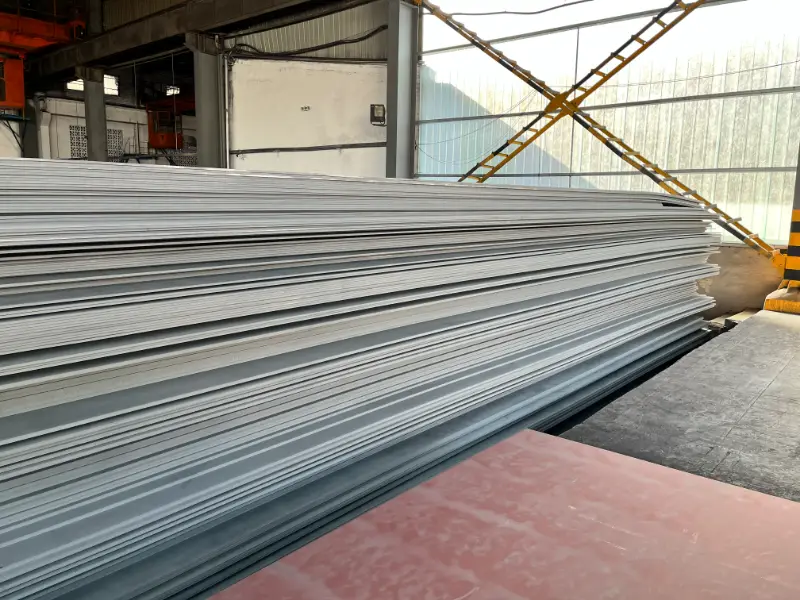
DNV D460 Extra High Strength Shipbuilding Steel
DNV D460 Extra High Strength Shipbuilding Steel - Grade, Properties & Equivalents
DNV D460 is an extra high strength structural steel for shipbuilding, certified by DNV GL. It offers a minimum yield strength of 460 MPa with excellent low‑temperature toughness (‑20°C impact tested). This steel is used for critical hull structures and offshore components.
Thermomechanically rolled (TMCP) or quenched and tempered (Q&T); cutting, cold forming, hot forming, welding under qualified procedures
- Phone : +8618037372205
- Email : [email protected]
- WhatsApp: Contact via Whtsapp
- WeChat: +8618037372205
DNV D460 Extra High Strength Shipbuilding Steel Introduction
DNV D460 is a thermomechanically rolled or quenched and tempered extra high strength structural steel governed by the DNV GL rules for classification of ships. It is designated with the 'D' toughness level, meaning it meets impact requirements at ‑20°C, and a minimum yield strength of 460 MPa.
- High strength permits weight reduction and optimised design.
- Excellent notch toughness at ‑20°C ensures reliable performance in cold maritime environments.
- Good weldability is achieved by controlled carbon equivalent (CEV) and microalloying.
- Applicable for ship hulls, offshore platform structural members, and heavy‑duty marine engineering.
DNV D460 Extra High Strength Shipbuilding Steel Chemical Composition – DNV D460
The DNV standard does not prescribe fixed chemical limits for extra high strength grades, but requires a ladle analysis reporting all major and microalloying elements. The carbon equivalent (CEV) must not exceed the specified maximum for weldability. Typical reported elements and their common control ranges (subject to DNV approval) are listed below. CEV = C + Mn/6 + (Cr+Mo+V)/5 + (Ni+Cu)/15 ≤ 0.43 (t ≤ 50 mm) / ≤ 0.45 (50 < t ≤ 100 mm).
| Element | Maximum Value (ladle analysis, %) | Remarks |
|---|---|---|
| C (Carbon) | 0.18 | Typical upper limit; actual according to CEV formula |
| Si (Silicon) | 0.55 | Typically ≤0.55 |
| Mn (Manganese) | 1.70 | Up to 1.70; higher Mn may be allowed subject to CEV |
| P (Phosphorus) | 0.025 | Max for all DNV ship steels |
| S (Sulfur) | 0.025 | Max for all DNV ship steels |
| Al (Aluminium, total) | 0.015 min | Minimum for killed fine‑grain practice; typical 0.020–0.050 |
| N (Nitrogen) | 0.012 | Maximum, if not bound by nitride formers |
| Nb (Niobium) | 0.05 | May be added for grain refinement; sum Nb+V+Ti ≤ 0.12 (t ≤ 50 mm) |
| V (Vanadium) | 0.10 | May be added; sum with Nb+Ti ≤ 0.12 |
| Ti (Titanium) | 0.05 | May be added; sum with Nb+V ≤ 0.12 |
| Cu (Copper) | 0.35 | Maximum if intentionally added |
| Cr (Chromium) | 0.20 | Maximum if intentionally added |
| Ni (Nickel) | 0.40 | Maximum if intentionally added |
| Mo (Molybdenum) | 0.08 | Maximum if intentionally added |
DNV D460 Extra High Strength Shipbuilding Steel Thermal & Electrical Physical Properties
These physical properties are not explicitly mandated by the DNV standard for D460, but represent typical data for low‑alloy structural steels of this strength class. They can be used for design calculations. Values are at room temperature unless otherwise noted.
| Property | Typical Value | Unit | Test Conditions / Remarks |
|---|---|---|---|
| Density (ρ) | 7850 | kg/m³ | Ambient temperature |
| Elastic Modulus (E) | 205 – 210 | GPa | Room temperature |
| Shear Modulus (G) | 80 | GPa | Room temperature |
| Poisson's Ratio (ν) | 0.3 | – | Room temperature |
| Thermal Expansion (α) | 11.5 – 12.5 | 10⁻⁶/K | 20 … 200 °C |
| Thermal Conductivity (λ) | 35 – 45 | W/(m·K) | At 100 °C |
| Specific Heat Capacity | 460 – 500 | J/(kg·K) | Room temperature |
| Electrical Resistivity (ρ_e) | 0.20 – 0.25 | μΩ·m | Room temperature |
DNV D460 Extra High Strength Shipbuilding Steel Mechanical Properties – DNV D460
Mechanical properties are determined on standard test specimens according to DNV GL material rules. Values depend on product thickness and orientation. The transverse properties are typically slightly lower. Bend test is performed to verify formability. Impact energy is averaged over three Charpy V‑notch specimens.
| Property | Requirement | Unit | Test Conditions / Remarks |
|---|---|---|---|
| Yield Strength (ReH) | 460 min | MPa | Thickness ≤ 50 mm; longitudinal |
| Yield Strength (ReH) | 440 min | MPa | 50 mm < thickness ≤ 100 mm; longitudinal |
| Tensile Strength (Rm) | 570 – 720 | MPa | Thickness ≤ 100 mm |
| Elongation (A5) | 14 min | % | Gauge length 5.65√So; longitudinal |
| Elongation (A5) | 12 min | % | Gauge length 5.65√So; transverse |
| Bend Test (180° bend) | d = 3a | – | Thickness a ≤ 12.5 mm; no cracks |
| Bend Test (180° bend) | d = 4a | – | Thickness a > 12.5 mm; no cracks |
| Charpy Impact (KV2) | 27 min (average) | J | ‑20°C; longitudinal; 20 min for single specimen |
| Charpy Impact (KV2) | 20 min (average) | J | ‑20°C; transverse (if requested); 14 min for single specimen |
DNV D460 Extra High Strength Shipbuilding Steel Fully Equivalent Standards & Replaceable Grades
| Country/Region | Standard | Grade | Remarks |
|---|---|---|---|
| International | DNV GL Rules Pt. 2 Ch. 2 | D460 | Original certification |
| United Kingdom | Lloyd's Register Rules | LR D460 | Identical technical requirements |
| USA | ABS Rules | ABS D460 | Identical yield and impact; D indicates ‑20°C |
| France | Bureau Veritas Rules | BV D460 | Full equivalence |
| China | CCS Rules | CCS D460 | Full equivalence |
| South Korea | KR Rules | KR D460 | Full equivalence |
| Japan | NK Rules | NK D460 | Full equivalence |
| Italy | RINA Rules | RINA D460 | Full equivalence |
| Europe | EN 10025‑6 | S460Q / QL1 | ‑20°C impact option, Q+T, 460 MPa yield; CEV comparable |
| International | ISO 4950‑3 | E460 | High yield strength flat products, various delivery conditions |
DNV D460 Extra High Strength Shipbuilding Steel Application Introduction
DNV D460 steel is chosen where high static and dynamic strength combined with reliable low‑temperature toughness is essential. It is primarily used in welded ship and offshore structures. Key design aspects:
- Excellent structural efficiency – thinner sections reduce weight and cost.
- Good weldability with low‑hydrogen processes and proper pre‑heating.
- Available in plates and coils for fabricating large structural members.
- Often used in combination with lower‑strength grades to optimise hull weight distribution.
Product Applications: Hull plates in high‑stress areas (bottom shell, bilge strake, sheer strake, hatch coamings), Deck plates and longitudinal stiffeners for ultra‑large container vessels, Legs and chords of jack‑up drilling platforms, Main beams and columns of floating production units (FPSO), Brackets and transition pieces for offshore wind monopiles
Processed into products: Stiffened panels and box girders, Heavy brackets and deck fittings, Rudder horns and stern frames, Crane pedestals and boom rests, Sea‑fastening and grillage frames for large modules, Docking/landing pads and sole plates, Truss nodes and K‑joints in offshore jackets
Application industries: Marine shipbuilding (tankers, bulk carriers, container ships, ice‑strengthened vessels), Offshore engineering (jack‑up rigs, semi‑submersibles, platform topsides), Offshore wind turbine foundations (transition pieces, jackets), Port and harbour construction (steel pile walls, crane rails), Heavy machinery base frames subjected to dynamic loads
DNV D460 Extra High Strength Shipbuilding Steel Similar / Alternative Materials
| Country/Region | Standard | Grade | Remarks |
|---|---|---|---|
| Europe | EN 10025‑4 | S460ML | Thermomechanically rolled, ‑20°C impact, but yield often slightly higher; different delivery condition |
| USA | ASTM A572 | Grade 65 | Minimum 450 MPa yield, but no specified low‑temp impact; cannot replace D460 without verification |
| USA | ASTM A514/A709 | Grade HPS 100W | Higher strength (690 MPa), Q&T, different toughness; not a direct alternative |
| Japan | JIS G 3128 | SHY685N‑D | Higher strength, different application, but same toughness level |
| Germany | DIN 17102 | StE460 | Older standard, normalized or TM, similar strength; availability may be limited |
| International | API Spec 2W Grade 50T | API RP 2W‑50T | Offshore structural steel, similar strength, impact tested at ‑20°C; close but not identical |
Notes:
- Welding must follow DNV GL approved procedures; low‑hydrogen consumables are recommended. Pre‑heat and interpass temperatures depend on plate thickness and applied CEV.
- The steel is supplied with mandatory DNV surveyor inspection and marking of each plate or coil.
- For specific projects, the manufacturer's guaranteed chemical composition may be restricted by additional purchaser requirements, especially for sour service or severe cold.
- D460 can also be ordered with improved Z‑direction properties (lamellar tearing resistance) per DNV rules Section 6.
- Share



