
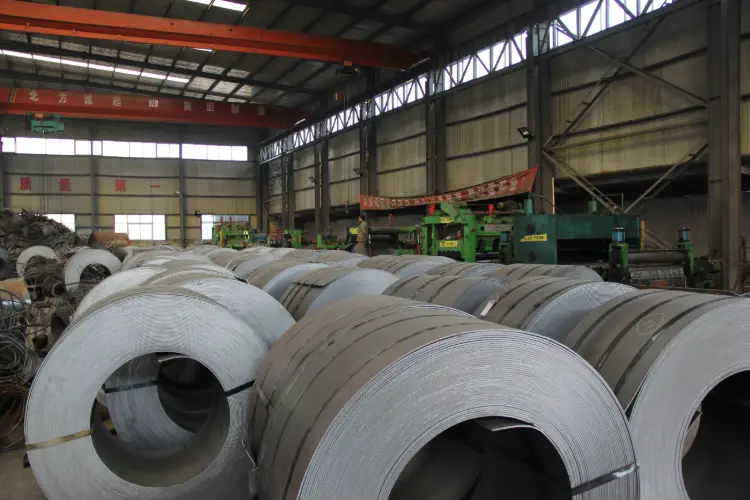
DNV A460 Shipbuilding Steel Coil
DNV A460 Shipbuilding Steel Coil | High-Strength Hull Structural Grade with 460 MPa Yield
Detailed technical data of DNV A460 shipbuilding steel coil: chemical composition, mechanical and physical properties, international equivalents, and application guidelines for marine and offshore structures.
TMCP, normalized, cut-to-length, slitting, laser cutting, welding, forming, bending
- Phone : +8618037372205
- Email : [email protected]
- WhatsApp: Contact via Whtsapp
- WeChat: +8618037372205
DNV A460 Shipbuilding Steel Coil Introduction
DNV A460 (also designated NV A460) is a high-strength, weldable fine-grain structural steel grade for shipbuilding and offshore constructions, certified by DNV GL. It delivers a minimum yield strength of 460 MPa and is intended for primary hull and marine structures exposed to moderate temperatures (impact test at 0 °C). The steel is supplied in thermo-mechanically controlled rolled (TMCP) or normalized condition, offering excellent toughness, good weldability, and high resistance to brittle fracture.
- Typical delivery forms: coils, plates, and wide flats.
- Used in stiffened panels, frames, decks, and offshore modules.
- Meets the requirements of DNV rules for classification of ships and DNV-OS-B101.
DNV A460 Shipbuilding Steel Coil Chemical Composition
The chemical composition complies with DNV rules for grade NV A460. Carbon equivalent (CEV) is controlled to guarantee weldability. Typical limits for thickness ≤ 50 mm are shown.
- Grain-refining elements such as Al, Nb, V, Ti are added to achieve fine grain structure.
- Stringent limits on impurities ensure high toughness and low brittle fracture risk.
| Element | Standard Value (max unless range) | Remarks |
|---|---|---|
| Carbon (C) | 0.18% | Ladle analysis |
| Silicon (Si) | 0.10 - 0.50% | Typical range per DNV |
| Manganese (Mn) | 0.90 - 1.65% | For CEV control |
| Phosphorus (P) | 0.025% max | Low P for toughness |
| Sulfur (S) | 0.025% max | Low S for ductility |
| Aluminium (Al total) | ≥ 0.020% | Grain refining |
| Niobium (Nb) | 0.05% max | Micro-alloy |
| Vanadium (V) | 0.10% max | Micro-alloy |
| Titanium (Ti) | 0.02% max | Grain refining |
| Copper (Cu) | 0.35% max | Residual element |
| Chromium (Cr) | 0.20% max | Residual element |
| Nickel (Ni) | 0.40% max | Residual element |
| Molybdenum (Mo) | 0.08% max | Residual element |
| Nitrogen (N) | 0.012% max | Bound by Al and Ti |
| Carbon Equivalent (CEV) | ≤ 0.43 (t ≤ 50 mm) | CEV = C + Mn/6 + (Cr+Mo+V)/5 + (Ni+Cu)/15 |
DNV A460 Shipbuilding Steel Coil Thermal and Electrical Physical Properties
Physical properties are typical for normalized or TMCP high-strength shipbuilding steel at room temperature unless stated otherwise.
- Data assists in design, welding simulation, and heat transfer calculations.
- Variation with temperature should be considered using the thermal expansion and heat capacity values.
| Property | Typical Reference Value | Unit | Test Condition |
|---|---|---|---|
| Density (ρ) | 7.85 | g/cm³ | At 20 °C |
| Elastic modulus (E) | 205 | GPa | At 20 °C |
| Shear modulus (G) | ~80 | GPa | Calculated from E and ν |
| Poisson ratio (ν) | 0.3 | — | Elastic range |
| Thermal expansion coefficient (α) | 12.0 | ×10⁻⁶/K | 20–100 °C |
| Thermal expansion coefficient (α) | 12.5 | ×10⁻⁶/K | 20–200 °C |
| Thermal expansion coefficient (α) | 13.2 | ×10⁻⁶/K | 20–400 °C |
| Thermal conductivity (λ) | ~50 | W/(m·K) | At 20 °C |
| Thermal conductivity (λ) | ~45 | W/(m·K) | At 200 °C |
| Specific heat capacity (c) | ~460 | J/(kg·K) | At 20 °C |
| Electrical resistivity (ρ_e) | 0.20 - 0.25 | μΩ·m | At 20 °C |
DNV A460 Shipbuilding Steel Coil Mechanical Properties
Mechanical properties apply to TMCP or normalized condition for thickness ≤ 100 mm. Transverse test pieces are standard, with additional requirements for longitudinal samples if specified.
- Minimum absorbed energy at 0 °C guarantees safe application in cold waters.
- Bend test uses mandrel diameter 3× thickness (t) for transverse specimens.
| Property | Standard Requirement | Unit | Test Condition / Remarks |
|---|---|---|---|
| Yield strength (ReH) | ≥ 460 | MPa | Transverse; t ≤ 100 mm |
| Tensile strength (Rm) | 570 - 720 | MPa | Transverse |
| Elongation (A) | ≥ 17 | % | L₀=5.65√S₀, transverse |
| Elongation (A) | ≥ 19 | % | Longitudinal, for reference |
| Bend test | D = 3t | — | 180°, transverse; no cracks |
| Impact energy (KV₂) | ≥ 34 | J | Transverse at 0 °C (A-grade) |
| Impact energy (KV₂) | ≥ 50 | J | Longitudinal at 0 °C (if required) |
DNV A460 Shipbuilding Steel Coil Exact Equivalent Material Standards & Substitute Grades
DNV A460 is harmonized across major classification societies. The following grades are identical in terms of yield strength, toughness class (0 °C), and chemical composition limits.
| Country / Region | Standard | Grade | Remarks |
|---|---|---|---|
| LR (United Kingdom) | Lloyd Register Rules | LR A460 | Equivalent impact test 0 °C |
| ABS (USA) | ABS Rules | ABS A460 | Identical requirements |
| BV (France) | Bureau Veritas Rules | BV A460 | Fully interchangeable |
| NK (Japan) | ClassNK Rules | NK A460 | Same mechanical limits |
| RINA (Italy) | RINA Rules | RINA A460 | Equivalent designation |
| KR (South Korea) | Korean Register Rules | KR A460 | Commonly used |
| CCS (China) | CCS Rules | CCS A460 | Adopted from IACS UR W11 |
DNV A460 Shipbuilding Steel Coil Application Introduction
DNV A460 steel coil is designed for heavily loaded ship and offshore structures requiring high strength and reliable fracture toughness at 0 °C.
- Excellent weldability with low carbon equivalent eases fabrication.
- Typical applications include major hull components and offshore modules.
Product Applications: Shell plates and stiffeners for tankers, bulk carriers, container ships, Decks, bulkheads, and bottom structures in large vessels, Jack-up rig legs and spud cans, Float-over installation components, Wind turbine foundation transition pieces
Processed into products: Hull girder panels and plates, Stringers, frames, and webs, Heavy-duty brackets and stiffeners, Offshore module structural beams and columns, Mooring brackets and pad-eyes
Application industries: Shipbuilding (commercial and naval vessels), Offshore oil & gas platforms, Offshore wind energy (transition pieces, monopile reinforcement), Heavy lifting and transportation (crane pedestals, heavy-lift vessel structures)
DNV A460 Shipbuilding Steel Coil Similar / Approximate Alternative Materials
These grades have comparable mechanical strength but may differ in toughness requirements, delivery condition, or chemical composition. They can be considered for non-classed or alternative design scenarios with appropriate engineering review.
| Country / Region | Standard | Grade | Remarks |
|---|---|---|---|
| Europe | EN 10025-6 | S460QL / S460QL1 | Quenched and tempered; higher CEV, not always classed for marine |
| Europe | EN 10225 | S460G2+M | Offshore structural steel; TMCP; may have stricter Z-quality; similar but different standard |
| USA | API 2W | Grade 50 (345 MPa) / Grade 60 | Yield strength lower; Grade 60 approaches but not full 460 MPa class |
| USA | ASTM A572/A572M | Grade 65 (450 MPa) | Slightly lower yield; not specific to ship classification |
| China | GB/T 712 | FH460 | −40 °C impact energy, stricter toughness than A grade; can substitute |
Notes:
- Coils are usually supplied in thickness range 6–25 mm; plates available up to 100 mm.
- CEV and PCM limits may be reduced for thicker materials to ensure crack-free welding.
- Z-direction through-thickness properties (Z25/ Z35) can be agreed for demanding joints.
- Ultrasonic testing (UT) according to EN 10160 or ASTM A578 is commonly specified.
- Share



