
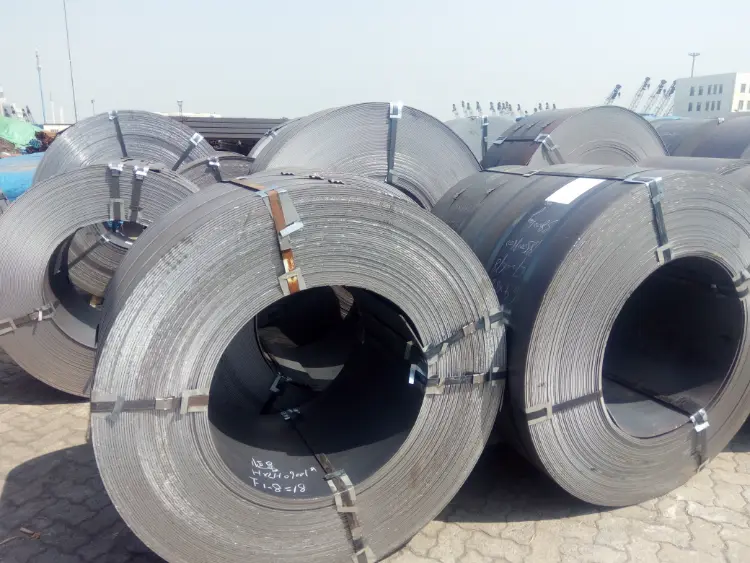
DNV A690 Shipbuilding Steel Coil
DNV A690 Shipbuilding Steel Coil - High Strength Structure & Offshore Grade
Explore the properties, chemical composition, mechanical performance, and applications of DNV A690 extra-high strength shipbuilding steel coil, including international equivalents and processing capabilities.
Hot rolling, cold forming, welding (SMAW, SAW, GMAW), cutting (plasma, laser), edge preparation, bending, machining
- Phone : +8618037372205
- Email : [email protected]
- WhatsApp: Contact via Whtsapp
- WeChat: +8618037372205
DNV A690 Shipbuilding Steel Coil Introduction
DNV A690 is an extra-high strength shipbuilding structural steel grade under the DNV (Det Norske Veritas) classification rules, now part of DNV GL. It is designed for demanding marine and offshore applications where superior strength, toughness at 0 °C, and excellent weldability are required. With a minimum yield strength of 690 MPa, this quenched and tempered (Q&T) steel enables weight reduction in hull structures, heavy lift crane pedestals, jack-up rig legs, and pressure vessels. The "A" designation indicates impact testing at 0 °C, making it suitable for moderate climate service. It conforms to IACS UR W11 and is fully equivalent to other classification society grades such as ABS AH690, LR AH690, and BV AH690. The steel is typically supplied in normalized or quenched and tempered condition, in the form of plates, coils, and sections. Its low carbon equivalent ensures good weldability, while microalloying with niobium, vanadium, and titanium refines grain size for enhanced toughness.
DNV A690 Shipbuilding Steel Coil Chemical Composition
The chemical composition of DNV A690 is governed by IACS UR W11 and confirmed by DNV classification rules. This grade utilizes a low-carbon microalloyed design to achieve high strength while maintaining good weldability and impact toughness. Carbon equivalent (CEV) is typically limited to ≤0.65 to avoid cold cracking. Key alloying elements such as Mn, Cr, Ni, and Mo provide hardenability, while Nb, V, and Ti refine the microstructure. Residual elements like P and S are strictly controlled to ensure ductility and resistance to brittle fracture.
| Element | Content (%) | Remarks |
|---|---|---|
| Carbon (C) | ≤ 0.20 | Higher levels reduce weldability |
| Silicon (Si) | 0.10 – 0.55 | Deoxidation and strength |
| Manganese (Mn) | 1.00 – 1.70 | Hardenability and strength |
| Phosphorus (P) | ≤ 0.020 | Max for toughness |
| Sulfur (S) | ≤ 0.010 | Max for cleanliness |
| Chromium (Cr) | ≤ 0.80 | Optional, enhances corrosion resistance |
| Nickel (Ni) | ≤ 2.00 | Optional, improves low-temperature toughness |
| Molybdenum (Mo) | ≤ 0.70 | Optional, promotes hardenability |
| Copper (Cu) | ≤ 0.50 | Optional, atmospheric corrosion resistance |
| Vanadium (V) | ≤ 0.10 | Grain refinement (sum V+Nb+Ti ≤0.22) |
| Niobium (Nb) | ≤ 0.06 | Grain refinement and precipitation |
| Titanium (Ti) | ≤ 0.05 | Grain refinement; kills nitrogen |
| Aluminium (Al total) | ≥ 0.020 | Grain refinement, deoxidation |
| Nitrogen (N) | ≤ 0.012 | Max to avoid strain aging |
| Carbon Equivalent (CEV) | ≤ 0.65 | CEV = C + Mn/6 + (Cr+Mo+V)/5 + (Ni+Cu)/15 |
DNV A690 Shipbuilding Steel Coil Thermal & Electrical Physical Properties
Physical properties are not mandatory certification items in DNV rules but are provided for design and processing. The values below are typical for a low-alloy quenched and tempered steel of this grade, measured at room temperature unless specified otherwise. Density is similar to other structural steels. Thermal expansion coefficients allow for welding and service temperature calculations; thermal conductivity and specific heat are relevant for heat treatment and welding thermal cycle modelling. Electrical resistivity aids in heating calculations.
| Property | Typical Value | Unit | Condition/Remarks |
|---|---|---|---|
| Density (ρ) | 7.85 | g/cm³ | Room temperature |
| Elastic modulus (E) | 210 | GPa | Room temperature, static |
| Shear modulus (G) | 80 | GPa | Calculated from E and ν |
| Poissonu0027s ratio (ν) | 0.3 | — | In elastic range |
| Thermal expansion coefficient (α) | 12.0 | 10⁻⁶/K | 20–100 °C range |
| Thermal conductivity (λ) | 45 | W/(m·K) | At 20 °C |
| Specific heat capacity | 500 | J/(kg·K) | At 20 °C |
| Electrical resistivity (ρₑ) | 0.22 | 10⁻⁶ Ω·m | At 20 °C, typical for low-alloy steel |
DNV A690 Shipbuilding Steel Coil Mechanical Properties
Mechanical properties are determined according to DNV rules and IACS UR W11 using standard test pieces taken from the delivered plates or coils. The steel is tested in the as-delivered (Q&T) condition. The minimum yield strength is 690 MPa, and tensile strength ranges from 770 to 940 MPa. Elongation provides ductility assurance, and Charpy V-notch impact tests at 0 °C guarantee toughness suitable for marine environments. Bending tests confirm formability; the steel must withstand 180° bending over a specified former diameter without cracking.
| Property | Requirement | Unit | Test Condition |
|---|---|---|---|
| Yield strength (ReH) | ≥ 690 | MPa | t ≤ 100 mm; t = thickness |
| Tensile strength (Rm) | 770 – 940 | MPa | t ≤ 100 mm |
| Elongation (A) | ≥ 14 | % | Proportional gauge length L₀ = 5.65√S₀ |
| Bending test (180°) | No cracks; d = 4t | — | Mandrel diameter (d) = 4 × thickness (t) |
| Charpy impact energy (KV) at 0 °C | ≥ 50 (longitudinal) | J | Standard V-notch, average of 3 tests |
| Charpy impact energy (KV) at 0 °C | ≥ 34 (transverse) | J | Standard V-notch, average of 3 tests |
DNV A690 Shipbuilding Steel Coil Fully Equivalent Material Standards & Substitute Grades
| Country / Region | Standard / Society | Grade | Remarks |
|---|---|---|---|
| International | IACS UR W11 | AH690 | Original unified requirement for 0 °C impact |
| Norway / International | DNV GL | NV A690 | Direct designation in DNV rules |
| USA | ABS (American Bureau of Shipping) | ABS AH690 | Equivalent AH690 with 0 °C impact |
| UK / Global | Lloydu0027s Register (LR) | LR AH690 | AH690 grade, 0 °C Charpy |
| France / International | Bureau Veritas (BV) | BV AH690 | Grade AH690 as per BV rules |
| China | CCS (China Classification Society) | CCS AH690 | Corresponding CCS high-strength grade |
| Italy | RINA | RINA AH690 | RINA equivalent, same strength and toughness |
| Japan | ClassNK (Nippon Kaiji Kyokai) | NK AH690 | ClassNK AH690 with 0 °C KV² |
| South Korea | Korean Register (KR) | KR AH690 | KR extreme-strength ship steel AH690 |
| Russia | Russian Maritime Register (RS) | RS AH690 | RS grade with identical mechanical properties |
DNV A690 Shipbuilding Steel Coil Application Introduction
DNV A690 is specifically engineered for load-bearing structures in marine and harsh environments. Its combination of high strength, good toughness at 0 °C, and weldability enables lighter and more durable designs. It is supplied with full classification society certification, ensuring traceability and compliance with international safety standards.
- Offshore and marine: primary hull structure, deck plating, longitudinal frames, and hatch coamings.
- Mobile offshore units: leg chords for jack-up rigs, crane pedestals, and helideck support structures.
- Heavy engineering: pressure vessels, lifting equipment, and mining machinery.
- Renewable energy: wind turbine foundations, transition pieces, and floating substructures.
Product Applications: LPGC and LNG carrier hulls, Jack-up rig legs and spudcans, Crane pedestals and heavy lift crane booms, FPSO and FLNG structural modules, Offshore wind turbine monopiles and transition pieces, Heavy-duty dump truck bodies, Pressure surge vessels
Processed into products: Hull plating and stiffeners (bottom, side, deck), Web frames and girders, Brackets and reinforcements, Crane house and slew ring mounts, Lifting eyes and padeyes, Riser protection frames, Bolted or welded structural connectors
Application industries: Shipbuilding, Offshore oil & gas, Marine engineering, Heavy machinery and lifting, Wind energy (offshore and onshore), Bridge construction, Pressure vessel fabrication
DNV A690 Shipbuilding Steel Coil Similar / Comparable Substitute Materials
| Country / Region | Standard | Grade | Remarks |
|---|---|---|---|
| EU | EN 10025-6 | S690Q | Quenched & tempered; impact at 0 °C, similar strength, may differ in CEV limits; check delivery condition. |
| EU | EN 10025-6 | S690QL | Q&T with -20 °C impact; slightly tougher, acceptable if minimum service temperature is lower but over-spec for 0 °C. |
| USA | ASTM A514 | A514 Grade B/H/FQ | High-strength Q&T plate (690 MPa), various chemistry; verify 0 °C impact per supplemental requirements. |
| USA | ASTM A709 | Grade HPS 100W | 690 MPa high-performance steel for bridges, 0 °C option with appropriate supplementary requirements. |
| China | GB/T 16270 | Q690D | High-strength structural steel, quenched & tempered, 0 °C impact ≥47 J, close match to DNV A690. |
| Japan | JIS G 3128 | SHY 685 | High yield strength steel for welded structures, yield ≥685 MPa, often used in Japan; confirm Charpy temperature. |
Notes:
Welding recommendations: Preheat and interpass temperature must be controlled according to the approved welding procedure. For plate thicknesses above 30 mm, a typical preheat of 100–150 °C is required. Low-hydrogen consumables (AWS E11018 type or similar) should be used to avoid hydrogen-induced cracking. Post-weld heat treatment (PWHT) is generally not required unless imposed by design codes for thick sections; if applied, tempering temperature should not exceed the original tempering temperature to avoid loss of strength. Certification: Material is supplied with DNV GL 3.2 certificate (or EN 10204 3.2) including chemical analysis, tensile, impact, and surface inspection results. Supplementary testing like ultrasonic examination (UT) or lamellar tearing (Z-quality) can be ordered as per DNV standards. Storage and handling: Avoid prolonged exposure to marine atmosphere without protective coating to prevent pitting corrosion.
- Share



