
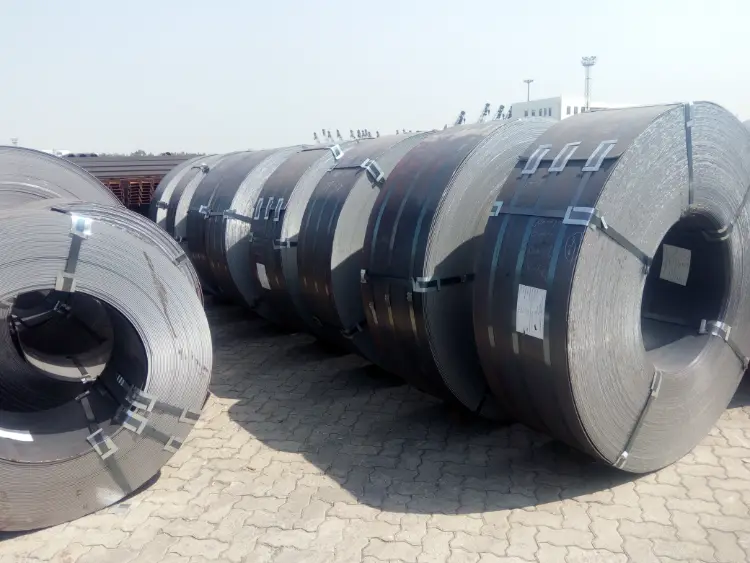
DNV D690 Shipbuilding Steel Coil
DNV D690 Shipbuilding Steel Coil – High Strength Quenched and Tempered Marine Steel
DNV D690 is a high-strength quenched and tempered shipbuilding steel coil designed for offshore and marine structures, offering a minimum yield strength of 690 MPa and excellent weldability.
Hot rolling followed by quenching and tempering (Q&T); suitable for cold forming, machining, and welding with appropriate consumables and procedures.
- Phone : +8618037372205
- Email : [email protected]
- WhatsApp: Contact via Whtsapp
- WeChat: +8618037372205
DNV D690 Shipbuilding Steel Coil Introduction
DNV D690 is a high-strength structural steel grade certified by DNV (Det Norske Veritas) for shipbuilding and offshore applications. It belongs to the group of quenched and tempered steels with a specified minimum yield strength of 690 MPa in the delivery condition. The steel exhibits an excellent combination of high strength, good toughness, and superior weldability, making it suitable for weight-critical marine and offshore structures. It is typically supplied as coil or plate, and its mechanical properties are achieved through a precisely controlled heat treatment process. The material is widely used in the construction of hulls, decks, superstructures, and offshore platforms where high load-bearing capacity and resistance to dynamic forces are essential.
DNV D690 Shipbuilding Steel Coil Chemical Composition
The chemical composition of DNV D690 is tightly controlled to ensure the required mechanical properties and weldability. Typical alloying includes carbon, manganese, silicon, chromium, nickel, molybdenum, boron, and microalloying elements. Maximum limits for phosphorus and sulfur are low to maintain toughness and cleanliness.
- Carbon equivalent (CEV) is often specified to guarantee weldability.
- Actual values depend on thickness and manufacturer but are within DNV class rules.
| Element | Specified Value (max, unless range) | Remarks |
|---|---|---|
| C (Carbon) | ≤ 0.20% | Ladle analysis; often 0.16–0.20% for heavy plates |
| Mn (Manganese) | ≤ 1.70% | Typically 1.00–1.60% |
| Si (Silicon) | ≤ 0.55% | Commonly 0.10–0.50% |
| P (Phosphorus) | ≤ 0.025% | Strict maximum for toughness |
| S (Sulfur) | ≤ 0.025% | Strict maximum for cleanliness |
| Cr (Chromium) | ≤ 1.50% | Optional; often 0.50–1.20% |
| Ni (Nickel) | ≤ 2.00% | Optional; enhances toughness |
| Mo (Molybdenum) | ≤ 0.70% | Optional; improves hardenability |
| Cu (Copper) | ≤ 0.50% | May be present as residual |
| Nb (Niobium) | ≤ 0.06% | Microalloy for grain refinement |
| V (Vanadium) | ≤ 0.10% | Optional microalloy |
| Ti (Titanium) | ≤ 0.05% | Optional; grain refiner |
| B (Boron) | ≤ 0.005% | May be added for hardenability |
| Al (Aluminum) | ≥ 0.015% | Minimum for fine grain practice |
| N (Nitrogen) | ≤ 0.015% | Typically controlled |
| CEV (Carbon Equivalent) | ≤ 0.52% (typical) | CEV = C + Mn/6 + (Cr+Mo+V)/5 + (Ni+Cu)/15 |
DNV D690 Shipbuilding Steel Coil Thermal and Electrical Physical Properties
Physical properties are provided as typical values for high-strength low-alloy quenched and tempered steels. They are not part of the mandatory DNV specification but are useful for design calculations.
- Properties are representative for nominal ambient conditions; they change with temperature.
| Property | Typical Value | Unit | Test Condition |
|---|---|---|---|
| Density (ρ) | ~ 7850 | kg/m³ | At 20 °C |
| Young's Modulus (E) | ~ 210 | GPa | At 20 °C |
| Shear Modulus (G) | ~ 80 | GPa | At 20 °C |
| Poisson's Ratio (ν) | ~ 0.3 | – | Elastic range |
| Thermal expansion coefficient (α) | ~ 12 × 10⁻⁶ | K⁻¹ | 20–200 °C |
| Thermal conductivity (λ) | ~ 38 | W/(m·K) | At 20 °C |
| Specific heat capacity | ~ 480 | J/(kg·K) | At 20 °C |
| Electrical resistivity (ρ_e) | ~ 0.25 × 10⁻⁶ | Ω·m | At 20 °C |
DNV D690 Shipbuilding Steel Coil Mechanical Properties
Mechanical properties are determined on specimens taken from the delivered condition (quenched and tempered). The values meet DNV class rules. The steel exhibits high strength and good ductility. Charpy V-notch impact tests are performed at specified temperatures to guarantee toughness.
- Properties may vary with product thickness; thicker sections may have slightly reduced strength.
- Inspection and testing according to DNV material certificate requirements.
| Property | Specified Value | Unit | Test Condition |
|---|---|---|---|
| Yield Strength (ReH) | ≥ 690 | MPa | t ≤ 50 mm (transverse) |
| Yield Strength (ReH) | ≥ 670 | MPa | 50 < t ≤ 100 mm |
| Tensile Strength (Rm) | 770 – 940 | MPa | t ≤ 50 mm |
| Tensile Strength (Rm) | 750 – 920 | MPa | 50 < t ≤ 100 mm |
| Elongation (A5) | ≥ 14 | % | Gauge length 5.65√So, t ≤ 50 mm |
| Elongation (A5) | ≥ 14 | % | 50 < t ≤ 100 mm |
| Charpy V-notch Impact (KV2) | ≥ 27 (min. individual 19) | J | Test temp. -40 °C (Grade D), transverse |
| Charpy V-notch Impact (KV2) | ≥ 27 (min. individual 19) | J | Test temp. -60 °C (Grade E, optional extra) |
| Bend Test (Bend diameter) | 3 × thickness (180°) | – | No cracks, t ≤ 50 mm |
DNV D690 Shipbuilding Steel Coil Fully Equivalent Material Standards and Substitute Grades
| Country/Region | Standard/Specification | Grade | Remarks |
|---|---|---|---|
| Norway / International | DNV Rules | D690 | Original classification grade |
| UK / Lloyd's Register | LR Rules | L690 | Equivalent high-strength marine steel |
| USA / American Bureau of Shipping | ABS Rules | EQ70 | Similar minimum 690 MPa yield offshore grade |
| China / CCS | CCS Rules | F690 | High strength quenched and tempered steel for ships |
| Europe | EN 10025-6 | S690QL | Structural steel Q&T, but requires adaptation for marine service |
| International (offshore) | API 2Y / EN 10225 | S690G2+M or S690QL1 | Fixed offshore structures, comparable strength |
DNV D690 Shipbuilding Steel Coil Application Introduction
DNV D690 steel is engineered for marine and offshore structures where high strength-to-weight ratio is essential. It is suitable for various structural components in shipbuilding and offshore engineering. Application sectors include:
- Shipbuilding: hulls, decks, bulkheads, and superstructures
- Offshore: jack-up rig legs, platforms, and subsea structures
- Heavy lifting and transport: crane booms, heavy-lift vessel components
- Naval and defense: naval vessel hulls
Product Applications: Container ships and bulk carriers, Offshore support vessels (OSV), Jack-up drilling rigs, Semi-submersible platforms, Floating production storage and offloading (FPSO) units, Offshore wind turbine foundations (transition pieces), Heavy-duty crane and lifting appliances
Processed into products: Hull plates and shell plating, Deck plates and stringers, Stiffeners and girders, Longitudinal and transverse frames, Cargo hold structural members, Legs of jack-up rigs, Reinforcement pads and lifting lugs, Weldments requiring high fatigue resistance
Application industries: Shipbuilding, Offshore Oil & Gas, Offshore Wind Energy, Marine Engineering, Heavy Lifting Equipment, Naval / Defense
DNV D690 Shipbuilding Steel Coil Similar/Alternative Materials with Close Properties
| Country/Region | Standard/Specification | Grade | Remarks |
|---|---|---|---|
| USA | ASTM A514 | Grade Q (modified) | Quenched and tempered alloy steel plate; mechanical properties similar but requires verification for marine approval |
| USA | API 2W | Grade 60 | High strength steel for offshore platforms; 60 ksi yield (~414 MPa) – not directly comparable; mention as lower strength alternative |
| Europe | EN 10025-6 | S890QL | Higher strength Q&T steel (890 MPa) – may be considered for weight reduction but stricter welding requirements |
| Japan | JIS G 3106 | SM570 | Lower strength (570 MPa) structural steel, often used in shipbuilding but not a direct substitute |
| Russia | GOST 19281 | 14KhG2SAFD (example) | High strength low alloy steel, but properties and certification differ |
Notes:
Welding cautions: DNV D690 steel requires proper preheating, interpass temperature control, and low hydrogen consumables to prevent cold cracking. Post-weld heat treatment (PWHT) is generally not recommended for Q&T grades as it may reduce strength. Formability: Cold forming is possible with appropriate die radii considering the high strength; hot forming must be followed by a new Q&T process if required. Corrosion: As a steel it is not inherently corrosion resistant; protective coatings or cathodic protection are necessary for marine service. Certification: All plates are delivered with DNV material certificates (3.1 per EN 10204).
- Share



