
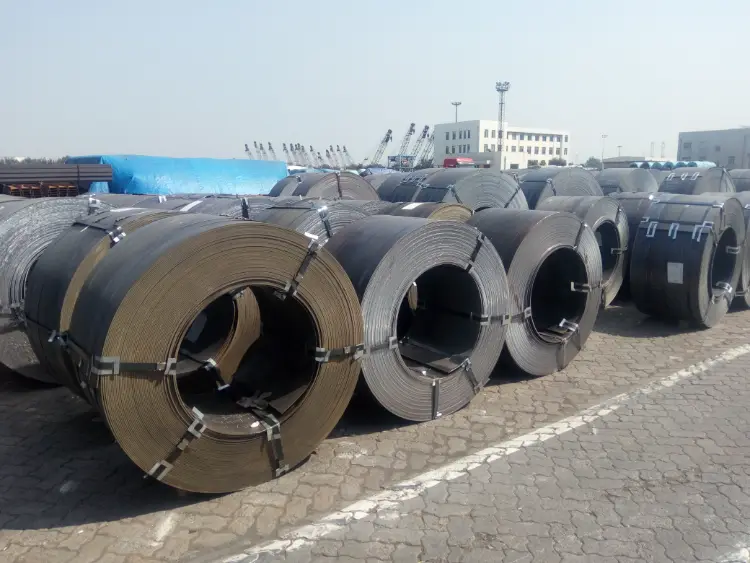
DNV E690 Shipbuilding Steel Coil
DNV E690 Shipbuilding Steel Coil: High-Strength Quenched & Tempered Offshore Structural Plate
Detailed analysis of DNV E690 shipbuilding steel coil: chemical composition, mechanical properties, thermal and electrical properties, international equivalents, and application guidance for marine and offshore engineering.
Hot rolling, quenching and tempering, normalizing (occasionally), welding, cutting, forming
- Phone : +8618037372205
- Email : [email protected]
- WhatsApp: Contact via Whtsapp
- WeChat: +8618037372205
DNV E690 Shipbuilding Steel Coil Introduction
DNV E690 is a high-strength quenched and tempered structural steel grade certified by DNV (Det Norske Veritas) for shipbuilding and offshore applications. It belongs to the EH (extra high-strength) category with a minimum yield strength of 690 MPa. The letter 'E' denotes that the material is subjected to Charpy V‑notch impact testing at -40 °C, ensuring good low‑temperature toughness.
- Key properties: excellent weldability, high strength‑to‑weight ratio, superior notch toughness, and good resistance to brittle fracture in cold marine environments.
- Typical delivery condition: quenched and tempered (Q&T), supplied as coils, plates, or sections.
- Thickness range: mainly up to 150 mm, with properties adjusted accordingly.
This steel is widely used in critical structural components of ships, offshore platforms, jack‑up rig legs, and heavy‑duty cranes where high load capacity and safety are paramount.
DNV E690 Shipbuilding Steel Coil Chemical Composition – Typical Values per DNV E690
The following chemical composition complies with DNV rules for grade E690. The steel is fine‑grain treated with Al and micro‑alloyed with Nb, V, Ti to achieve high strength and good weldability. Carbon equivalent (Ceq) is strictly controlled to ≤ 0.47–0.49 % (depending on thickness) to guarantee satisfactory welding performance.
- All values are ladle analysis unless noted.
- Elements not listed are within residual limits.
| Element | Standard Value (%) | Remarks |
|---|---|---|
| C | ≤ 0.20 | Ladle analysis |
| Si | 0.10 – 0.55 | Deoxidizer |
| Mn | 0.90 – 1.70 | |
| P | ≤ 0.025 | |
| S | ≤ 0.025 | |
| Cr | ≤ 0.20 | Residual |
| Ni | ≤ 0.40 | Residual |
| Mo | ≤ 0.08 | Residual |
| Cu | ≤ 0.35 | Residual |
| Al (acid sol.) | ≥ 0.020 | Fine‑grain practice |
| Nb | ≤ 0.06 | Microalloying |
| V | ≤ 0.10 | Microalloying |
| Ti | ≤ 0.05 | Microalloying |
| N | ≤ 0.009 | |
| Ceq* | ≤ 0.47 – 0.49 | Depending on thickness; Ceq = C+Mn/6+(Cr+Mo+V)/5+(Ni+Cu)/15 |
DNV E690 Shipbuilding Steel Coil Thermal and Electrical Physical Properties – Typical Values
The following physical properties are representative for quenched and tempered structural steel of similar composition. They are not guaranteed values but are useful for design calculations. Density is standard for steel; thermal expansion and thermal conductivity influence welding and service behaviour.
| Property | Typical Value | Unit | Condition |
|---|---|---|---|
| Density (ρ) | 7850 | kg/m³ | 20 °C |
| Modulus of elasticity (E) | 205 | GPa | ambient |
| Shear modulus (G) | 80 | GPa | ambient |
| Poisson's ratio (ν) | 0.3 | – | ambient |
| Thermal expansion coefficient (α) | 12 × 10⁻⁶ | /K | 20–100 °C |
| Thermal conductivity (λ) | 35 – 40 | W/(m·K) | 100 °C |
| Specific heat capacity (cₚ) | 460 – 480 | J/(kg·K) | ambient |
| Electrical resistivity (ρ_e) | 0.15 – 0.25 | Ω·mm²/m | 20 °C |
DNV E690 Shipbuilding Steel Coil Mechanical Properties – Typical Values for DNV E690
Mechanical properties are determined on quenched and tempered specimens. Values vary with product thickness; the table below shows requirements for plates/coils ≤ 50 mm. Impact test is performed on Charpy V‑notch specimens at -40 °C (transverse).
- Tensile testing in accordance with DNV rules.
- Bend test (180°) on full‑thickness specimens using a mandrel diameter = 3× specimen thickness.
| Property | Requirement | Unit | Test Condition |
|---|---|---|---|
| Yield strength (ReH) | ≥ 690 | MPa | ambient, t ≤ 50 mm |
| Tensile strength (Rm) | 770 – 940 | MPa | ambient, t ≤ 50 mm |
| Elongation (A5) | ≥ 14 | % | gauge length 5.65√S₀ |
| Bend test | No cracks | – | 180°, mandrel dia. 3×t |
| Charpy impact energy (KV₂) | ≥ 50 (average of 3) | J | transverse, -40 °C |
| Charpy impact energy (KV₂) single min. | ≥ 35 | J | transverse, -40 °C |
DNV E690 Shipbuilding Steel Coil Fully Equivalent Material Standards – Replaceable Grades
| Country / Region | Standard / Classification Society | Grade | Remarks |
|---|---|---|---|
| International | ABS | EH690 | American Bureau of Shipping |
| International | Lloyd's Register (LR) | EH690 | LR Rules |
| International | Bureau Veritas (BV) | EH690 | BV Rules |
| International | China Classification Society (CCS) | EH690 | CCS Rules |
| International | Nippon Kaiji Kyokai (ClassNK) | EH690 | NK Rules |
| International | Registro Italiano Navale (RINA) | EH690 | RINA Rules |
| International | Korean Register (KR) | EH690 | KR Rules |
| International | DNV | F690 | Variant with impact at -20 °C; E690 preferred for lower temperature |
DNV E690 Shipbuilding Steel Coil Application Introduction
DNV E690 steel is engineered for the most demanding marine and offshore environments. Its high strength allows weight reduction while maintaining structural integrity under extreme loads and harsh weather conditions. Key design considerations:
- Excellent weldability with low carbon equivalent (Ceq) minimises cold cracking risks.
- Proper preheat and heat input control are essential when welding thick sections.
- Can be cold‑formed to limited radii; hot forming requires re‑heat treatment to restore properties.
- Corrosion protection (coatings, cathodic protection) is necessary for submerged service.
Product Applications: Ship hulls and deck structures, Self‑elevating platform legs (jack‑up rigs), Boom and jib sections of offshore cranes, Offshore flare towers and helidecks, Pressure hulls for submersibles
Processed into products: Longitudinal stiffeners and girders, Transverse web frames, Bottom and side shell plating, Deck stringer plates, A‑frames and strong points, Floating production storage & offloading (FPSO) module support beams
Application industries: Shipbuilding (naval, commercial, LNG carriers, FPSO vessels), Offshore oil & gas (platforms, jackets, topsides), Renewable energy (offshore wind turbine foundations), Heavy lifting and transportation (cranes, heavy‑lift ships), Bridge construction (special applications requiring high strength)
DNV E690 Shipbuilding Steel Coil Similar / Comparable Materials – High-Strength Structural Steels
| Country / Region | Standard | Grade | Remarks |
|---|---|---|---|
| Europe | EN 10025‑6 | S690QL / S690QL1 | Quenched & tempered fine‑grain structural steel; impact at -20 °C (L) or -40 °C (L1); similar mechanical properties but not identical marine certification. |
| USA | ASTM A514 / A517 | Grade Q / other grades | High‑yield‑strength quenched & tempered alloy steel plate; 690 MPa min. yield; impact properties depend on grade. |
| Japan | JIS G 3128 | SHY685 (or SHY70N) | High tension steel for welded structures; 685 MPa class; may require supplementary agreement for marine impact testing. |
| China | GB/T 1591 | Q690D / Q690E | High strength low alloy structural steel; Q690E offers -40 °C impact, but not automatically DNV‑certified. |
Notes:
Surface condition: Coils are available as rolled, pickled & oiled, or shot‑blasted and shop‑primed (typically with weldable zinc‑rich primer). Thickness tolerance: according to EN 10029 or classification society rules. Ultrasonic testing: can be performed upon customer request (e.g., Class A or B according to EN 10160). Documentation: 3.2 certificate (DNV) is provided. This steel is NOT intended for pressure vessel service unless specific additional requirements are met.
- Share



