
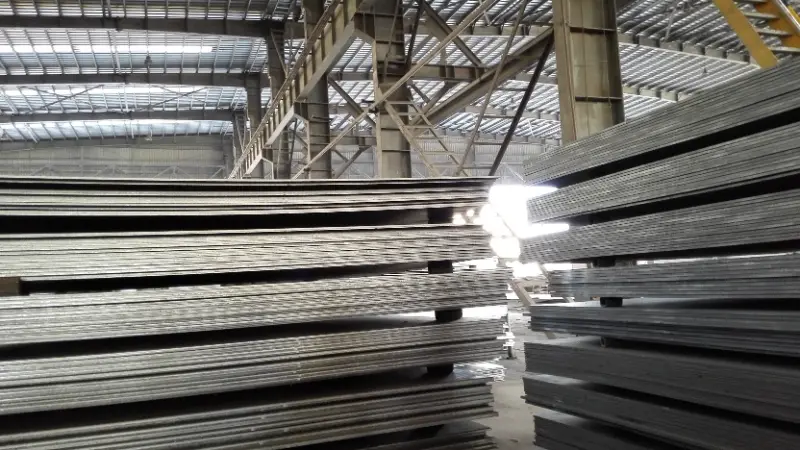
DNV F690 High-Strength Shipbuilding Steel Coil & Plate
DNV F690 High-Strength Shipbuilding Steel Coil & Plate - Ultra-High Yield Marine Grade Steel for Offshore Structures
Detailed material data for DNV F690 shipbuilding steel coil including chemical composition, mechanical properties, thermal and electrical properties, international equivalents, and application guidance. Compliant with DNV classification society rules for high-strength marine structures.
Hot rolling, cold forming, cutting, welding, bending, machining
- Phone : +8618037372205
- Email : [email protected]
- WhatsApp: Contact via Whtsapp
- WeChat: +8618037372205
DNV F690 High-Strength Shipbuilding Steel Coil & Plate Introduction
DNV F690 is a premium high-strength shipbuilding steel grade certified by Det Norske Veritas (DNV). It belongs to the quenched and tempered (Q&T) structural steels with a minimum yield strength of 690 MPa. The material offers exceptional weldability, excellent low-temperature toughness (F-grade guarantees impact energy at -60 °C), and good formability. Typical delivery condition is quenched and tempered. The steel is used in critical offshore and marine applications where weight reduction and high load-bearing capacity are essential.
DNV F690 High-Strength Shipbuilding Steel Coil & Plate Chemical Composition – Ladle Analysis
The chemical composition is based on DNV regulations for grade F690 with thickness ≤ 50 mm. Values represent maximum limits unless a range is given. Microalloying elements (V, Nb, Ti, Al) are added for grain refinement and precipitation strengthening, while nickel and chromium improve hardenability and low-temperature toughness.
| Chemical Element | Standard Value (max unless noted) | Remarks |
|---|---|---|
| Carbon (C) | 0.20 | Typical max, depending on thickness and CEV |
| Silicon (Si) | 0.10 – 0.55 | Range |
| Manganese (Mn) | 0.70 – 1.70 | Range |
| Phosphorus (P) | 0.025 | Max |
| Sulfur (S) | 0.025 | Max |
| Chromium (Cr) | 1.50 | Max |
| Nickel (Ni) | 2.00 | Max |
| Molybdenum (Mo) | 0.70 | Max |
| Copper (Cu) | 0.50 | Max |
| Vanadium (V) | 0.12 | Max |
| Niobium (Nb) | 0.06 | Max |
| Titanium (Ti) | 0.05 | Max |
| Aluminium (Al total) | min 0.020 | Min, for grain refinement |
| Nitrogen (N) | 0.020 | Max |
| Boron (B) | 0.005 | Max, residual |
| Carbon Equivalent (CEV) | specified by formula | Typical max ~0.52 for weldability |
DNV F690 High-Strength Shipbuilding Steel Coil & Plate Thermal and Electrical Physical Properties
Physical properties are not specified by DNV and represent typical values for a high-strength quenched and tempered steel similar to S690. These values are provided for engineering calculations and general guidance. Thermal expansion and heat conductivity may vary slightly with tempering conditions.
| Property | Standard/Typical Value | Unit | Test Condition / Remarks |
|---|---|---|---|
| Density (ρ) | 7850 | kg/m³ | At 20 °C |
| Modulus of Elasticity (E) | 205 – 210 | GPa | Room temperature, static |
| Shear Modulus (G) | 80 | GPa | Calculated from E and ν |
| Poisson's Ratio (ν) | 0.28 – 0.30 | – | Room temperature |
| Thermal Expansion Coefficient (α) | 11.5 – 13.0 | ×10⁻⁶/K | 20 °C to 100 °C |
| Thermal Conductivity (λ) | 35 – 45 | W/(m·K) | At 20 °C |
| Specific Heat Capacity (cp) | 460 – 500 | J/(kg·K) | At 20 °C |
| Electrical Resistivity (ρₑ) | 0.25 – 0.30 | ×10⁻⁶ Ω·m | At 20 °C |
DNV F690 High-Strength Shipbuilding Steel Coil & Plate Mechanical Properties
Mechanical properties as required by DNV for plate thickness ≤ 50 mm in quenched and tempered condition. Impact toughness is guaranteed for grade F at -60 °C. Bending test requirements depend on thickness and sample orientation.
| Property | Standard Requirement (min unless noted) | Unit | Test Condition |
|---|---|---|---|
| Yield Strength (ReH) | 690 | MPa | Transverse, ambient, thickness ≤ 50 mm |
| Tensile Strength (Rm) | 770 – 940 | MPa | Transverse, ambient |
| Elongation (A5) | 14 | % | Gauge length 5.65√S₀, thickness ≤ 50 mm |
| Impact Energy (KV₂) | 50 (longitudinal), 33 (transverse) | J | Charpy-V, -60 °C (F-grade) |
| Bend Test (180°) | No cracks – dia = 3t (t ≤ 25 mm) | – | Bending mandrel diameter, thickness dependent |
| Bend Test (180°) | No cracks – dia = 4t (25 < t ≤ 50 mm) | – | For thicker plates |
DNV F690 High-Strength Shipbuilding Steel Coil & Plate Fully Equivalent Material Standards and Replaceable Grades
| Country / Region | Standard | Grade | Remarks |
|---|---|---|---|
| International / Europe | EN 10025-6 | S690QL (1.8928) / S690QL1 (1.8988) | Identical yield class, Charpy at -40 °C / -60 °C, same chemical philosophy |
| USA | ASTM A514 / A517 | A514 Grade Q / A517 Grade Q | Modified Q&T plates, similar strength, impact test temperatures may differ |
| International | ISO 4950-2 | E690DD (FeE690 V) | High yield strength, DD designates improved weldability; Charpy at -20 °C, adjust for F-grade |
| UK | BS 7191 | 690 Q&T | Similar mechanical limits, weldable fine-grain structural steel |
| China | GB/T 16270 | Q690D (Q690E) | High-strength structural steel, D/E denotes lower impact test temperature, comparable when Q&T |
DNV F690 High-Strength Shipbuilding Steel Coil & Plate Application Introduction
DNV F690 steel is engineered for demanding marine and offshore environments. Its exceptional strength-to-weight ratio enables lighter structures and higher payloads. Typical products include heavy-duty ship components, offshore platform columns, and pressure vessels for Arctic conditions. The steel is easily welded using low-hydrogen processes and preheat recommendations based on carbon equivalent. Post-weld heat treatment may be omitted for thicknesses below specified limits.
Product Applications: Hull plates for high-stress areas (deck, bottom, sheer strake), Structural beams and columns for offshore topsides, Crane pedestals and booms, Heavy machinery frames, Pressure vessels for liquefied gas (with extra notch toughness), Subsea templates and manifolds
Processed into products: Ship longitudinal stiffeners and web frames, Jacket legs and braces for offshore platforms, Boom sections for port cranes, Transition pieces for monopile wind turbines, Arctic-grade piping components, Connecting flanges and thick gusset plates
Application industries: Shipbuilding and marine engineering, Offshore oil & gas (fixed and floating platforms), Renewable energy (offshore wind turbine foundations), Heavy lifting and cargo handling equipment, Defense and naval vessels (icebreakers, military ships), Bridge construction (where low-temperature toughness is critical)
DNV F690 High-Strength Shipbuilding Steel Coil & Plate Closely Related / Alternative Materials with Comparable Performance
| Country / Region | Standard | Grade | Remarks |
|---|---|---|---|
| Europe | EN 10025-6 | S690Q (1.8925) | Quenched and tempered, same yield class but lower guaranteed toughness (Q; 0 °C / -20 °C |
| Japan | JIS G 3106 | SM570 (TMC) | TMCP steel, yield 460-530 MPa, lower strength but good weldability and toughness |
| USA | ASTM A709 / A709M | Grade HPS 100W | High-performance weathering steel, yield 690 MPa, used in bridges; similar strength with corrosion resistance |
| France | NF A36-204 | 18 SENDCOL 700 | French high-strength grade, similar yield but less Ni content |
| International | API 2W / 2Y | Grade 60 / 70 | Offshore structural steel plates, yield 415–690 MPa, produced by TMCP/QT process; toughness adapted to service |
Notes:
All data are based on DNV Rules for Classification of Ships (Pt.2 Ch.2 Effective date 2023) and typical industrial practice for quenched and tempered steels. Chemical composition may be adjusted by the manufacturer to achieve specified mechanical properties and weldability (CEV control). For thicknesses above 50 mm, mechanical values must be agreed with the classification society. Surface condition and ultrasonic testing (UT) can be specified according to delivery standard.
- Share



