
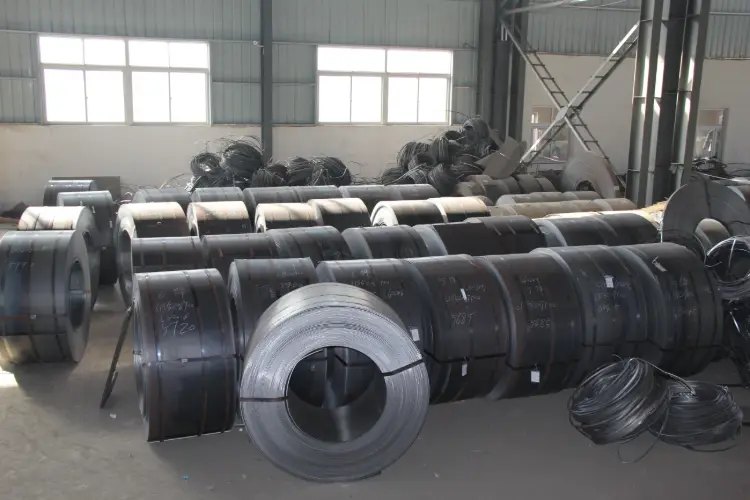
DNV F36 Shipbuilding Steel Coil
DNV F36 Shipbuilding Steel Coil: High-Strength Marine Grade for Extreme Performance
Comprehensive material data for DNV F36 shipbuilding steel coil, including chemical composition, mechanical properties, and physical characteristics according to DNV classification rules.
Hot rolling, controlled rolling (normalizing rolling or TMCP), cutting, cold forming, welding, bending
- Phone : +8618037372205
- Email : [email protected]
- WhatsApp: Contact via Whtsapp
- WeChat: +8618037372205
DNV F36 Shipbuilding Steel Coil Introduction
DNV F36 is a high-strength shipbuilding structural steel grade certified by DNV (Det Norske Veritas). It offers a minimum yield strength of 355 MPa and excellent toughness down to -60°C, making it ideal for critical hull components and offshore structures operating in harsh environments. Key features include:
- Excellent weldability with controlled carbon equivalent
- Fine-grained microstructure through normalizing rolling or thermo-mechanical control process
- Superior impact resistance at cryogenic temperatures
- Good formability for cold bending and profiling
- Full compliance with DNV Rules for Classification of Ships/HSLC
DNV F36 Shipbuilding Steel Coil Chemical Composition
Cast analysis according to DNV rules for FH36 grade. Fine grain elements (Nb, V, Ti) may be added singly or in combination, and total concentrations are controlled. The carbon equivalent (CEV) typically does not exceed 0.38-0.43% depending on thickness and delivery condition. All values are maximum unless a range is shown.
| Element | Typical Specification (wt.%) | Remarks |
|---|---|---|
| C | ≤ 0.16 | Max. carbon |
| Si | 0.10 – 0.50 | Silicon range |
| Mn | 0.90 – 1.60 | Manganese range |
| P | ≤ 0.025 | Max. phosphorus |
| S | ≤ 0.025 | Max. sulfur |
| Al (acid soluble) | ≥ 0.015 | Minimum aluminium for grain refinement |
| Nb | 0.02 – 0.05 | Optional microalloy (max. 0.05 when added) |
| V | 0.05 – 0.10 | Optional microalloy (max. 0.10 when added) |
| Ti | ≤ 0.02 | Optional microalloy, max. 0.02 |
| Cu | ≤ 0.35 | Copper if specified |
| Cr | ≤ 0.20 | Chromium residual/max. |
| Ni | ≤ 0.40 | Nickel residual/max. |
| Mo | ≤ 0.08 | Molybdenum residual/max. |
| N | ≤ 0.009 | Nitrogen max. |
DNV F36 Shipbuilding Steel Coil Thermal and Electrical Physical Properties
Typical physical constants for carbon-manganese structural steels at room temperature (20°C). These values are not explicitly mandated by shipbuilding class rules but are representative for F36/FH36 grade steel.
| Property | Typical Value | Unit | Test Condition / Remarks |
|---|---|---|---|
| Density (ρ) | 7850 | kg/m³ | Room temperature |
| Young's modulus (E) | 205 – 210 | GPa | Room temperature, tension |
| Shear modulus (G) | ~80 | GPa | Calculated from E and ν |
| Poisson's ratio (ν) | 0.3 | – | Elastic range |
| Coefficient of thermal expansion (α) | 11.5 – 12.5 × 10⁻⁶ | 1/K | 20–100°C |
| Thermal conductivity (λ) | 50 – 55 | W/(m·K) | 20–100°C |
| Specific heat capacity (cp) | 460 – 500 | J/(kg·K) | 20–100°C |
| Electrical resistivity (ρ_e) | 0.20 – 0.25 × 10⁻⁶ | Ω·m | Room temperature |
DNV F36 Shipbuilding Steel Coil Mechanical Properties
Tensile and impact requirements at delivery condition per DNV. The values apply to plate/coil thickness ≤ 50 mm unless otherwise noted. Impact testing temperature: -60°C (longitudinal, standard Charpy V-notch). Bend test mandrel diameter is 3 times the specimen thickness (3a) for thickness ≤ 50 mm.
| Property | Specified Value | Unit | Test Condition |
|---|---|---|---|
| Upper yield strength (ReH) | ≥ 355 | MPa | t ≤ 50 mm, transverse sample |
| Tensile strength (Rm) | 490 – 620 | MPa | t ≤ 50 mm, transverse sample |
| Elongation after fracture (A) | ≥ 21 | % | Gauge length 5.65√So (A5), transverse |
| Charpy V-notch impact energy (KV2) | ≥ 34 | J | at -60°C, longitudinal sample |
| Bend test (180°, d=3a) | No cracks or defects | – | t ≤ 50 mm, bend radius 3t |
DNV F36 Shipbuilding Steel Coil Completely Equivalent Material Standards and Replaceable Grades
| Country/Region | Standard | Grade | Remarks |
|---|---|---|---|
| International | DNV Rules | FH36 (F36) | Original classification grade |
| USA | ABS Rules | FH36 | Identical strength and impact class |
| France | BV Rules | FH36 | Identical requirement |
| China | CCS Rules | FH36 | Identical requirement |
| UK | LR Rules | FH36 | Identical requirement |
| Japan | NK Rules | FH36 | Identical requirement |
| Italy | RINA Rules | FH36 | Identical requirement |
| South Korea | KR Rules | FH36 | Identical requirement |
| International | ISO 630-4 | FH355 | Closest ISO grade for shipbuilding |
| Europe | EN 10225 | S355G10+M (closest) | Offshore structural steel, similar strength and toughness |
DNV F36 Shipbuilding Steel Coil Application Introduction
DNV F36 steel, with its guaranteed -60°C toughness, is engineered for critical low-temperature structures in the maritime and offshore industry. It can be processed into coils and further fabricated into a wide range of components. Key applications include:
- Hull plating for ice-class vessels and arctic LNG carriers
- Decks and bulkheads of offshore platforms exposed to sub-zero temperatures
- Stiffeners, longitudinal frames, and transverse web frames
- Offshore wind turbine foundation structures (transition pieces, monopiles)
Product Applications: Plates and coils for ship hulls, Structural sections (angles, channels, T-bars) for marine frameworks, Cut-to-length sheets for bending and profiling, Welded beams and girders for deck and bottom construction
Processed into products: Hull main plates and side shells, Stiffeners and stringers, Bulkhead plates and corrugated bulkheads, Deck plating and deck reinforcements, Web frames and floors, Offshore jacket legs, braces, and transition pieces, Cryogenic storage tank supports (LNG)
Application industries: Shipbuilding (commercial and naval vessels, icebreakers), Offshore oil & gas (platforms, FPSOs, subsea structures), Renewable energy (offshore wind foundations), Arctic engineering and polar marine structures
DNV F36 Shipbuilding Steel Coil Similar / Alternative Material Recommendations
| Country/Region | Standard | Grade | Remarks |
|---|---|---|---|
| International | DNV Rules | AH36 | Same strength (355 MPa), impact test at 0°C |
| International | DNV Rules | DH36 | Same strength, impact test at -20°C |
| International | DNV Rules | EH36 | Same strength, impact test at -40°C |
| Europe | EN 10025-4 | S355ML | Thermomechanical rolled structural steel, Min. 355 MPa, toughness to -50°C, may substitute if weldability and toughness requirements align |
| Japan | JIS G 3106 | SM490B/YP355 | Similar tensile class, but not certified for marine use; additional impact testing needed |
| USA | ASTM A131 | FH36 | Same strength and temperature designation, alternative standard |
Notes:
Welding: Preheating is typically not required for thicknesses up to 30 mm due to low carbon equivalent. For thicker sections, a minimum preheat of 50–75°C may be recommended. Forming: Cold forming is possible with minimum bend radii of 2–3t. For hot forming, normalization may need to be applied. Traceability: Each coil is supplied with DNV 3.2 inspection certificate, including mechanical test results and chemical analysis. Surface condition: As-rolled or shot-blasted/primed according to marine protection requirements.
- Share



