
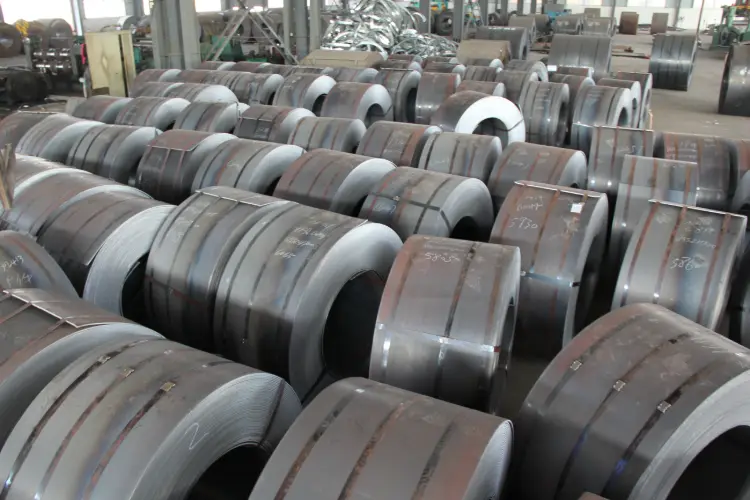
DNV E36 Shipbuilding Steel Coil
DNV E36 Shipbuilding Steel Coil: High-Strength Marine Steel with -40°C Impact Toughness
Comprehensive material data for DNV E36 shipbuilding steel coil including chemical composition, mechanical properties, physical parameters, international equivalents, and application guidance.
Hot rolling, normalizing, TMCP (thermo-mechanical control process), quenching and tempering (optional for thicker gauges)
- Phone : +8618037372205
- Email : [email protected]
- WhatsApp: Contact via Whtsapp
- WeChat: +8618037372205
DNV E36 Shipbuilding Steel Coil Introduction
DNV E36 is a high-strength hull structural steel under the DNV (Det Norske Veritas) classification society rules. It belongs to the normalized or TMCP (thermo-mechanically controlled processed) fine-grain steel series with a specified minimum yield strength of 355 MPa. The E designation indicates guaranteed impact toughness at -40°C, making it suitable for critical ship structures operating in cold climates. Key features include excellent weldability, uniform mechanical properties across thicknesses up to 100 mm, and good formability for cold bending. The steel is primarily delivered in coil or plate form after normalizing or TMCP rolling, ensuring a fine-grained microstructure for high ductility and crack arrest capability. Typical applications range from main hull girders and ice-strengthened ships to offshore structures requiring robust low-temperature performance.
DNV E36 Shipbuilding Steel Coil Chemical Composition
The chemical composition of DNV E36 is controlled to achieve high strength and excellent low-temperature toughness. Microalloying elements such as niobium and vanadium refine grain size, while aluminum is added for deoxidation and nitrogen fixation. The low carbon equivalent ensures good weldability without preheating under normal shipyard conditions. Values below represent the maximum limits unless a range is specified, according to DNV Rules Pt.2 Ch.2.
| Element | Standard Value (wt.%) | Remarks |
|---|---|---|
| C | ≤0.18 | Ladle analysis; max. |
| Mn | 0.90 – 1.60 | Range for product analysis |
| Si | 0.10 – 0.50 | Range |
| P | ≤0.035 | Max. |
| S | ≤0.035 | Max. |
| Al (acid soluble) | ≥0.015 | Min., for grain refinement |
| Nb | 0.02 – 0.05 | Microalloying element |
| V | 0.05 – 0.10 | Microalloying element |
| Ti | ≤0.02 | Max. |
| Cu | ≤0.35 | Max. |
| Cr | ≤0.20 | Max. |
| Ni | ≤0.40 | Max. |
| Mo | ≤0.08 | Max. |
| N | ≤0.009 (or ≤0.012 if Al sufficient) | Max., depending on aluminum content |
DNV E36 Shipbuilding Steel Coil Thermal and Electrical Physical Properties
Physical properties are representative for DNV E36 steel at ambient temperature and are not mandatory specification requirements. These values are typical for low-carbon microalloyed structural steel and may vary slightly with specific heat treatment condition and thickness. They are useful for design calculations involving thermal expansion, heat transfer, and electrical conductivity.
| Property | Typical Value | Unit | Test Condition |
|---|---|---|---|
| Density (ρ) | 7850 | kg/m³ | 20°C |
| Modulus of Elasticity (E) | 205 | GPa | Room temperature |
| Shear Modulus (G) | 80 | GPa | Calculated |
| Poisson's Ratio (ν) | 0.30 | – | Room temperature |
| Coefficient of Thermal Expansion (α) | 11.7 | 10⁻⁶/K | 20 – 100°C |
| Thermal Conductivity (λ) | 51 | W/(m·K) | 20°C |
| Specific Heat Capacity (cp) | 460 | J/(kg·K) | 20°C |
| Electrical Resistivity (ρe) | 0.23 | 10⁻⁶ Ω·m | 20°C |
DNV E36 Shipbuilding Steel Coil Mechanical Properties
Mechanical properties for DNV E36 are verified by tensile and impact testing in accordance with DNV standards. Values refer to the transverse direction for plate products unless longitudinal (L) specimens are specified. For thicknesses above 50 mm, slight reductions in elongation and impact energy may apply per the standard. The -40°C Charpy V-notch test guarantees ductile behavior in cold climates. Bending test is performed to confirm formability.
| Property | Standard Requirement | Unit | Test Condition |
|---|---|---|---|
| Yield Strength (ReH) | ≥355 | MPa | Room temperature; all thicknesses |
| Tensile Strength (Rm) | 490 – 630 | MPa | Room temperature |
| Elongation (A5) | ≥22 | % | Gauge length 5.65√S0; thickness ≤50 mm |
| Elongation (A5) | ≥21 | % | 50 < thickness ≤70 mm |
| Elongation (A5) | ≥20 | % | 70 < thickness ≤100 mm |
| Charpy V-notch Impact Energy (KV2) | ≥34 (longitudinal) | J | -40°C; thickness ≤50 mm |
| Charpy V-notch Impact Energy (KV2) | ≥24 (transverse) | J | -40°C; thickness ≤50 mm |
| Bend Test (180°) | No cracks | – | Mandrel diameter d = 3a (a = specimen thickness); thickness ≤50 mm |
| Bend Test (180°) | No cracks | – | d = 4a for thickness >50 mm |
DNV E36 Shipbuilding Steel Coil Fully Equivalent Material Standards and Replaceable Grades
| Country / Region | Standard / Classification Society | Grade | Remarks |
|---|---|---|---|
| American Bureau of Shipping (ABS) | ABS Rules | EH36 | Identical mechanical and impact properties at -40°C |
| Lloyd's Register (LR) | LR Rules | EH36 | Fully equivalent, recognized for marine use |
| Bureau Veritas (BV) | BV Rules | EH36 | Same requirements as DNV E36 |
| China Classification Society (CCS) | CCS Rules | EH36 | Direct counterpart with matching specifications |
| Nippon Kaiji Kyokai (ClassNK) | NK Rules | EH36 | Equivalent E-grade high-strength hull steel |
| Registro Italiano Navale (RINA) | RINA Rules | EH36 | Conforms to unified IACS requirements |
| Korean Register (KR) | KR Rules | EH36 | Same strength and toughness class |
| Russian Maritime Register of Shipping (RS) | RS Rules | EH36 | Matching grade for ship structures |
| Indian Register of Shipping (IRS) | IRS Rules | EH36 | Compatible with E36 specifications |
DNV E36 Shipbuilding Steel Coil Application Introduction
Marine and offshore sectors rely on DNV E36 for primary structural components requiring high strength and superior low-temperature toughness. The material's excellent weldability and formability allow efficient fabrication of large, curved hull sections. Typical processing includes plasma cutting, submerged arc welding, and cold forming without preheating for moderate thicknesses. It is especially suited for vessels and structures operating in Arctic or North Atlantic waters.
Product Applications: Ship hull plates (main deck, side shell, bottom shell), Longitudinal stiffeners and frames, Bulkhead plates, Bottom and side longitudinals, Web frames and stringers, Offshore module structural beams, Wind turbine transition pieces
Processed into products: Hull shell plates and panels, Deck plating and stringer plates, Bilge keels and skegs, Stern and bow sections, Ice belt (strengthened area), Watertight bulkheads, Superstructure components, Helideck support structures
Application industries: Commercial shipbuilding (container ships, tankers, bulk carriers), Naval shipbuilding (warships, patrol vessels), Ice-going vessels and icebreakers, Offshore oil & gas platforms (jackets, decks), Offshore wind turbine foundations, Floating production storage and offloading (FPSO) units, Docks, lock gates, and marine infrastructure
DNV E36 Shipbuilding Steel Coil Similar or Substitute Materials with Close Properties
| Country / Region | Standard / Classification Society | Grade | Remarks |
|---|---|---|---|
| International (IACS) | UR W11 | E36 | Generic IACS unified requirement which DNV E36 follows |
| All IACS Members | Class Rules | DH36 | Lower toughness class: impact at -20°C; otherwise identical tensile properties |
| All IACS Members | Class Rules | AH36 | Lowest toughness class: impact at 0°C; suitable for non-cold applications |
| All IACS Members | Class Rules | E40 | Higher yield strength (390 MPa min.); tough at -40°C; heavier sections possible |
| Europe | EN 10025-4 | S355ML | Thermo-mechanically rolled, 355 MPa yield, impact at -50°C; does not have all shipbuilding certification |
| USA | ASTM A131 / A131M | EH36 | Shipbuilding steel, identical chemical and mechanical properties |
| ISO | ISO 630-3:2021 | E355 | High-strength structural steel; similar mechanical properties but not automatically class-approved for marine use |
| USA | API 2H | Grade 50 | Offshore structural steel, 345 MPa yield; needs additional certification for hull applications |
Notes:
Manufacturing considerations: DNV E36 can be supplied with additional requirements such as Z-grade through-thickness tensile testing (e.g., Z25, Z35) for lamellar tearing resistance, or additional ultrasonic testing. Welding consumables should be matched to the base metal strength and toughness level (typically -40°C). For TMCP condition, heat input and cooling time (t8/5) must be controlled to maintain the mechanical properties after welding. For plate thicknesses above 40–50 mm, post-weld heat treatment may be required depending on design codes and service conditions. The steel is fully recyclable and complies with IMO regulations for ship recycling.
- Share



