
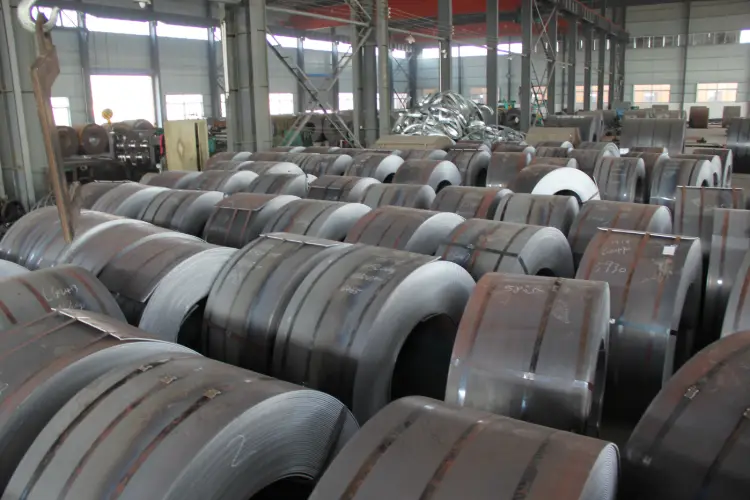
DNV D36 Shipbuilding Steel Coil
DNV D36 Shipbuilding Steel Coil – High-Strength Hull Structural Steel | Expert Data
Complete technical data for DNV D36 shipbuilding steel coil: chemical composition, mechanical properties, thermal properties, and international equivalent grades. Ideal for ship hulls and offshore structures.
Welding, flame cutting, cold forming, hot forming, machining
- Phone : +8618037372205
- Email : [email protected]
- WhatsApp: Contact via Whtsapp
- WeChat: +8618037372205
DNV D36 Shipbuilding Steel Coil Introduction
DNV D36 is a high-strength structural steel grade certified by DNV (Det Norske Veritas) for shipbuilding and marine applications. With a minimum yield strength of 355 MPa and excellent weldability, it is widely used in the construction of hulls, decks, and critical structural components. The steel offers good toughness at low temperatures, meeting DNV standards for plastic strain and impact resistance. It undergoes controlled rolling or normalizing to achieve fine-grained microstructure and consistent properties. Equivalent to AH36 grades in other classification societies, it ensures global compliance and reliable performance in harsh marine environments.
DNV D36 Shipbuilding Steel Coil Chemical Composition
Chemical requirements for D36 steel according to DNV rules. Maximum values unless otherwise specified. Fine-grain practice with sufficient aluminum is required.
| Element | Standard Value (%) | Remarks |
|---|---|---|
| Carbon (C) | ≤0.18 | Heat analysis; product analysis may have slight deviations |
| Silicon (Si) | 0.10 – 0.50 | Deoxidation element; typical range |
| Manganese (Mn) | 0.90 – 1.60 | Improves strength and toughness |
| Phosphorus (P) | ≤0.035 | Maximum limit to ensure ductility |
| Sulfur (S) | ≤0.035 | Maximum limit for good welding and toughness |
| Niobium (Nb) | ≤0.05 | Microalloying for grain refinement (optional) |
| Vanadium (V) | ≤0.10 | Grain refinement, higher strength (optional) |
| Titanium (Ti) | ≤0.02 | For sulphide shape control (optional) |
| Aluminum (Al, acid-soluble) | ≥0.015 | Required for fine-grain steel; total Al ≥0.020 |
| Copper (Cu) | ≤0.35 | Residual element; higher allows improved corrosion resistance |
| Chromium (Cr) | ≤0.20 | Residual element |
| Nickel (Ni) | ≤0.40 | Residual element; beneficial for toughness |
| Molybdenum (Mo) | ≤0.08 | Residual element |
| Nitrogen (N) | ≤0.012 | Maximum; higher if sufficient nitride formers present |
| Carbon Equivalent (CEV) | ≤0.38% (for ≤50mm) | CEV = C+Mn/6+(Cr+Mo+V)/5+(Ni+Cu)/15; product analysis |
DNV D36 Shipbuilding Steel Coil Thermal and Electrical Physical Properties
Typical physical properties of low-alloy carbon steel similar to D36 at room temperature. Actual values may vary slightly depending on heat treatment and exact composition.
| Property | Typical Value | Unit | Test Condition |
|---|---|---|---|
| Density (ρ) | 7.85 | g/cm³ | At 20°C |
| Modulus of elasticity (E) | 205 | GPa | At 20°C |
| Shear modulus (G) | 80 | GPa | Estimated from E and ν |
| Poisson's ratio (ν) | 0.30 | - | Typical for steel |
| Thermal expansion coefficient (α) | 11.5 × 10⁻⁶ | /K | 20°C to 100°C; 12.5 × 10⁻⁶ from 20-200°C |
| Thermal conductivity (λ) | 52 | W/(m·K) | At 20°C; decreases with temperature |
| Specific heat capacity | 460 | J/(kg·K) | At 20°C; increases with temperature |
| Electrical resistivity (ρₑ) | 0.15 | μΩ·m | At 20°C |
DNV D36 Shipbuilding Steel Coil Mechanical Properties
Tensile and impact properties as specified in DNV rules for D36 steel. Unless otherwise agreed, testing is performed in the as-delivered condition.
| Property | Standard Required Value | Unit | Test Condition |
|---|---|---|---|
| Yield strength (ReH) | ≥355 | MPa | Transverse test piece; thickness ≤50 mm |
| Tensile strength (Rm) | 490 – 620 | MPa | Transverse test piece; thickness ≤50 mm |
| Elongation (A) | ≥21 | % | Gauge length 5.65√So; transverse; thickness ≤50 mm |
| Bend test (bend diameter) | d=3a | - | 180° bending; no cracks; thickness ≤50 mm |
| Charpy V-notch impact energy (KV) | ≥34 (longitudinal) | J | Test temperature -20°C; individual values; average of three ≥34 J, one min. 24 J |
| Charpy V-notch impact energy (KV) | ≥24 (longitudinal) | J | Single minimum value at -20°C |
DNV D36 Shipbuilding Steel Coil Fully Equivalent Material Standards and Substitute Grades
| Country / Region | Standard | Grade | Remarks |
|---|---|---|---|
| International | DNV | D36 | Original classification society |
| USA / International | ABS | AH36 | Same strength level, impact test -20°C |
| UK / International | LR | AH36 | Lloyd's Register equivalent |
| France / International | BV | AH36 | Bureau Veritas equivalent |
| China | CCS | AH36 | China Classification Society equivalent |
| Japan / International | NK | AH36 | Nippon Kaiji Kyokai equivalent |
| South Korea / International | KR | AH36 | Korean Register equivalent |
| Italy / International | RINA | AH36 | Registro Italiano Navale equivalent |
| Russia / International | RS | AH36 | Russian Maritime Register equivalent |
| Europe | EN 10025-4 | S355ML | Similar mechanical properties, impact at -20°C, structural steel |
DNV D36 Shipbuilding Steel Coil Application Introduction
DNV D36 steel coil is designed for load-bearing structures in marine and offshore environments. Its balanced strength and toughness make it ideal for cold forming, welding, and heavy fabrication. Common delivery conditions include TMCP to ensure excellent weldability and reduced preheating requirements.
Product Applications: Ship hull plates and coils, Offshore platform structural components, Wind turbine monopiles and transition pieces, Crane booms and jibs, Heavy-duty storage tanks and pressure vessels (non-critical)
Processed into products: Bilge keels, Web frames and stringers, Deck plating, Shell plating, Stiffeners and brackets, Bulkhead plates, Helideck structures, Mud mats and sea fastenings
Application industries: Shipbuilding (container ships, tankers, bulk carriers, naval vessels), Offshore oil & gas (jackets, decks, modules, drilling platforms), Offshore renewable energy (wind turbine foundations, substations), Port and harbor construction (cranes, berths, sheet piling), Heavy machinery and structural engineering
DNV D36 Shipbuilding Steel Coil Similar / Substitutional Material Recommendations
| Country / Region | Standard | Grade | Remarks |
|---|---|---|---|
| International | DNV | E36 | Higher toughness (impact -40°C) for lower temperature service |
| International | DNV | F36 | Very high toughness (impact -60°C) for extreme cold conditions |
| International | DNV | A36 | Lower toughness (impact 0°C), not for critical structures |
| USA | ASTM A131 | AH36 | Conventional shipbuilding steel, similar strength and impact |
| Europe | EN 10025-3 | S355N/NL | Fine grain structural steel with similar strength, impact temperature options |
Notes:
All values refer to typical thickness ≤50 mm unless specified otherwise. For thicker plates, impact requirements may be adjusted. DNV certification includes mandatory tests: chemical analysis, tensile test, Charpy V-notch impact test, and bend test. Supplementary testing (ultrasonic, CTOD) may be required for critical applications. The delivery condition should be agreed upon at the time of order to achieve the required microstructure and properties.
- Share



