
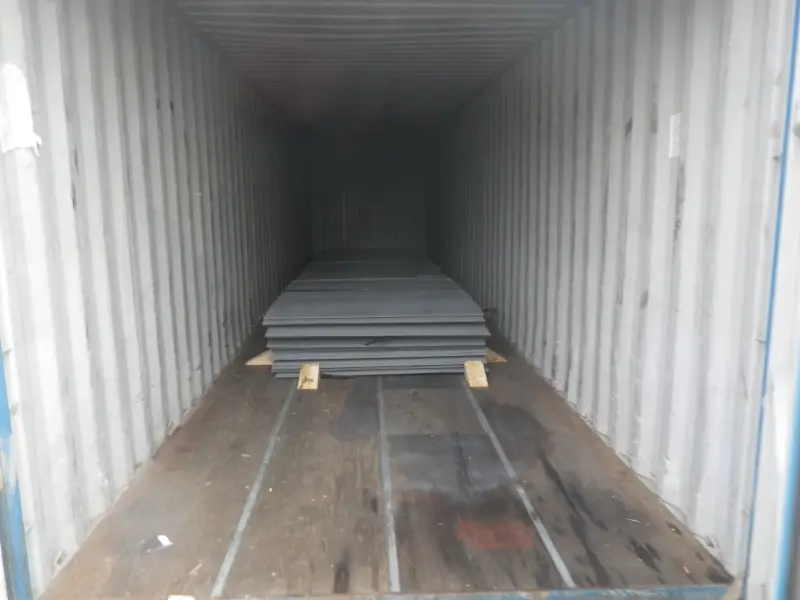
Austenitic 316Cb (S31640) Stainless Steel Plate & Coil
Austenitic 316Cb (S31640) Stainless Steel Plate & Coil: Complete Material Data
Thorough technical data sheet for Austenitic 316Cb (UNS S31640) stainless steel plate and coil, including chemical composition, mechanical properties, thermal and electrical physical properties, international equivalents, and application guidance.
Hot rolling, cold rolling, solution annealing, pickling, skin pass (optional)
- Phone : +8618037372205
- Email : [email protected]
- WhatsApp: Contact via Whtsapp
- WeChat: +8618037372205
Austenitic 316Cb Stainless Steel Plate & Coil Introduction
Austenitic 316Cb (UNS S31640) is a niobium-stabilized austenitic stainless steel designed for superior resistance to intergranular corrosion in as-welded or high-temperature service conditions. The addition of niobium (columbium) suppresses chromium carbide precipitation at grain boundaries, preserving the stainless steel's integrity without the need for post-weld heat treatment. It contains molybdenum for enhanced pitting and crevice corrosion resistance in chloride environments.
- Key features: Excellent weldability, good oxidation resistance up to ~870°C, and high creep strength.
- Available forms: plates, sheets, coils, and strips in various thicknesses and finishes.
- Typical applications: chemical processing equipment, heat exchangers, pressure vessels, and piping systems operating in corrosive media.
The data in this specification are drawn from ASTM A240/A240M and supplemented with typical physical properties from authoritative sources.
Austenitic 316Cb Stainless Steel Plate & Coil Chemical Composition , ASTM A240/A240M
The following chemical composition is specified for UNS S31640 austenitic stainless steel. Niobium (Nb) stabilization requires a minimum Nb content of 10 times the carbon content to effectively tie up carbon and prevent chromium carbide formation. All values are in weight percent, as cast or heat analysis.
| Chemical Element | Standard Value (wt%) | Remarks |
|---|---|---|
| Carbon (C) | ≤ 0.08 | |
| Manganese (Mn) | ≤ 2.00 | |
| Silicon (Si) | ≤ 1.00 | |
| Phosphorus (P) | ≤ 0.045 | |
| Sulfur (S) | ≤ 0.030 | |
| Chromium (Cr) | 16.0 – 18.0 | Essential for corrosion resistance |
| Nickel (Ni) | 10.0 – 14.0 | Stabilizes austenitic structure |
| Molybdenum (Mo) | 2.00 – 3.00 | Enhances pitting corrosion resistance |
| Niobium (Nb) [Columbium] | 10 × C min – 1.10 | Stabilizer; Nb + Ta may be reported |
Austenitic 316Cb Stainless Steel Plate & Coil Thermal & Electrical Physical Properties
Representative physical properties for 316Cb (S31640) in the annealed condition. These numbers are not part of ASTM A240 specification but are widely accepted engineering values. Density, modulus, and expansion coefficients closely match those of unstabilized 316 stainless steel. Thermal conductivity and specific heat data assist in thermal design.
| Property | Standard Value | Unit | Test Condition / Temperature Range |
|---|---|---|---|
| Density (ρ) | 8.0 | g/cm³ | At 20°C |
| Elastic Modulus (E) | 193 | GPa | At 20°C |
| Shear Modulus (G) | 77 | GPa | At 20°C (calculated) |
| Poisson's Ratio (ν) | 0.27 | — | At 20°C (typical) |
| Thermal Expansion Coefficient (α) | 15.9 | 10⁻⁶/°C | 0–100°C |
| Thermal Expansion Coefficient | 16.2 | 10⁻⁶/°C | 0–315°C |
| Thermal Expansion Coefficient | 17.5 | 10⁻⁶/°C | 0–538°C |
| Thermal Expansion Coefficient | 18.5 | 10⁻⁶/°C | 0–649°C |
| Thermal Conductivity (λ) | 16.2 | W/m·K | At 100°C |
| Thermal Conductivity | 21.5 | W/m·K | At 500°C |
| Specific Heat Capacity | 500 | J/kg·K | At 20–100°C |
| Electrical Resistivity (ρₑ) | 0.74 | µΩ·m | At 20°C |
Austenitic 316Cb Stainless Steel Plate & Coil Mechanical Properties per ASTM A240/A240M
Mechanical test values for plate and sheet in the solution-annealed condition. Yield strength is based on 0.2% offset. Tensile testing performed in the longitudinal direction. Elongation requirements vary with product thickness to account for gauge length effects. All values are minimum unless otherwise indicated.
| Property | Standard Value | Unit | Test Condition / Thickness Range |
|---|---|---|---|
| Yield Strength (0.2% offset) | ≥ 205 | MPa | All thicknesses, annealed |
| Tensile Strength | ≥ 515 | MPa | All thicknesses, annealed |
| Elongation in 50 mm (2 in.) | ≥ 40 | % | Thickness ≤ 7.94 mm (5/16 in.) |
| Elongation in 50 mm (2 in.) | ≥ 35 | % | Thickness 7.94 mm < t ≤ 19.05 mm (5/16–3/4 in.) |
| Elongation in 50 mm (2 in.) | ≥ 30 | % | Thickness 19.05 mm < t ≤ 50.8 mm (3/4–2 in.) |
| Elongation in 50 mm (2 in.) | ≥ 25 | % | Thickness > 50.8 mm (>2 in.) |
Austenitic 316Cb Stainless Steel Plate & Coil Completely Equivalent Material Standards and Substitute Grades
| Country/Region | Standard | Grade | Notes |
|---|---|---|---|
| USA | ASTM A240/A240M | 316Cb (UNS S31640) | Reference grade |
| Europe | EN 10028-7 / EN 10088-2 | 1.4580 – X6CrNiMoNb17-12-2 | Identical composition and stabilization |
| Japan | JIS G4304 / G4305 | SUS316Nb | Fully equivalent |
| International | ISO 4954 | X6CrNiMoNb17-12-2 | Harmonized with EN |
| China | GB/T 4237 | 06Cr17Ni12Mo2Nb (S31668) | Corresponding Chinese designation |
Austenitic 316Cb Stainless Steel Plate & Coil Application Introduction
316Cb (S31640) excels in environments where chloride corrosion, high temperatures, and weld decay must be avoided. Its niobium stabilization makes it ideal for as-welded fabrications that cannot be heat-treated afterward. The molybdenum addition broadens its use in reducing and oxidizing media, including warm seawater, flue gases, and organic acids. Because of its excellent creep resistance, the alloy is often selected for elevated-temperature service up to about 870°C, provided that oxidation conditions are controlled.
Product Applications: Heat exchangers and condensers, Pressure vessels and reactors, Piping, flanges, and fittings, Storage tanks and silos, Welded structural assembles, Valve bodies and trim, Pump casings and impellers, Food-grade equipment
Processed into products: Tube sheets for shell-and-tube exchangers, Reactor internals and distributors, Distillation column trays and packings, Boiler shells and headers, Welded nozzles and manways, Fasteners for high-temperature bolting, Corrugated furnace sheets, Expansion bellows and metal hoses
Application industries: Chemical processing, Petrochemical & refining, Oil & gas (offshore and onshore), Food & beverage processing, Pharmaceutical manufacturing, Marine engineering, Power generation (fossil and nuclear), Pulp & paper
Austenitic 316Cb Stainless Steel Plate & Coil Similar / Alternative Stainless Steel Grades
| Country/Region | Standard | Grade | Remarks |
|---|---|---|---|
| USA | ASTM A240 | 316Ti (UNS S31635) | Titanium-stabilized variant; similar intergranular corrosion resistance, slightly different mechanicals |
| USA | ASTM A240 | 316L (UNS S31603) | Low carbon version; not stabilized, may require PWHT for thick welds |
| USA | ASTM A240 | 316 (UNS S31600) | Standard 316 without stabilization; prone to sensitization in as-welded condition |
Notes:
The mechanical properties listed are minimum requirements as per ASTM A240/A240M for plate material in the solution-annealed condition. Actual values may be higher depending on the specific heat and processing.
Physical property data are typical and intended for engineering design; they are not specification requirements. For critical applications, it is recommended to verify properties with the material manufacturer.
Welding should be performed with matching or over-alloyed filler metals (e.g., ER316Nb) to maintain corrosion resistance. Post-weld heat treatment is generally not required for this stabilized grade.
- Share



