
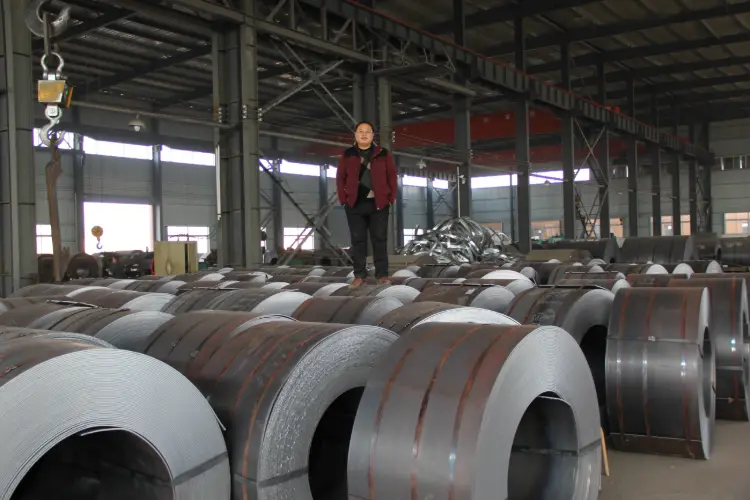
DNV A36 Shipbuilding Steel Coil
DNV A36 Shipbuilding Steel Coil - High Strength Marine Structural Steel
DNV A36 is a high strength structural steel for shipbuilding, certified by DNV GL, featuring minimum yield strength of 355 MPa and excellent weldability for marine applications.
Welding, bending, cold forming, cutting, machining (with suitable tools), suitable for all common shipyard fabrication processes
- Phone : +8618037372205
- Email : [email protected]
- WhatsApp: Contact via Whtsapp
- WeChat: +8618037372205
DNV A36 Shipbuilding Steel Coil Introduction
DNV A36, also designated as NV A36 in earlier DNV rules, is a high strength shipbuilding structural steel governed by the DNV classification society standards. It is intended for the construction of hulls, superstructures, and critical marine components. Key properties:
- Minimum yield strength of 355 MPa in the as-rolled or normalized condition
- Good toughness at 0 °C, with Charpy-V impact energy ≥ 34 J (longitudinal)
- Excellent weldability with standard shipyard procedures
- Supplied as coils, plates, and sections in normalized or thermomechanically rolled condition
The steel is produced via basic oxygen or electric arc furnace, often fully killed and fine grain treated. It meets DNV rules for hull structural steel, ensuring high reliability in harsh marine environments.
DNV A36 Shipbuilding Steel Coil Chemical Composition
The typical ladle analysis for DNV A36 according to DNV high strength steel rules. Fine grain practice and fully killed steel are normally applied. Key points:
- Carbon equivalent (Ceq) is controlled to ensure weldability.
- Microalloying elements (Nb, V, Ti, Al) may be added singly or in combination for grain refinement.
- Residual elements (Cr, Ni, Mo, Cu) shall not exceed the limits unless agreed.
| Chemical Element | Standard Value (max, unless range) | Remarks |
|---|---|---|
| C (Carbon) | ≤ 0.18 | Ladle analysis |
| Si (Silicon) | ≤ 0.50 | |
| Mn (Manganese) | 0.90 – 1.60 | If required impact test at -20°C or below, Mn min may be increased |
| P (Phosphorus) | ≤ 0.035 | |
| S (Sulphur) | ≤ 0.035 | |
| Cr (Chromium) | ≤ 0.20 | Residual element, if not intentionally added |
| Ni (Nickel) | ≤ 0.40 | Residual element |
| Mo (Molybdenum) | ≤ 0.08 | Residual element |
| Cu (Copper) | ≤ 0.35 | Residual element |
| Al (Aluminium) total | ≥ 0.015 | Minimum for fine grain practice (acid soluble Al) |
| Nb (Niobium) | ≤ 0.05 | Optional microalloy |
| V (Vanadium) | ≤ 0.10 | Optional microalloy |
| Ti (Titanium) | ≤ 0.025 | Optional; if used, Al/Ti ratio may be specified |
DNV A36 Shipbuilding Steel Coil Thermal and Electrical Physical Properties
These properties are representative for A36 high strength steel at room temperature and for typical temperature ranges relevant to design. Actual values may vary with heat treatment and composition. Sources: typical EN 10025 structural steel data, widely applicable to carbon manganese HSLA grades.
| Property | Standard Required Value (Typical) | Unit | Test Condition / Remarks |
|---|---|---|---|
| Density (ρ) | 7.85 | g/cm³ | At 20 °C |
| Young's Modulus (E) | 205 | GPa | At 20 °C, average |
| Shear Modulus (G) | 79 | GPa | Calculated from E and ν |
| Poisson's Ratio (ν) | 0.3 | – | At 20 °C, elastic range |
| Thermal Expansion Coefficient (α) | 12.0 | 10⁻⁶ /K | Between 20 °C and 100 °C; average value |
| Thermal Conductivity (λ) | 52 | W/(m·K) | At 20 °C; decreases with temperature increase |
| Specific Heat Capacity (c) | 470 | J/(kg·K) | At 20 °C; typical for carbon-manganese steel |
| Electrical Resistivity (ρ_e) | 0.15 | 10⁻⁶ Ω·m | At 20 °C |
DNV A36 Shipbuilding Steel Coil Mechanical Properties
Mechanical properties are determined on standard tensile test pieces and Charpy-V notch specimens taken from the final product. The specified values apply to the as-delivered condition and cover product thickness usually up to 100 mm. Note:
- Yield strength (ReH) may decrease with increasing thickness; consult DNV rules for thickness reduction factors.
- Impact test temperature: 0 °C for A36 grade (longitudinal).
| Property | Standard Required Value | Unit | Test Condition / Remarks |
|---|---|---|---|
| Yield Strength (ReH) | ≥ 355 | MPa | Thickness ≤ 100 mm, as-rolled or normalized; for greater thicknesses refer to DNV rules, min may reduce to 315 MPa for t=100-150 mm |
| Tensile Strength (Rm) | 490 – 620 | MPa | For all thicknesses |
| Elongation after fracture (A) | ≥ 21 (min. 22 for thickness ≤ 25 mm) | % (longitudinal) | Gauge length 5.65√S0; usually measured on A50 or proportional specimen |
| Charpy-V Impact Energy (KV) | ≥ 34 (min. single value: 24) | J | Test temperature 0 °C; longitudinal direction; average of 3 tests. Applies up to 50 mm thickness; for thicker material individual minimum average energy agreed. |
| Bend Test (180°) | No cracks or defects | – | Bend diameter = 3 x thickness for t ≤ 25 mm; DNV rules for thicker; mandrel diameter increased with thickness |
DNV A36 Shipbuilding Steel Coil Direct Equivalent Material Standards and Replaceable Grades
| Country / Region | Standard | Grade | Remarks |
|---|---|---|---|
| International (IACS) | Classification Society Rules, UR W11 | AH36 | General symbol for high strength ship steel, yield 355 MPa |
| USA | ABS Rules | AH36 | American Bureau of Shipping |
| UK | Lloyd's Register (LR) Rules | AH36 | |
| France | Bureau Veritas (BV) Rules | AH36 | |
| Italy | RINA Rules | AH36 | |
| China | CCS Rules | AH36 | China Classification Society |
| Japan | NK (ClassNK) Rules | AH36 | Nippon Kaiji Kyokai |
| Norway/Germany | DNV (now DNV GL) | NV A36 | Original DNV designation, often used synonymously |
| Korea | KR Rules | AH36 | Korean Register |
| Russia | RS Rules | A36 or D36, E36 | Russian Maritime Register; grade with same yield |
DNV A36 Shipbuilding Steel Coil Application Introduction
DNV A36 steel coil is widely used in marine and offshore construction where high strength, good weldability, and reliable toughness at 0 °C are required. Typical applications include:
- Hull plating and stiffeners
- Decks, bulkheads, and superstructures
- Offshore platform topsides and jackets
- Ship unloaders, cranes, and marine terminal structures
The material can be formed into components by cold bending, rolling, punching, and welded using all common arc welding processes. Preheating is generally not required for moderate thicknesses (< 25 mm) and low hydrogen welding consumables are recommended.
Product Applications: Container ships, bulk carriers, tankers, cruise ships hulls, Naval vessels and coast guard ships, Offshore platform modules, flare booms, boat landings, Floating production storage and offloading (FPSO) units, Quay cranes, gantry cranes, and shiploaders
Processed into products: Bottom and side shell plates, Deck stringers and deck plates, Longitudinal and transverse stiffeners, Bulkhead web and flange plates, Main / intermediate frames and brackets, Reinforcing plates for hatch coamings and mooring points, Bogie frames and structural arms of shipyard cranes
Application industries: Shipbuilding and ship repair, Offshore oil & gas platforms, Marine engineering and port equipment, Bridge and heavy civil construction (subject to approval), Wind turbine foundation structures (offshore)
DNV A36 Shipbuilding Steel Coil Similar / Substitute Materials with Comparable Properties
| Country / Region | Standard | Grade | Remarks |
|---|---|---|---|
| Europe | EN 10025-2 | S355J2(+N/+AR) | Structural steel with min. yield 355 MPa; not certified for marine use but chemically and mechanically similar; requires separate approval for marine applications. |
| USA | ASTM A572 / A572M | Grade 50 [345] (Type 1) | Min. yield 345 MPa (50 ksi); slightly lower than 355 MPa; often used in structural applications, no marine notch toughness at 0°C unless agreed. |
| USA | ASTM A131 / A131M | AH36 | Shipbuilding steel from ASTM; essentially equivalent to DNV A36. |
| Japan | JIS G 3106 | SM490A/B/C | Welded structural steel, min. yield ~325-365 MPa depending on thickness; C-type has specified impact energy. Not specifically to ship classification; need extra verification. |
| International | API Spec 2W / 2Y | Grade 50 (345 MPa) | Offshore structural steel; similar strength, might have additional toughness requirements. |
Notes:
For severe cold service (design temperature below 0 °C), consider DH36 (impact at -20 °C) or EH36 (impact at -40 °C). Always refer to the latest DNV rules for complete thickness-dependent property variations and welding guidelines. Mill certificates must state the delivery condition and actual chemical and mechanical test results. When ordering coils, it is recommended to specify flatness tolerances and surface condition according to EN 10163 or equivalent.
- Share



