
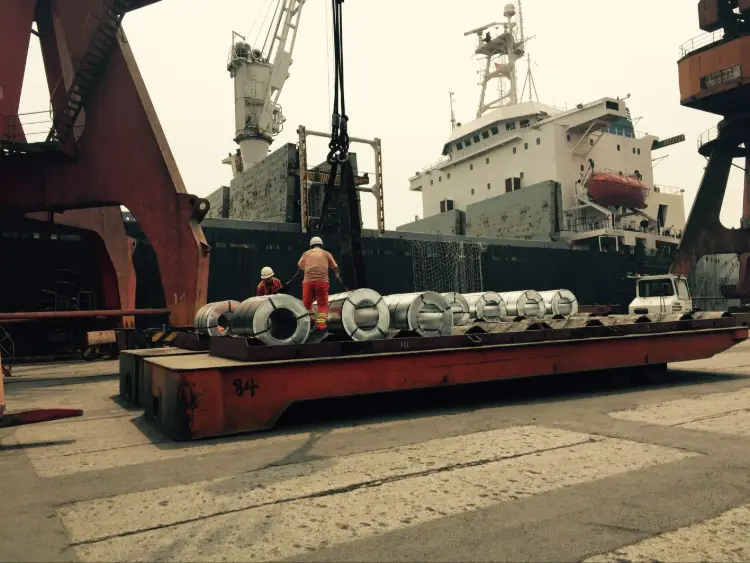
DNV F32 Shipbuilding Steel Coil
DNV F32 Shipbuilding Steel Coil: High-Strength, Low-Temperature Marine Steel for Ice-Class Vessels
Complete datasheet for DNV F32 shipbuilding steel coil: chemical composition, mechanical and thermal properties, international equivalents, and application guidelines for Arctic and offshore engineering.
Hot rolling, normalizing, thermomechanical controlled processing (TMCP), welding, cutting, bending, forming
- Phone : +8618037372205
- Email : [email protected]
- WhatsApp: Contact via Whtsapp
- WeChat: +8618037372205
DNV F32 Shipbuilding Steel Coil Introduction
DNV F32 is a high-strength hull structural steel grade in accordance with Det Norske Veritas (DNV) rules. It offers a minimum yield strength of 315 N/mm² and tensile strength in the range of 440–570 N/mm². Designed for welded ship structures operating in cold climates, the 'F' designation guarantees excellent low‑temperature impact toughness down to -60°C. Typical delivery is as hot‑rolled, normalized, or TMCP coils and plates. This grade is widely used for ice‑strengthened vessels, polar ships, offshore platforms, and heavy marine components where reliability under severe conditions is essential.
DNV F32 Shipbuilding Steel Coil Chemical Composition
The table shows the specified ladle analysis limits according to DNV rules for grade F32.
Fine‑grain practice is mandatory: aluminium, niobium, vanadium, or titanium may be added individually or in combination.
The carbon equivalent (Ceq) shall not exceed 0.36% for thickness ≤ 50 mm, or as agreed for thicker sections.
| Chemical Element | Standard Value (mass %) | Remarks |
|---|---|---|
| Carbon (C) | ≤ 0.16 | Ceq = C + Mn/6 + (Cr+Mo+V)/5 + (Ni+Cu)/15 |
| Silicon (Si) | ≤ 0.50 | Deoxidation element |
| Manganese (Mn) | 0.90 – 1.60 | Higher Mn improves strength and toughness |
| Phosphorus (P) | ≤ 0.025 | Max. for product analysis |
| Sulfur (S) | ≤ 0.025 | Max. for product analysis |
| Aluminium (Al, acid sol.) | ≥ 0.015 | Fine‑grain requirement |
| Niobium (Nb) | ≤ 0.05 | Optional micro‑alloy, grain refiner |
| Vanadium (V) | ≤ 0.10 | Optional micro‑alloy |
| Titanium (Ti) | ≤ 0.02 | Optional, often combined with Nb/V |
| Copper (Cu) | ≤ 0.35 | Residual, may be specified for corrosion resistance |
| Chromium (Cr) | ≤ 0.20 | Residual |
| Nickel (Ni) | ≤ 0.40 | Residual |
| Molybdenum (Mo) | ≤ 0.08 | Residual |
DNV F32 Shipbuilding Steel Coil Thermal and Electrical Physical Properties
The following are typical reference values for Grade F32 type steel at room temperature unless otherwise stated.
These properties are not part of the mandatory DNV specification but are useful for engineering calculations.
| Property | Standard Value | Unit | Test Conditions |
|---|---|---|---|
| Density (ρ) | 7850 | kg/m³ | 20°C |
| Elastic Modulus (E) | 206 | GPa | 20°C |
| Shear Modulus (G) | 80 | GPa | 20°C |
| Poisson Ratio (ν) | 0.30 | – | Elastic range |
| Thermal Expansion Coeff. (α) | 12.0 × 10⁻⁶ | K⁻¹ | 20–100°C |
| Thermal Conductivity (λ) | 50 | W/(m·K) | 20°C |
| Specific Heat Capacity | 460 | J/(kg·K) | 20°C |
| Electrical Resistivity (ρ_e) | 0.20 × 10⁻⁶ | Ω·m | 20°C |
DNV F32 Shipbuilding Steel Coil Mechanical Properties
Tensile and impact values are mandatory acceptance criteria per DNV rules for grade F32.
Tests are performed on material in the delivery condition (normalised or TMCP).
Elongation is measured on a gauge length of 5.65√S₀ (A5).
| Property | Required Value | Unit | Test Conditions |
|---|---|---|---|
| Yield Strength (ReH) | ≥ 315 | N/mm² | Transverse or longitudinal; thickness ≤ 100 mm |
| Tensile Strength (Rm) | 440 – 570 | N/mm² | All thicknesses |
| Elongation (A5) | ≥ 22 | % | Longitudinal, gauge length 5.65√S₀ |
| Charpy Impact Energy (KV) | ≥ 42 | J | Longitudinal specimen, -60°C, V‑notch |
| Charpy Impact Energy (KV) | ≥ 28 | J | Transverse specimen, -60°C, V‑notch |
| Bend Test (D = 3a, 180°) | No cracks or flaws | – | Diameter of former = 3 × thickness; width ≥ 30 mm |
DNV F32 Shipbuilding Steel Coil Exact Equivalent Material Standards and Substitutable Grades
| Country / Region | Standard / Specification | Grade | Remarks |
|---|---|---|---|
| International (IACS) | IACS UR W11 | F32 | Basis for all classification societies |
| Norway / DNV | DNV Rules Pt.2 Ch.2 | DNV F32 | Original grade |
| USA | ASTM A131 / A131M | ASTM A131 Grade FH32 | Equivalent, impact test @ -60°C |
| American Bureau of Shipping | ABS Rules | ABS F32 | Full equivalence |
| Lloyd's Register (UK) | LR Rules | LR F32 | Full equivalence |
| Bureau Veritas (France) | BV Rules | BV F32 | Full equivalence |
| China Classification Society | CCS Rules | CCS F32 | Full equivalence |
| ClassNK (Japan) | NK Rules | NK F32 | Full equivalence |
| Korean Register | KR Rules | KR F32 | Full equivalence |
| RINA (Italy) | RINA Rules | RINA F32 | Full equivalence |
DNV F32 Shipbuilding Steel Coil Application Introduction
DNV F32 steel coils are specifically engineered for the marine and offshore industries where a combination of high strength, excellent weldability, and superior low‑temperature toughness is mandatory.
Typical applications include:
- Construction of ice‑strengthened vessels (icebreakers, Arctic cargo ships)
- LNG/LPG carriers with low‑temperature cargo containment structures
- Offshore platforms, FPSO hulls, and subsea structures exposed to cold seawater
- Wind‑turbine foundations and transition pieces in ice‑prone waters
Product Applications: Ship hull plates and coils, Deck and bulkhead plate, Stiffeners, girders, and brackets, Cold‑formed sections, Rolled beams and channels for ice‑belt reinforcement
Processed into products: Hull shell plating (side, bottom, transom), Main deck and strength deck plating, Watertight and structural bulkheads, Ice‑belt and ice‑strengthened frames, Longitudinal stiffeners and web frames, Hatch coamings and crane pedestals
Application industries: Shipbuilding and ship repair, Offshore oil & gas (platforms, FPSO), Renewable energy (offshore wind foundations), Heavy engineering (bridges, port structures in cold climates)
DNV F32 Shipbuilding Steel Coil Similar / Comparable Materials
| Country / Region | Standard / Specification | Grade | Remarks |
|---|---|---|---|
| Europe | EN 10025‑3 | S355NL (1.0546) | Yield 355 N/mm², KV -50°C ≥27 J; slightly lower toughness & strength |
| USA | ASTM A572 | Grade 50 Type 2 | Yield 345 N/mm²; no guaranteed low‑temperature impact, not for primary ship structure |
| International | API 2H | Grade 50 | Offshore structural plate, carbon equivalent similar, impact typically -40°C; not full -60°C guarantee |
Notes:
Delivery forms: Hot‑rolled coil (commonly 2–25 mm thickness), heavy plate (up to 200 mm).
Certification: Supplied with DNV 3.2 inspection certificate traceable to cast analysis.
Welding recommendation: Low‑hydrogen processes; preheating may be needed for thicker sections (>50 mm) depending on carbon equivalent.
Corrosion protection: Can be supplied with shop primer (zinc‑silicate or epoxy) upon request.
Tolerances and flatness according to DNV or EN 10051.
- Share



