
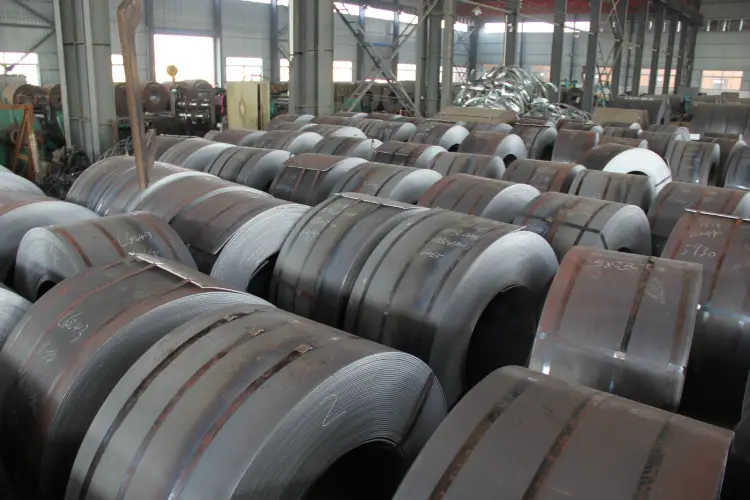
DNV A40 Shipbuilding Steel Coil
DNV A40 Shipbuilding Steel Coil: High-Strength Structural Steel for Marine Applications
Comprehensive data for DNV A40 shipbuilding steel coil covering chemical composition, mechanical properties, thermal and electrical physical properties, international equivalents, and applications.
Hot rolling, normalizing, thermo-mechanical controlled processing (TMCP), welding, cutting, forming
- Phone : +8618037372205
- Email : [email protected]
- WhatsApp: Contact via Whtsapp
- WeChat: +8618037372205
DNV A40 Shipbuilding Steel Coil Introduction
DNV A40 is a high-strength shipbuilding structural steel grade normalized or thermo-mechanically rolled, specified by Det Norske Veritas (DNV) rules for classification of ships. With a minimum yield strength of 390 MPa, it offers excellent weldability and toughness suitable for critical structural components in marine and offshore environments. This grade provides high strength-to-weight ratio, good corrosion resistance, and complies with stringent safety requirements. Typical applications include hull structures, decks, and offshore platforms.
DNV A40 Shipbuilding Steel Coil Chemical Composition
The chemical composition meets DNV GL rules for grade A40. Maximum limits are specified for elements such as C, Mn, Si, P, S, with additional requirements for Al, Nb, V, Ti and others depending on the deoxidation practice and thickness.
- Carbon equivalent (CEV) is controlled to ensure weldability.
- All values are in weight percent.
| Element | Standard Value (max % unless range) | Remarks |
|---|---|---|
| Carbon (C) | ≤ 0.18 | Ladle analysis |
| Manganese (Mn) | 0.90 – 1.60 | For thickness ≤ 100 mm |
| Silicon (Si) | 0.10 – 0.50 | Killed fine grain practice |
| Phosphorus (P) | ≤ 0.025 | Max |
| Sulfur (S) | ≤ 0.025 | Max |
| Aluminum (Al) total | ≥ 0.020 | Min for fine grain when Al is used |
| Niobium (Nb) | ≤ 0.05 | When present |
| Vanadium (V) | ≤ 0.10 | When present |
| Titanium (Ti) | ≤ 0.02 | When present |
| Copper (Cu) | ≤ 0.35 | When specified |
| Chromium (Cr) | ≤ 0.20 | Max unless agreed |
| Nickel (Ni) | ≤ 0.40 | Max unless agreed |
| Molybdenum (Mo) | ≤ 0.08 | Max unless agreed |
| Nitrogen (N) | ≤ 0.012 | For Al treated steels |
| Carbon Equivalent (CEV) | ≤ 0.38 (typical) | CEV = C + Mn/6 + (Cr+Mo+V)/5 + (Ni+Cu)/15, based on product thickness |
DNV A40 Shipbuilding Steel Coil Thermal and Electrical Physical Properties
Physical properties are typical for carbon-manganese structural steels. Values may vary slightly with exact composition and heat treatment.
- Density is approximately 7850 kg/m³.
- Thermal conductivity and expansion depend on temperature.
Data based on similar steel grades (DNV A40 is comparable to AH40/EH40).
| Property | Typical Value | Unit | Test Condition |
|---|---|---|---|
| Density (ρ) | 7850 | kg/m³ | At 20°C |
| Elastic Modulus (E) | 205 – 210 | GPa | At 20°C |
| Shear Modulus (G) | 80 – 81 | GPa | At 20°C |
| Poisson's Ratio (ν) | 0.29 – 0.30 | — | At 20°C |
| Thermal Expansion Coefficient (α) | 11.5 – 12.5 x 10⁻⁶ | K⁻¹ | Range 20 – 100°C |
| Thermal Expansion Coefficient (α) | 12.5 – 13.5 x 10⁻⁶ | K⁻¹ | Range 20 – 200°C |
| Thermal Expansion Coefficient (α) | 13.0 – 14.0 x 10⁻⁶ | K⁻¹ | Range 20 – 400°C |
| Thermal Conductivity (λ) | 45 – 50 | W/(m·K) | At 20°C |
| Thermal Conductivity (λ) | 40 – 45 | W/(m·K) | At 200°C |
| Specific Heat Capacity (c) | 460 – 500 | J/(kg·K) | At 20°C |
| Electrical Resistivity (ρ_e) | 0.20 – 0.25 x 10⁻⁶ | Ω·m | At 20°C |
DNV A40 Shipbuilding Steel Coil Mechanical Properties
Mechanical properties per DNV rules for grade A40 in normalized or TMCP condition. Testing is performed on transverse specimens.
- Minimum yield strength (ReH) is 390 MPa for thicknesses ≤ 100 mm.
- Tensile strength range 510 – 660 MPa.
- Impact energy tested at -40°C for A40 grade.
Values apply to product thickness t (mm).
| Property | Standard Requirement | Unit | Test Condition |
|---|---|---|---|
| Yield Strength (ReH) | ≥ 390 | MPa | t ≤ 100 mm, transverse |
| Tensile Strength (Rm) | 510 – 660 | MPa | t ≤ 100 mm, transverse |
| Elongation (A5) | ≥ 20 | % | Gauge length 5.65√S₀, transverse |
| Elongation (A50) | ≥ 18 (for thickness > 12.5 mm) | % | Transverse, depending on thickness |
| Charpy Impact Energy (KV) | ≥ 34 (longitudinal), ≥ 24 (transverse) | J | at -40°C, min average of 3 tests |
| Bend Test (d = 3a for t ≤ 25 mm) | No cracks or defects | — | 180° bend, d = mandrel diameter, a = specimen thickness |
DNV A40 Shipbuilding Steel Coil Fully Equivalent Material Standards and Replaceable Grades
| Country / Region | Standard | Grade | Remarks |
|---|---|---|---|
| International (IACS) | IACS UR W11 | AH40 | Identical strength level, impact at 0°C; EH40 for -40°C comparable |
| American Bureau of Shipping (ABS) | ABS Rules | AH40 / EH40 | AH40 with impact at 0°C; EH40 at -40°C is direct equivalent to A40 |
| Lloyd's Register (LR) | LR Rules | AH40 / EH40 | EH40 matches -40°C impact |
| Bureau Veritas (BV) | BV Rules | AH40 / EH40 | EH40 directly corresponds |
| China Classification Society (CCS) | CCS Rules | AH40 / EH40 | EH40 corresponds |
| ClassNK (NK) | NK Rules | AH40 / EH40 | EH40 corresponds |
| Korean Register (KR) | KR Rules | AH40 / EH40 | EH40 corresponds |
| RINA | RINA Rules | AH40 / EH40 | EH40 corresponds |
| DNV GL (now DNV) | DNV GL Rules | A40 | The base specification |
| European Standard | EN 10025-4 | S420M / S420ML | Thermo-mechanically rolled; S420ML has comparable impact at -50°C, yield 420 MPa, close match |
DNV A40 Shipbuilding Steel Coil Application Introduction
DNV A40 steel coil is widely used in marine and offshore engineering where high strength, excellent toughness at low temperatures, and good weldability are essential. The grade is suitable for heavy structural members, deepwater applications, and arctic service. Typical products and fabricated components include:
Product Applications: Hull plates and stiffeners, Deck and bottom structures, Bulkheads and watertight doors, Offshore platform topsides, Jack-up rig legs and spudcans, Wind turbine substructures (offshore), FPSO and FLNG modules
Processed into products: Longitudinal and transverse frames, Stringers and web frames, Brackets and knees, Hatch coamings, Crane pedestals and boom sections, Mooring components, Rudder horns and shaft brackets, Heavy lift pad eyes and padeyes
Application industries: Shipbuilding, Offshore oil & gas, Marine engineering, Port and harbor structures, Bridge construction, Pressure vessels (marine service)
DNV A40 Shipbuilding Steel Coil Similar / Near Equivalent Material Recommendations
| Country / Region | Standard | Grade | Remarks |
|---|---|---|---|
| Japan | JIS G 3106 | SM490YB / SM490B | Yield 325-365 MPa, lower strength but similar weldability; not a direct substitute |
| China | GB/T 712 | DH40 / EH40 | DH40 impact -20°C; EH40 -40°C close to A40 |
| Russia | GOST R 52927 | E40 / D40 | E40 with KCV at -40°C, comparable |
| Europe | EN 10025-3 | S460N / S460NL | Higher yield 460 MPa, normalized, good toughness; can be used for higher strength demand |
| USA | ASTM A131 / API 2H | EH40 / Grade 50 | EH40 directly comparable; API 2H Grade 50 for offshore structures |
Notes:
- All data is based on DNV GL rules edition July 2020 or later. For specific projects, always refer to the latest rules and approved material certificates.
- Weldability: CEV ≤ 0.38 ensures good weldability without preheating for moderate thicknesses. Preheating may be required for thicker sections.
- NDT: Ultrasonic testing per DNV class guidelines is normally required for thicknesses above 12.5 mm.
- Tolerances on thickness, width, and flatness comply with EN 10029 or DNV specific requirements.
- Corrosion protection: Surface treatment (shop primer) often applied; standard primers are zinc silicate or epoxy based.
- Share



